
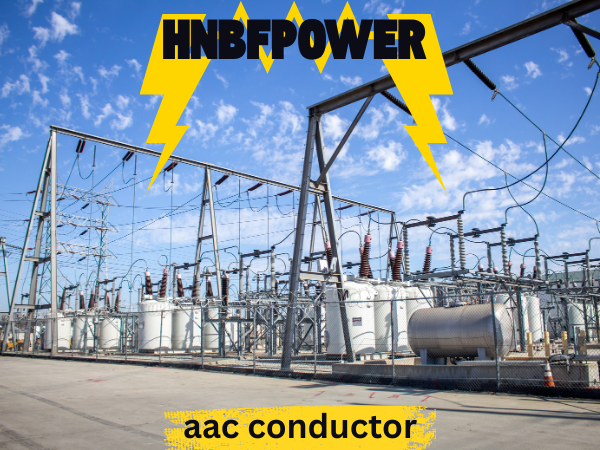
In today’s rapidly expanding power transmission and distribution networks, utilities and EPC contractors are under constant pressure to balance performance, cost, and long-term reliability. One of the most widely adopted solutions for short-to-medium span overhead lines is the AAC conductor.
An AAC conductor (All Aluminium Conductor) is manufactured entirely from high-purity aluminium wires stranded together to form a lightweight, highly conductive overhead line conductor. Thanks to its excellent electrical conductivity and corrosion resistance, AAC remains a preferred option for urban distribution networks, coastal areas, and substations where mechanical loading is moderate but electrical efficiency is critical.
As a global manufacturer of overhead conductors and power cables, HNBF Power supplies AAC conductors engineered to meet international utility standards and modern grid requirements, supporting power utilities, EPC contractors, and industrial projects worldwide.
What Is an AAC Conductor?
An AAC conductor is a stranded overhead line conductor composed only of aluminium wires typically EC-grade aluminium (Electrical Conductor grade). Unlike composite conductors such as ACSR, AAC does not contain a steel or alloy core.
Key characteristics of AAC conductor
-
100% aluminium construction
-
Excellent electrical conductivity
-
Lightweight structure
-
Good corrosion resistance
-
Ideal for short spans and low to medium mechanical loads
Because of its simple construction, AAC offers a highly economical and efficient solution for many distribution and sub-transmission applications.
Why Utilities Choose AAC Conductor for Distribution Lines
High electrical efficiency
AAC conductor provides higher conductivity per unit weight than aluminium alloy or steel-reinforced conductors. This translates into lower line losses and improved energy efficiency, especially in dense urban networks.
Lightweight for easier installation
The low mass of AAC conductor simplifies stringing operations, reduces tower loading, and lowers overall installation cost. For utility engineers and project managers, this means faster deployment and reduced structural requirements.
Strong corrosion resistance
In coastal and humid environments, corrosion performance is a major concern. AAC conductor naturally forms a protective oxide layer, making it well-suited for aggressive atmospheres and polluted urban areas.
Cost-effective solution
Without a steel core or complex material structure, AAC conductor offers an attractive cost-to-performance ratio for short-span overhead distribution systems.
Typical Applications of AAC Conductor
AAC conductor is widely used across utility and industrial power networks, particularly in:
-
Urban and suburban overhead distribution lines
-
Coastal transmission corridors
-
Power plant switchyards and substations
-
Industrial facilities and private distribution networks
-
Low-sag, short-span installations
For projects where mechanical strength is not the primary design constraint, AAC conductor provides a practical and efficient solution.
AAC Conductor vs ACSR and AAAC – How Should Engineers Select?
AAC conductor
-
Best electrical conductivity
-
Lowest weight
-
Lower tensile strength
-
Best for short spans and light mechanical loading
AAAC (All Aluminium Alloy Conductor)
-
Higher mechanical strength than AAC
-
Slightly lower conductivity
-
Better for longer spans and higher tension requirements
ACSR (Aluminium Conductor Steel Reinforced)
-
Very high tensile strength
-
Suitable for long spans and heavy loading
-
Lower overall conductivity per cross-section
From a design perspective, AAC conductor is typically selected when efficiency, corrosion resistance, and cost optimization are more critical than mechanical performance.
Technical Construction of AAC Conductor
Aluminium wire quality
AAC conductor is manufactured using high-purity aluminium rods that are drawn into wires and stranded according to standard configurations. Uniform strand geometry ensures stable current distribution and consistent mechanical behavior.
Stranding design
The conductor is normally produced in concentric stranded layers. This structure improves flexibility during installation and enhances vibration performance under wind loading.
Compliance with international standards
AAC conductor supplied by HNBF Power can be manufactured in accordance with major international standards such as:
-
ASTM standards for overhead conductors
-
IEC standards for aluminium conductors
-
Utility-specific technical specifications
This ensures compatibility with existing infrastructure and global project requirements.
Performance Advantages of AAC Conductor in Modern Power Networks
Reduced power losses
The high conductivity of AAC conductor directly supports energy-efficient distribution networks and contributes to lower operational costs over the service life of the line.
Improved thermal performance
AAC conductor performs reliably under elevated operating temperatures, allowing utilities to maximize line capacity within defined design limits.
Lower structural loading
Because of its light weight, AAC conductor minimizes stress on poles, cross-arms, and hardware, enabling more economical support structure design.
Why HNBF Power for AAC Conductor Supply?
HNBF Power is a global manufacturer of overhead conductors and power cables, including AAC, AAAC, ACSR, ABC cable, LV power cable, and concentric cable solutions.
For utility companies, EPC contractors, and grid infrastructure developers, HNBF Power offers:
-
Consistent quality control across raw materials and stranding processes
-
Custom conductor sizes and constructions based on project design
-
Flexible production capacity for utility-scale projects
-
Technical support for conductor selection and specification matching
By combining manufacturing experience with application-focused engineering support, HNBF Power helps utilities deploy reliable and compliant overhead line solutions.
How to Specify the Right AAC Conductor for Your Project
Before finalizing your AAC conductor selection, engineers and procurement teams should evaluate:
-
Required current-carrying capacity
-
Span length and sag limits
-
Environmental conditions (corrosion, wind, pollution)
-
Applicable national or utility standards
-
Installation method and hardware compatibility
Early coordination with the manufacturer ensures that the selected AAC conductor fully meets mechanical, electrical, and regulatory requirements.
FAQs About AAC Conductor
1. What does AAC conductor stand for?
AAC conductor stands for All Aluminium Conductor, made entirely from stranded aluminium wires without a steel or alloy core.
2. Is AAC conductor suitable for long-span transmission lines?
AAC conductor is generally not recommended for long spans. For higher mechanical strength and longer distances, ACSR or AAAC conductors are usually more appropriate.
3. Can AAC conductor be used in coastal environments?
Yes. AAC conductor offers excellent corrosion resistance and is widely used in coastal and high-humidity areas.
4. How does AAC conductor compare in conductivity to ACSR?
AAC conductor provides higher conductivity per unit cross-section because it contains only aluminium and no steel core.
5. Does HNBF Power offer customized AAC conductor designs?
Yes. HNBF Power supplies customized AAC conductor sizes and constructions based on project standards and technical specifications.
Final Thoughts and Next Steps
AAC conductor remains a proven and highly efficient solution for modern overhead distribution networks where electrical performance, corrosion resistance, and cost efficiency are top priorities. For utility engineers and procurement professionals, selecting the right AAC conductor can significantly improve network reliability while controlling project and operational costs.
Contact HNBF Power today to discuss your AAC conductor requirements and receive customized overhead conductor solutions tailored to your power transmission and distribution projects.

 English
 Arabic
 French
 Spanish
 Portuguese
 Deutsch
 Turkish
 Dutch
Dutch
 Italiano
 Russian
 Romaian
 Greek
Greek