
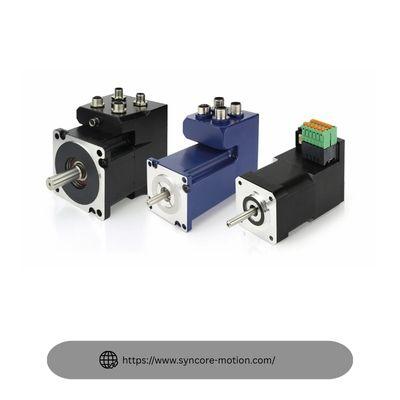
Working Principle of a Stepper Motor
Stepper motors The working principle of a stepper motor is based on electromagnetic attraction and repulsion. The motor consists of a stator with multiple windings and a rotor made of permanent magnets or soft iron.
When electrical pulses are applied to the stator windings in a specific sequence, a magnetic field is created. This magnetic field attracts the rotor, causing it to move by a small angle called a step. Each pulse moves the rotor one step forward, and the total rotation depends on the number of pulses applied.
The speed of the motor is controlled by the frequency of the input pulses, while the direction of rotation is determined by the order in which the stator windings are energized. Since the motor moves in discrete steps, it can hold its position without the need for a feedback system.
Stepper Motor Applications in Robotics and CNC Machines
play a vital role in modern automation, especially in robotics and CNC (Computer Numerical Control) machines. Their ability to move in precise, controlled steps makes them ideal for applications where accuracy, repeatability, and reliability are essential.
What Is a Stepper Motor?
A stepper motor is an electromechanical device that converts electrical pulses into discrete mechanical movements. Each pulse rotates the motor shaft by a fixed angle, allowing exact control over position and speed without the need for complex feedback systems.
Applications of Stepper Motors in Robotics
Precise Motion Control
Robotic systems often require accurate positioning for tasks such as picking, placing, welding, and assembly. Stepper motors allow robots to move arms, joints, and grippers with high precision.
Robotic Arms and Joints
Stepper motors are commonly used in robotic arms to control joint rotation. Their step-by-step movement ensures smooth and repeatable motion, which is critical in industrial and educational robots.
Mobile Robots
In autonomous robots and robotic vehicles, stepper motors drive wheels and tracks. They help control direction, speed, and turning angles accurately, improving navigation and path planning.
Low-Cost and Educational Robots
Because stepper motors are affordable and easy to control using microcontrollers, they are widely used in hobby robotics, research projects, and learning environments.
Applications of Stepper Motors in CNC Machines
Accurate Tool Positioning
CNC machines rely on stepper motors to control the movement of cutting tools along the X, Y, and Z axes. This ensures precise machining and consistent product quality.
Repetitive Operations
Stepper motors excel in repetitive tasks such as drilling, milling, and engraving. Their ability to return to exact positions makes them ideal for mass production.
Controlled Speed and Torque
In CNC systems, stepper motors provide controlled speed and sufficient torque at low speeds, which is essential for cutting hard materials accurately.
Cost-Effective CNC Systems
Many small and medium-sized CNC machines use stepper motors instead of servo motors due to their lower cost and simpler control requirements.

 English
 Arabic
 French
 Spanish
 Portuguese
 Deutsch
 Turkish
 Dutch
Dutch
 Italiano
 Romaian
 Portuguese (Brazil)
 Greek
Greek