
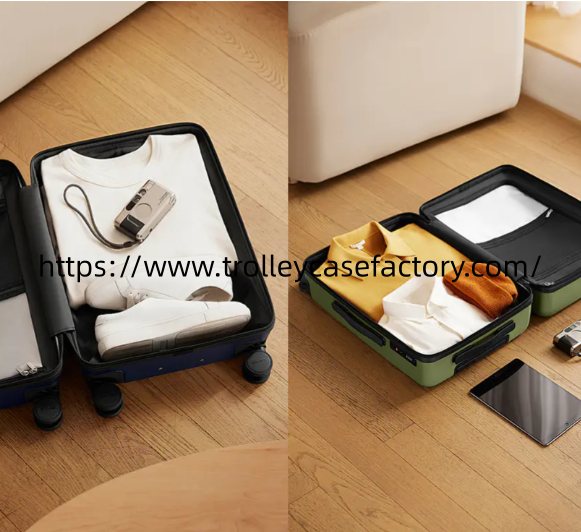
Trolley Luggage Factory selection should begin with your actual product requirements, target market, expected order quantity, and customization plans. Buyers should evaluate materials, shell construction, wheels, handles, zippers, locks, interior organization, dimensions, production processes, inspection procedures, packaging, and supplier communication. A clear purchasing checklist allows businesses to compare manufacturers according to practical requirements instead of relying only on photographs, catalog information, or quoted prices.
Define Your Product Requirements
Before contacting a manufacturer, prepare a complete product brief.
Specify dimensions, shell material, colors, surface finish, wheel arrangement, handle design, interior layout, logo position, packaging requirements, and estimated order quantity.
If you are developing a private-label product, include your branding requirements from the beginning.
A detailed brief can reduce misunderstandings and help the manufacturer prepare a more suitable sample.
It also makes supplier comparisons easier because different manufacturers can receive the same technical information.
Examine Shell Materials
The outer structure is an important part of the finished travel case.
Buyers should compare available materials according to weight, structure, appearance, processing requirements, and intended market.
Possible choices may include different plastic materials, textile fabrics, aluminum structures, or combinations of materials.
Do not evaluate a material only by its name. Ask about thickness, texture, surface treatment, color consistency, and processing method.
Once the material has been selected, record the specification for future production reference.
Inspect Wheel Systems
Wheels directly affect how easily a case can be moved.
During sample evaluation, buyers should check wheel size, rotation, alignment, attachment points, housing construction, and movement across different surfaces.
Try the product on smooth floors as well as slightly uneven surfaces that customers may encounter during normal travel.
Ask the manufacturer whether replacement wheel components are available and whether the same component specification can be maintained for future orders.
Check the Telescopic Handle
The handle should be tested at different extension positions.
Buyers can check how smoothly it extends and retracts, whether each locking position works properly, and whether the structure remains aligned during movement.
The grip should also be considered because its shape and material can affect handling.
For custom projects, record the handle dimensions, material, locking structure, and finish after approving the sample.
This information can become part of the production specification for later orders.
Evaluate Zippers and Closures
Zippers and closure systems deserve careful inspection.
Move the zipper repeatedly and check the puller, teeth alignment, stitching, and connection between the zipper and surrounding material.
If the product uses a combination of zipper closures and locks, test both systems together.
Buyers should also confirm the exact hardware specification before mass production.
A small change in hardware can alter the appearance or operating method, so any proposed replacement should be discussed before production.
Review the Interior
The internal layout should correspond with the intended customer group.
Check lining, compartments, dividers, pockets, straps, internal zippers, and attachment points.
Consider how customers will organize clothing, personal items, documents, or other belongings.
For a custom project, buyers should approve the interior together with the external structure.
It is useful to record the location and dimensions of pockets, straps, dividers, and branding elements so later production can follow the approved design.
Ask About Production Procedures
Buyers should understand how the manufacturer organizes production.
Ask about material preparation, cutting, molding or forming, component assembly, stitching where applicable, finishing, inspection, and packaging.
This does not mean buyers need to control every production step. Instead, the goal is to understand how the approved specifications are transferred into finished products.
Clear production procedures can also make it easier to identify where adjustments should be made when a sample requires modification.
Review Quality Inspection
Quality inspection should cover both appearance and function.
Depending on the product design, checks may include dimensions, color consistency, surface finish, wheel movement, handle operation, zipper function, lock operation, stitching, interior assembly, and packaging.
Buyers can request information about when inspections are performed and which product characteristics are checked.
For repeat orders, keeping inspection criteria consistent can help both sides maintain the same product expectations.
Request a Physical Sample
A physical sample is useful for checking details that cannot always be judged from images.
Inspect the overall size, weight, material, color, finish, wheels, handle, closures, interior arrangement, logo placement, and packaging.
Write down required modifications in a clear list.
After revisions are completed, review the updated sample again before approving bulk production.
Keeping a record of the approved version can help reduce confusion when the same product is ordered again.
Consider Customization Capability
Different businesses have different branding requirements.
Some buyers may only need a logo, color, and packaging changes. Others may want different dimensions, materials, wheel structures, handles, interior layouts, or surface treatments.
Ask the manufacturer which elements can be customized and whether development costs, tooling, sample charges, or minimum quantities apply.
For OEM or ODM projects, clarify the development process before production begins.
Clear communication at this stage can help prevent unexpected changes later.
Check Order Quantities and Scheduling
Minimum order quantity should match your business plan.
Ask whether different colors, materials, sizes, and customized configurations have separate quantity requirements.
Production scheduling should also be discussed before confirming an order.
Consider sample development, material preparation, production, inspection, packaging, and shipping when creating your purchasing schedule.
A realistic timeline helps wholesalers and retailers organize inventory and coordinate their sales plans.
Examine Packaging Requirements
Packaging should be discussed together with the product itself.
Buyers should confirm individual packaging, protective materials, carton dimensions, carton quantities, labels, shipping marks, and branding requirements.
If products will enter retail channels, packaging may need to match the visual identity of the brand.
Provide artwork and packaging specifications before production whenever possible.
This can reduce the chance of packaging changes close to shipment.
Evaluate Supplier Communication
A manufacturing relationship depends on clear communication.
Buyers should consider how the supplier handles technical questions, sample revisions, production updates, inspection requests, packaging changes, and repeat orders.
Organized documentation is especially useful for customized products.
trolleycasefactory works with buyers who require different product specifications, materials, component configurations, branding arrangements, and packaging solutions. Buyers can provide their target market, preferred design, expected order volume, and customization requirements for a focused product discussion.
For wholesalers, retailers, importers, and private-label brands, evaluating these factors before ordering can make supplier selection more organized and practical. To review available products and manufacturing options, visit the https://www.trolleycasefactory.com/product/ and discuss your preferred dimensions, materials, wheel systems, handle structures, interior layouts, branding requirements, packaging specifications, and production plans with the manufacturer.

 English
 French
 Spanish
 Portuguese
 Deutsch
 Turkish
 Dutch
Dutch
 Italiano
 Russian
 Romaian
 Portuguese (Brazil)
 Greek
Greek