
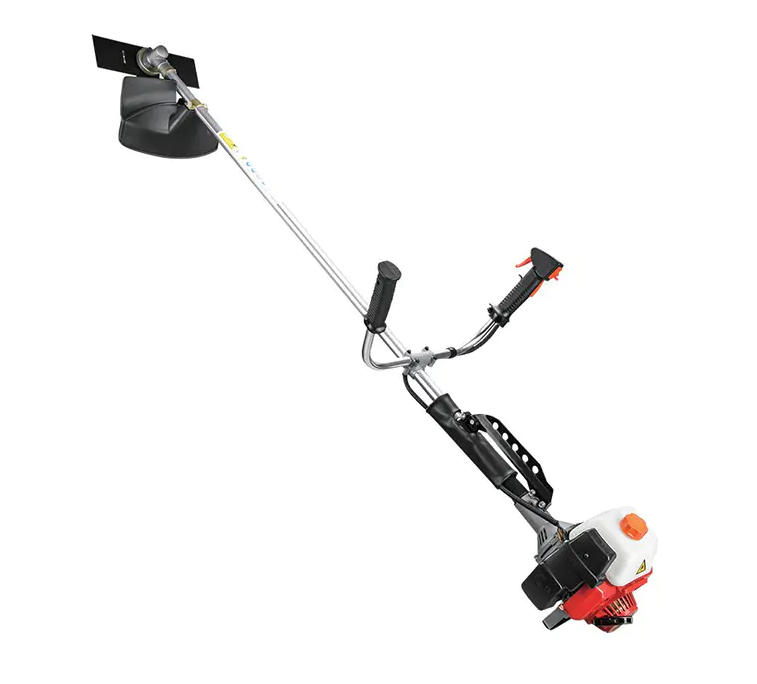
A Gasoline Brush Cutter is a practical outdoor machine designed for cutting grass, weeds, reeds, and other vegetation that can be difficult to handle using a standard lawn mower. It uses a gasoline engine to generate rotational power, which is transferred through a drive shaft to a cutting head or blade. This structure allows the operator to work across uneven ground, narrow areas, and sections where larger equipment may not fit easily.
The engine is one of the key components of a Gasoline Brush Cutter. Two-stroke engines are commonly found in compact models because they can provide a useful balance between size and power. Four-stroke versions are also available for applications that require a different engine structure. Engine displacement, fuel capacity, and output can vary according to the intended cutting task.
Cutting attachments give the machine additional flexibility. Nylon line heads are suitable for grass and softer weeds, while metal blades can handle thicker vegetation and tougher stems. Different blade shapes are designed for different cutting conditions. Choosing the appropriate attachment depends on the vegetation type, working area, and desired cutting result.
The shaft connects the engine to the cutting attachment. Straight-shaft designs are common for outdoor vegetation work because they provide a direct mechanical connection. The handle structure also affects control. Bicycle-style handles can provide a broad grip for larger cutting movements, while loop handles may suit compact working spaces.
A Gasoline Brush Cutter can be useful in gardens, roadside areas, orchards, parks, fields, and other locations where vegetation grows across irregular surfaces. Its portable structure allows users to move around trees, fences, slopes, drainage areas, and corners without relying on a wheeled machine.
Operator comfort is another part of equipment design. Shoulder harnesses can distribute part of the machine's weight, while vibration-reducing components may make the equipment more comfortable during extended use. The placement of the throttle, handle, and control switches also influences how easily the operator can change cutting speed.
When selecting a Gasoline Brush Cutter, buyers can compare engine type, displacement, cutting width, shaft structure, handle style, attachment compatibility, fuel tank capacity, and machine weight. These specifications help match the equipment to the actual working conditions.

 English
 Arabic
 French
 Spanish
 Portuguese
 Turkish
 Dutch
Dutch
 Italiano
 Russian
 Romaian
 Portuguese (Brazil)
 Greek
Greek