
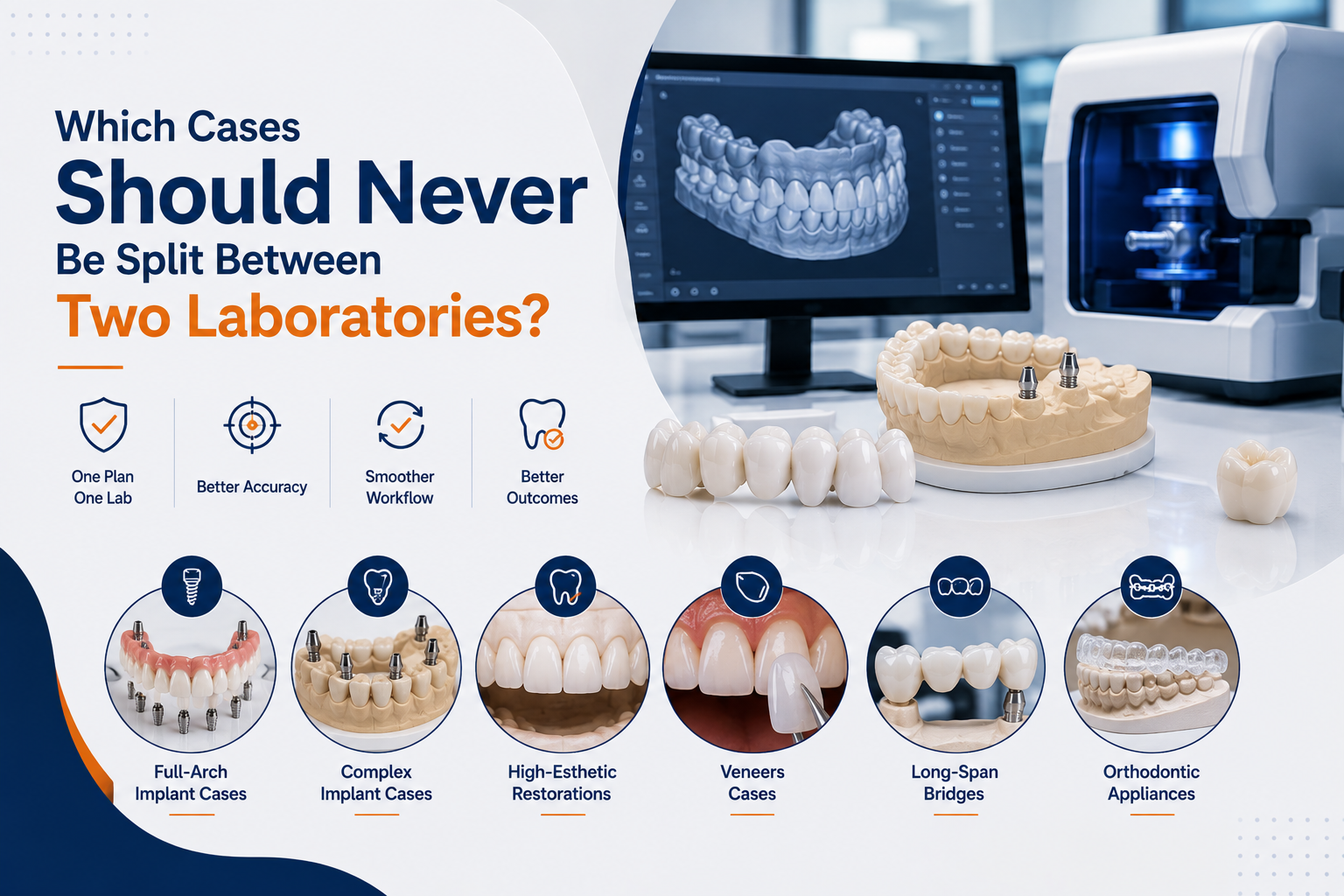
The test is dependency, not complexity. A case should stay with one laboratory whenever the design of one component determines the design of another. That covers four situations: anterior units that must match each other or an existing restoration, combined fixed and removable work in the same arch, full-arch implant prosthetics, and any case that changes vertical dimension.
Everything else can be split without consequence. A posterior crown and an unrelated partial denture in the opposing arch do not need to come from the same building.
The Test That Actually Decides It
Practices usually split cases by category. Crowns to one laboratory, removable to another, implants to a third. That division works until two components in the same case have to be designed against each other.
The question worth asking before splitting is simple: could the second laboratory produce its component correctly without seeing the first one?
-
If yes, the case can be split safely
-
If no, splitting means one laboratory is designing against an assumption
-
If the answer is "only if we send them the first restoration," the case is already sequential rather than parallel, and the time cost usually exceeds the benefit
Complexity is not the criterion. A difficult single unit is still independent. A straightforward crown that carries a rest seat is not.
Anterior Units That Must Match
This is the most common split failure and the easiest to predict. Work involving layered anterior ceramics, where a ceramist builds characterisation by hand, carries a matching requirement that posterior units do not.
A study on shade duplication in ceramic restorations measured what happens when different technicians follow matched protocols. Inter-technician variability reached ΔE 2 to 6.4, while the same technician repeating the work stayed between ΔE 0.2 and 1.5. The same ceramic batch, the same firing temperature, the same number of firing cycles. The variable was the person.
Those figures only mean something against a visual threshold. Research published in the Journal of Dentistry on CIEDE2000 perceptibility and acceptability thresholds places the 50:50 percent perceptibility threshold near ΔE00 1.01 and acceptability near 2.66, dropping to 0.71 and 1.78 when lightness weighting is adjusted. Inter-technician variability of 2 to 6.4 crosses both. Two ceramists producing adjacent units are working outside the range a patient will accept.
Cases this rules out splitting on:
-
Two or more anterior units in the same arch, where adjacent restorations sit side by side under the same light
-
A single central incisor matched to an existing crown on the contralateral tooth, since the reference is a restoration the second laboratory cannot see
-
Anterior work staged over time, where a unit placed this year has to match one placed two years ago
-
Any case where a previous attempt failed on colour, since the second attempt needs the first technician's notes rather than a fresh interpretation
The practical rule is that matching units belong to one ceramist, not merely one laboratory. A single laboratory that reassigns the case between technicians produces the same problem.
Combined Fixed and Removable in the Same Arch
This is the split that causes the most expensive failures and the one practices are least likely to anticipate. When a crown serves as an abutment for a removable partial denture, that crown is not a normal crown.
Research from the University of Michigan School of Dentistry describes the requirement plainly: a surveyed crown is contoured to exhibit a rest seat, guide plane, and ideal height of contour to fit against the clasp assembly of the partial denture. Every one of those features is determined by the partial denture design rather than by the tooth.
The sequence runs in a specific order. The partial is designed first. The cast is surveyed to establish the path of insertion. The crown wax-up is then surveyed including all partial denture components before it is finished. A crown fabricated without that information will have contours in the wrong place, and the error is not correctable chairside.
What goes wrong when this case is split:
-
The crown arrives with no rest seat, or one placed where the framework does not need it
-
Guide planes are absent or angled to a different path of insertion
-
The height of contour sits too high or too low for the planned clasp arm
-
The removable laboratory then designs around a crown it did not specify, producing a compromised framework
-
The correction is usually a crown remake, since adding a rest seat to a finished ceramic restoration is not a viable option
Practices restoring partial denture cases alongside fixed work should treat the arch as one case rather than two orders, even when the appointments are months apart.
Full-Arch Implant Prosthetics
Full-arch cases fail on passive fit, and passive fit depends on an unbroken verification chain.
The tolerance is narrow and not fully settled. A misfit simulation study in the Journal of Prosthetic Dentistry notes that up to 150 microns of misfit has been considered clinically acceptable, while a definitive threshold has not been determined, and that complete passive fit is almost impossible to achieve because errors accumulate at every clinical and laboratory step.
That last point is the argument. If error accumulates at each step, adding handoffs between laboratories adds steps.
Splitting introduces breaks at predictable points:
-
Verification jig made by one laboratory, framework by another. The jig confirms implant positions for a specific workflow. Passing it between laboratories reintroduces the error the jig was made to eliminate.
-
Framework and prosthetic teeth from different sources. Tooth position determines cantilever length and load distribution, so designing them separately means one is fitted to the other after the fact.
-
Surgical guide from a third party. If the guide was planned against a prosthetic design the restoring laboratory did not produce, implant angulation may not suit the prosthesis that gets made.
The sequence also involves multiple returns. Each handoff between laboratories adds a shipping cycle to a case that already carries several.
Cases That Change Vertical Dimension
Any case altering the occlusal scheme has to be built to one plan.
Full-mouth rehabilitation, cases restoring lost vertical dimension, and any treatment sequence where a diagnostic wax-up drives the final result share the same requirement: one mounting, one occlusal scheme, one set of records. Two laboratories working from copies of the same records will still produce two interpretations, because occlusal scheme is a design decision rather than a measurement.
The Cases at a Glance
| Case type | Why it cannot split | What fails if it does |
| Two or more anterior units | Shade and characterisation must match unit to unit | Visible mismatch, inter-technician ΔE 2 to 6.4 |
| Matching an existing restoration | Reference is a restoration the second lab cannot see | Mismatch with no recoverable reference |
| Crown serving as RPD abutment | Rest seats and guide planes come from the framework design | Crown remake, or a compromised framework |
| Full-arch implant prosthesis | Passive fit depends on an unbroken verification chain | Misfit beyond 150 microns, screw loosening |
| Change in vertical dimension | One occlusal scheme, one mounting | Two interpretations that will not reconcile |
| Staged anterior work over time | Later units must match earlier ones | Progressive drift across restorations |
Where Splitting Is Perfectly Safe
Not every case needs consolidating, and treating all work as inseparable creates its own cost.
-
Independent posterior units in different quadrants with no shared occlusal scheme
-
A crown in one arch and an unrelated restoration in the other, where neither determines the other's contours
-
Routine single units with no matching requirement and no removable component
-
Repair or reline work on an existing prosthesis, which is often faster at a laboratory close by
-
Night guards and appliances, which depend on records rather than on other restorations
A practice with a working specialty relationship for one case type has no reason to abandon it. The argument here is narrow: keep dependent components together, not every case.
If a Case Is Already Split
Some cases become dependent partway through, usually when a treatment plan changes.
-
Send the finished restoration, not just the model, to the second laboratory when a match is required
-
Provide the survey and path of insertion in writing if a crown is going to a different laboratory than the partial
-
Accept the added sequencing time rather than running both components in parallel
-
For anterior matching, request a photograph of the completed unit under corrected lighting before the second unit is designed
None of these fully removes the problem. They reduce it.
Frequently Asked Questions
Is one laboratory enough, or does it need to be one technician?
One technician, for anything involving shade matching. Measured variability between technicians working to identical protocols reached ΔE 2 to 6.4, which exceeds the acceptability threshold. A single laboratory that reassigns cases produces the same outcome as two laboratories.
Why can a crown for a partial denture not be made separately?
Its rest seat, guide plane, and height of contour are determined by the framework design and the surveyed path of insertion. Without that information the crown is being designed against an assumption, and adding a rest seat to a finished restoration is not practical.
Can two laboratories match a shade if both receive the same photograph?
Sometimes, for a single unit against natural teeth. For adjacent units the risk is high, since the two restorations are compared directly to each other rather than to a tab.
What about splitting a full-arch case to save time?
It usually costs time. Fit error accumulates at every clinical and laboratory step, and each handoff adds steps as well as a shipping cycle.
Does this argument mean a practice should use only one laboratory?
No. It means dependent components in the same case should stay together. Independent work can be split without consequence.
Final Insight
The useful question before splitting a case is not which laboratory is better at each part. It is whether either part can be designed correctly without the other.
Where the answer is no, the case has already decided the matter. Sending it to two laboratories does not divide the work. It divides the information, and the component made without it is the one that comes back.

 English
 Arabic
 French
 Spanish
 Portuguese
 Deutsch
 Dutch
Dutch
 Italiano
 Russian
 Romaian
 Portuguese (Brazil)
 Greek
Greek