
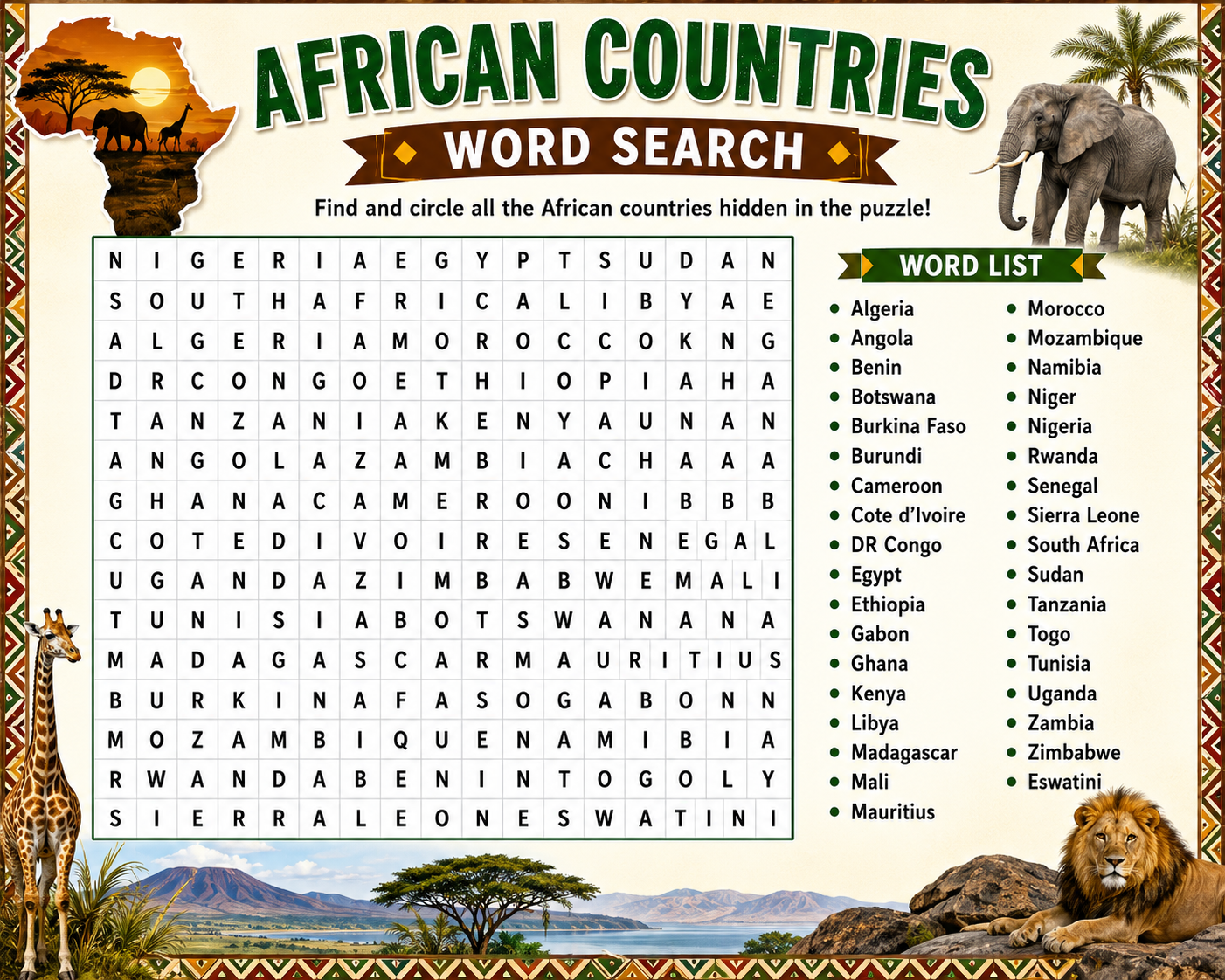
African Countries Word Search: A Gateway to the World's Most Diverse Continent
Africa is a continent that defies easy summary. With 54 sovereign nations, over 2,000 spoken languages, an unmatched range of landscapes, and a history stretching back to the very origins of humanity, it is arguably the most complex and layered continent on Earth. Yet despite this extraordinary richness, African geography often receives less classroom attention than it deserves, leaving many students and adults with surprisingly limited familiarity with even the most prominent African nations. An African countries word search offers a deceptively simple but genuinely effective way to begin closing that gap, introducing solvers to the names, spellings, and regional positions of countries spread across a continent of breathtaking variety.
Africa Through the Lens of a Puzzle
There is a particular value in engaging with African country names through an activity that demands active recognition rather than passive reading. Because many African country names contain spelling patterns unfamiliar to speakers of European languages, encountering and locating them within a puzzle grid creates a stronger memory impression than simply reading them on a map or a list. The process of scanning for Nigeria alongside Algeria, or distinguishing Rwanda from Tanzania within a dense letter grid, forces a level of focused attention that more passive learning approaches rarely achieve.
This active engagement is especially important for a continent whose nations are too often lumped together in popular imagination rather than recognized individually for their distinct identities, histories, and achievements. A word search that requires finding each country separately is, in its small way, a reminder that Africa is not a single entity but a vast collection of nations each deserving individual recognition.
The Fourteen Countries Featured in the Puzzle
The puzzle covers fourteen of Africa's most significant nations, spanning all major regions of the continent and representing an enormous range of cultures, landscapes, and historical legacies.
Nigeria, located in West Africa, is the continent's most populous nation and one of its largest economies, home to over 200 million people and an extraordinarily diverse collection of ethnic groups and languages. Ethiopia, one of the oldest countries in the world and the only African nation never fully colonized by a European power, sits in the Horn of Africa and carries deep historical and religious significance across multiple global traditions. Egypt anchors the northeastern corner of the continent, connecting Africa to the Middle East through the Nile Delta and carrying a civilizational legacy that spans more than five thousand years.
Kenya in East Africa is internationally recognized for its extraordinary wildlife, including the annual wildebeest migration across the Maasai Mara, as well as for producing some of the world's most celebrated long-distance runners. Ghana in West Africa, once known as the Gold Coast under British colonial rule, became in 1957 the first sub-Saharan African country to gain independence from European colonization, a moment that reverberated across the entire continent. Tanzania is home to Mount Kilimanjaro, Africa's highest peak, and the Serengeti, one of the world's most celebrated wildlife ecosystems.
Morocco, a North African kingdom facing both the Mediterranean Sea and the Atlantic Ocean, blends Berber, Arab, and European cultural influences into a distinctive national identity expressed through its ancient medinas, vibrant souks, and dramatic desert landscapes. Senegal in West Africa is renowned for its musical traditions, particularly the mbalax rhythm that has influenced popular music well beyond the continent's borders. Angola, situated in Southern Africa along the Atlantic coast, possesses significant oil and diamond reserves alongside a complex post-colonial history shaped by decades of civil conflict followed by remarkable economic recovery.
Zambia, a landlocked Asian Countries, is home to Victoria Falls, one of the largest and most dramatic waterfalls on Earth, shared with neighboring Zimbabwe along the Zambezi River. Somalia, located in the Horn of Africa, was historically one of the Indian Ocean's most important trading hubs, connecting East African commerce to Arabia, Persia, and South Asia long before European contact. Sudan, one of Africa's largest countries by land area, occupies a strategic position in Northeast Africa where the Blue and White Nile rivers converge before flowing northward through Egypt.
Rwanda, a small but densely populated East African nation, has undergone one of modern history's most remarkable national recoveries following the devastating genocide of 1994, rebuilding its institutions and economy to become one of the continent's fastest-growing nations. Algeria, the largest country in Africa by total land area, stretches from the Mediterranean coastline deep into the Sahara Desert, covering a geographic range that encompasses ancient Roman ruins, Berber mountain villages, and vast stretches of undisturbed desert.
Ready to Find Them All?
All fourteen of these nations are hidden within the grid at this African countries word search, where words are concealed horizontally, vertically, diagonally, and sometimes backward, creating a medium-difficulty challenge suited to solvers aged ten and above. The puzzle is completely free to play with no registration required, making it an easy resource to share with students, family members, or anyone curious about African geography.
What This Puzzle Reveals About African Geography
Working through the fourteen country names in this puzzle naturally highlights several important geographic patterns that are easy to miss when studying Africa through maps alone. The puzzle includes nations from all four major African regions, North Africa (Egypt, Morocco, Algeria, Sudan), West Africa (Nigeria, Ghana, Senegal), East Africa (Kenya, Ethiopia, Tanzania, Rwanda, Somalia), and Southern Africa (Angola, Zambia), giving solvers a natural exposure to the continent's regional diversity within a single activity.
This regional spread also hints at the remarkable climatic and ecological variety found across Africa, from the Saharan desert environments of the north to the tropical rainforests of the west, the highland savannas of the east, and the more temperate southern regions. No other continent encompasses such a complete range of ecological zones, and the country names themselves carry traces of this diversity for those who explore beyond the puzzle grid.
How Teachers Can Use This Resource Most Effectively
Geography and social studies teachers will find this puzzle most valuable when paired with complementary activities rather than used in isolation. Asking students to locate each found country on a blank map of Africa immediately after completing the puzzle reinforces geographic positioning alongside name recognition, addressing a common weakness in geography instruction where students can name countries without connecting them to actual locations.
Following the puzzle with a brief research activity, assigning each student one found country to investigate and present to the class, transforms the vocabulary activity into a broader cultural and historical learning experience. Teachers covering African history can use the puzzle as a pre-reading activity before introducing texts on colonialism, independence movements, or contemporary African politics, giving students a foundation of name familiarity that makes subsequent reading feel more grounded and meaningful.
Fascinating Facts About African Nations Worth Knowing
A handful of well-chosen facts can bring the
puzzle's country list to life in memorable ways. Algeria's land area is so vast that if superimposed over Western Europe, it would cover the entire region from Portugal to Poland. Ethiopia follows its own unique calendar system based on an ancient Coptic tradition, which means the Ethiopian new year falls in September rather than January, and the country currently runs approximately seven to eight years behind the Gregorian calendar used in most of the world. Ghana's name was chosen at independence to honor the ancient Ghana Empire, a medieval West African state that controlled trans-Saharan gold trade, even though modern Ghana's territory does not actually overlap geographically with the historical empire. Rwanda has the highest proportion of women in its national parliament of any country in the world, a transformation driven by constitutional reforms introduced during its post-conflict rebuilding process.
The Broader Significance of Learning African Geography
Familiarity with African countries matters beyond academic performance in geography class. As Africa becomes an increasingly significant player in global economics, diplomacy, and cultural production, basic geographic literacy about the continent is becoming a practical professional skill in fields ranging from international business to journalism, public health, and environmental policy. Understanding that Nigeria and Algeria are not neighboring countries, or that Somalia and Senegal are separated by nearly the entire width of the continent, provides a foundation for more nuanced thinking about African affairs that generic references to "Africa" as a unified concept cannot support.
A word search will not by itself produce that geographic fluency, but it can plant the seeds of familiarity with names and regional positions that make deeper learning easier and more engaging when it follows.
Conclusion
An African countries word search offers a starting point rather than a complete education, but it is a starting point with genuine value. By requiring active engagement with the names and spellings of fourteen significant African nations, the puzzle creates a foundation of recognition that supports more substantive learning about a continent whose complexity and significance the world is only beginning to appreciate fully. Whether used in a classroom, shared at home, or solved as a personal geography challenge, this puzzle is a small but worthwhile step toward knowing Africa not as a vague geographic concept but as a collection of distinct, fascinating, and endlessly rewarding nations worth knowing individually.

 English
 Arabic
 French
 Spanish
 Portuguese
 Turkish
 Dutch
Dutch
 Italiano
 Russian
 Romaian
 Portuguese (Brazil)
 Greek
Greek