
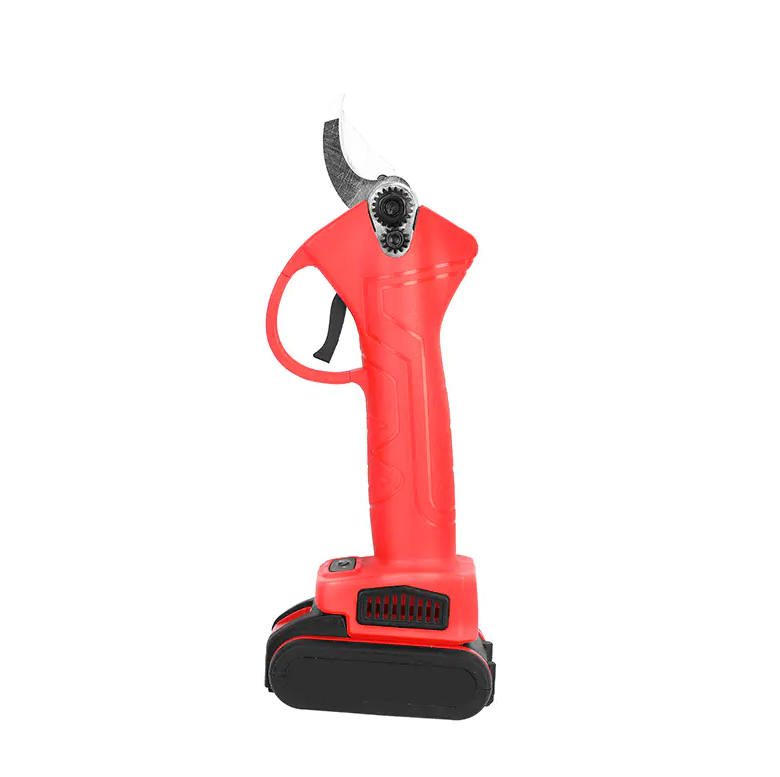
Behind every clean cut through a vine, branch, or shrub is a tool that was assembled, tested, and packaged somewhere — and for battery-powered garden tools, that somewhere is increasingly a lithium pruning shears factory equipped to handle both the mechanical and electronic sides of the product. These aren't simple hand tools. A lithium pruning shear combines a hardened steel blade system, a brushless or brushed motor drive, a lithium-ion battery pack, and an electronic control board into a compact unit that a farm worker or landscaper can operate for hours without fatigue.
A factory producing lithium pruning shears runs several distinct production processes under one roof. Blade manufacturing or blade sourcing and finishing is one; motor assembly and testing is another; battery pack assembly — including cell selection, spot welding, and BMS integration — is a third. Final assembly brings these subsystems together, followed by functional testing that checks cutting force, blade speed, battery charge retention, and safety cutoff response before the unit is cleared for packaging.
Lithium battery configuration varies by model. Most lithium pruning shears use 3.6V, 7.2V, or 16.8V battery packs depending on motor power and target cutting diameter. Removable battery designs allow users to carry spare packs and extend working time without returning to a charging point — a practical feature for large vineyard operations and orchard harvesting where continuous use across a full shift is the norm.
Production capacity and order flexibility vary between factories. Some focus on high-volume runs of standardized models for agricultural distributors. Others maintain smaller batch capability for specialty markets or seasonal product programs. Confirming minimum order quantities, lead times, and sample availability before committing to a sourcing relationship is standard practice for any importer evaluating a new lithium pruning shears factory.

 English
 Arabic
 French
 Spanish
 Deutsch
 Turkish
 Dutch
Dutch
 Italiano
 Russian
 Romaian
 Portuguese (Brazil)
 Greek
Greek