
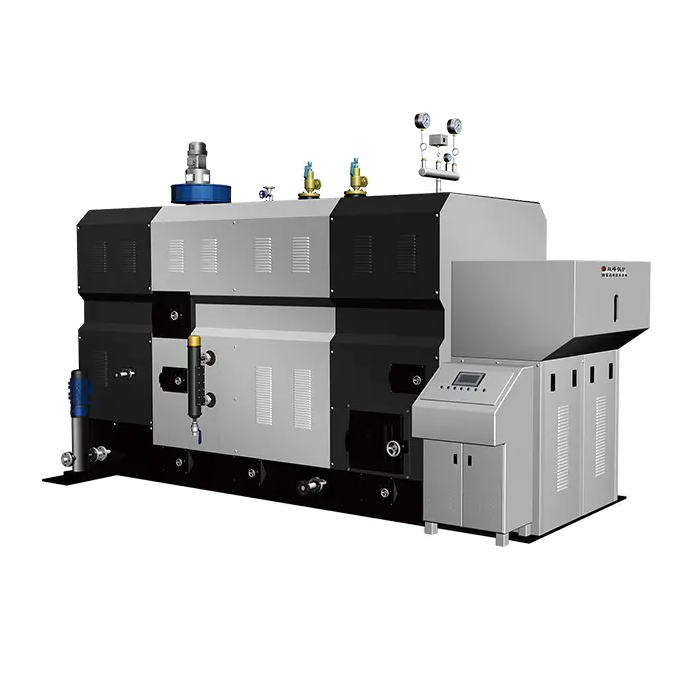
A Biomass Steam Boiler is an industrial thermal system designed to convert renewable organic materials into high-pressure steam for heating or process applications. Common fuels include wood chips, rice husk, straw, and biomass pellets. The system operates through controlled combustion, heat transfer, and steam generation inside a sealed pressure vessel.
Modern industrial configurations are widely built in the range of 1 ton/h to 40 ton/h steam capacity, with working pressure levels typically between 1.0 MPa and 2.5 MPa depending on application demand . These parameters make biomass systems suitable for textile production, food processing, chemical plants, and drying systems.
Combustion and Fuel Feeding System
Fuel is delivered into the furnace through a screw feeder or chain grate system. Inside the furnace, biomass goes through four combustion stages:
Drying phase to remove moisture
Pyrolysis releasing volatile gases
Gas combustion generating primary heat
Char burnout completing fuel conversion
A moving grate system is commonly used for continuous operation. It ensures stable fuel distribution and ash discharge, reducing manual intervention and improving operational consistency.
Steam Generation Process
Heat generated in the furnace is transferred to water tubes or a steam drum. Water absorbs thermal energy and gradually converts into saturated steam. Typical steam temperature ranges between 184°C and 226°C depending on pressure level and boiler configuration .
In many industrial units, economizers are installed at the tail section to recover waste heat from flue gas, preheating feedwater and improving thermal utilization.
Technical Operating Parameters
A medium-capacity system may include:
Steam capacity: 4–10 t/h
Working pressure: 1.25–1.6 MPa
Steam temperature: 194–204°C
Exhaust temperature: around 170°C
Thermal efficiency: generally above 85% in optimized design
These parameters directly influence fuel consumption and overall energy cost control.
Emission and Heat Recovery Design
Flue gas treatment is an important part of system structure. Multi-cyclone dust collectors and bag filters are often integrated to reduce particulate emissions. Air preheaters improve combustion air temperature, which supports more stable ignition and reduces unburned fuel loss.
Industrial Application Scope
This type of boiler is widely used in:
Food sterilization and cooking systems
Textile dyeing and drying
Paper pulp processing
Pharmaceutical sterilization
Agricultural product drying
Stable steam output makes it suitable for continuous industrial production lines.
Operational Considerations
Key factors affecting performance include:
Fuel moisture content
Air-fuel ratio control
Heat exchanger cleanliness
Ash discharge efficiency
Proper control of these parameters helps maintain stable steam output and consistent combustion behavior.
Conclusion
A Biomass Steam Boiler integrates renewable fuel utilization with industrial steam production needs. Its performance depends on combustion design, heat recovery systems, and fuel quality control. With proper configuration, it supports continuous industrial heating while reducing dependence on fossil-based energy sources.

 English
 French
 Spanish
 Portuguese
 Deutsch
 Turkish
 Dutch
Dutch
 Italiano
 Russian
 Romaian
 Portuguese (Brazil)
 Greek
Greek