
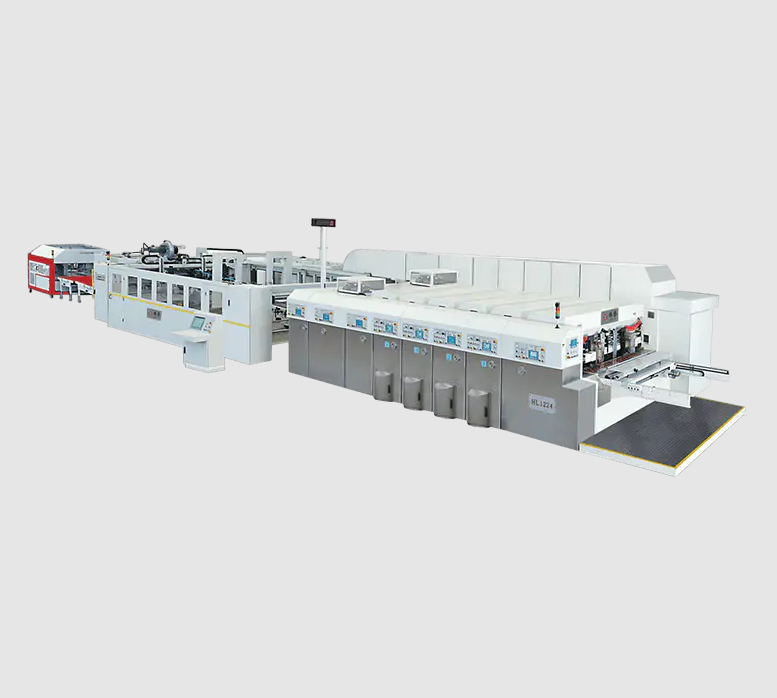
A modern packaging production line increasingly depends on automation to maintain stable output, and the Paste Box Machine has become a core piece of equipment in carton forming and sealing processes. It is widely used in industries such as cosmetics packaging, food cartons, electronics boxes, and lightweight corrugated packaging structures. The machine is designed to perform continuous folding, gluing, pressing, and box forming with minimal manual intervention.
The Paste Box Machine typically integrates several functional modules including automatic sheet feeding, glue application system, folding section, pressure forming unit, and automatic stacking output. In a standard configuration, the machine can process paperboard ranging from 210gsm to 600gsm, and some reinforced models support corrugated sheets up to 9mm thickness. Operating speed generally ranges from 0 to 150 meters per minute depending on box structure and glue viscosity conditions.
The feeding system is usually equipped with friction rollers or vacuum suction devices, ensuring stable sheet transfer without misalignment. A servo-driven control system coordinates the timing of glue dispensing and folding arms. Glue width can be adjusted between 3mm and 45mm, allowing precise bonding for different box designs. Polyvinyl acetate (PVA) and water-based adhesives are commonly supported due to their fast drying characteristics and environmental stability.
One important feature of the Paste Box Machine is its continuous production capability. Unlike manual folding and gluing methods, the machine operates without frequent stops, improving consistency across batches. The folding section is often designed with adjustable rails, enabling compatibility with multiple box shapes such as straight-line boxes, pre-fold boxes, and edge-fold structures. The tolerance control for folding accuracy is usually within ±0.5mm, ensuring stable box geometry.
Electrical control is handled through PLC systems combined with touch-screen interfaces. Operators can set parameters such as sheet length, folding angle, glue temperature (if hot melt system is included), and production speed. Many systems also include automatic counting functions capable of tracking up to 999,999 units, which supports large-scale production management.
From a production efficiency perspective, a Paste Box Machine can significantly reduce labor dependency. A single machine can replace multiple manual operators, especially in high-volume carton production environments. It also reduces glue waste due to controlled dispensing systems that apply adhesive only where needed.
In industrial usage, maintenance plays an important role. Regular cleaning of glue nozzles, inspection of conveyor belts, and lubrication of mechanical joints help maintain long-term stability. Many machines are designed with modular components, making replacement of rollers or belts more convenient.
Another key advantage lies in adaptability. The Paste Box Machine can handle both simple folding cartons and more complex structures with pre-folding requirements. Adjustments between different box sizes typically take less than 30 minutes, depending on operator experience and machine configuration.
In summary, the Paste Box Machine is not only a forming device but a complete automated packaging solution. Its ability to integrate feeding, gluing, folding, and stacking into a continuous workflow makes it a critical asset in modern packaging lines where consistency, speed, and controlled adhesive application are required.

 English
 Arabic
 French
 Spanish
 Portuguese
 Deutsch
 Turkish
 Italiano
 Russian
 Romaian
 Portuguese (Brazil)
 Greek
Greek