
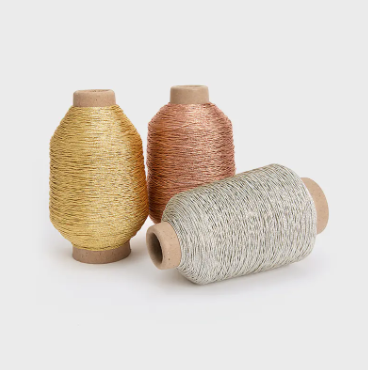
The textile and decorative fabric industry has seen increasing demand for materials that combine visual appeal with stable mechanical performance. Among different metallic yarn categories, M Type Metallic Yarn has become a widely used structure for weaving, embroidery, and decorative textile applications due to its flat film-based composition and consistent reflective properties.
M Type metallic yarn is manufactured using polyester film as the base material. The film is metallized through aluminum coating and then protected with epoxy resin. After coating, the film is slit into fine strips with controlled width. Common specifications include 1/69”, 1/100”, and 1/127”, while thickness typically ranges from 12μ to 25μ. These parameters directly influence flexibility, brightness, and processing behavior during weaving or knitting operations.
One of the key characteristics of this yarn type is its flat structure, which provides strong reflective effects under both natural and artificial lighting. The surface is smooth, allowing light to reflect uniformly across the yarn body. This property makes it suitable for decorative fabrics where visual impact is required without adding excessive weight to the textile base.
From a production perspective, M Type Metallic Yarn is designed to maintain dimensional stability during high-speed textile processing. The tensile strength is moderate compared with reinforced metallic yarn types, so it is more commonly used in applications where decorative function is prioritized over structural stress resistance. Typical applications include ribbon production, lace weaving, embroidery threads, gift packaging materials, and interior decorative fabrics.
In terms of processing performance, the yarn can be used in both warp and weft directions depending on fabric design. However, machine tension settings need to be adjusted carefully because excessive tension may cause film cracking. Recommended weaving speeds generally depend on fabric density, but many industrial setups maintain moderate speed ranges to ensure smooth feeding and reduce breakage risk.
Color availability is another advantage. Standard options include gold and silver, while customized color coatings can be applied depending on production requirements. This flexibility allows textile manufacturers to integrate metallic effects into seasonal fashion fabrics or themed decorative products.
Another technical aspect worth noting is yarn thickness consistency. Since the yarn is produced by precision slitting of polyester film, uniformity in thickness directly affects final fabric smoothness. Variations in thickness can lead to uneven shine or inconsistent texture across finished textile surfaces.
M Type Metallic Yarn is also used in combination with natural or synthetic fibers to create blended visual effects. When combined with cotton, polyester, or nylon base yarns, it can enhance surface brightness without significantly altering fabric softness. This makes it suitable for garments where comfort and aesthetics must be balanced.
In packaging and supply formats, metallic yarn is usually wound on ABS bobbins or spools to ensure stable unwinding during industrial use. This reduces tangling and supports continuous production lines in weaving and embroidery machines.
Overall, M Type Metallic Yarn plays an important role in decorative textile engineering due to its balance of shine, processability, and cost efficiency. Its flat film structure and controlled metallization process make it a practical material for applications requiring consistent visual enhancement without complex mechanical reinforcement.

 English
 French
 Spanish
 Portuguese
 Deutsch
 Turkish
 Dutch
Dutch
 Italiano
 Russian
 Romaian
 Portuguese (Brazil)
 Greek
Greek