
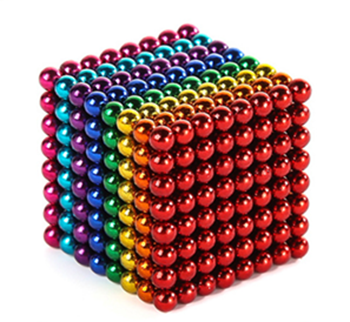
Solid building toys continue to play an important role in early education and creative development. Among modern construction toys, Solid Color Magnetic Block Cubes stand out because they combine visual learning, structural exploration, and magnetic engineering principles in a simple cube format.
The structure of Solid Color Magnetic Block Cubes is typically based on a 1-inch (2.5 cm) or 1.2-inch modular cube design. Each cube contains embedded neodymium magnets inside sealed ABS or similar durable plastic shells. The magnetic polarity is arranged so that each side can connect in multiple orientations, allowing stable 3D construction without needing alignment tools or mechanical locking systems.
A typical configuration includes 6 internal magnets per cube or 4 side-mounted magnetic points depending on the manufacturer design. The magnetic pull force is usually calibrated between 0.6–1.2 kg per connection point, which ensures both secure stacking and easy disassembly for children.
One of the defining features of Solid Color Magnetic Block Cubes is the solid pigment coloring process. Unlike printed or sticker-based toys, the color is integrated into the plastic through injection molding. This improves resistance to fading, scratching, and surface wear. Common color systems include CMYK-inspired educational palettes or primary color sets designed for cognitive recognition training.
From a structural engineering perspective, these cubes allow multiple geometry experiments:
Linear stacking for balance learning
3D lattice construction for spatial reasoning
Closed-loop structures for symmetry exploration
The magnetic system inside each cube enables 360-degree connection capability, which is a major difference compared to traditional interlocking blocks. This means users can build in vertical, diagonal, and rotational directions without restriction.
Material safety is another key consideration. Most Solid Color Magnetic Block Cubes are manufactured using BPA-free ABS plastic with ultrasonic sealing to prevent magnet exposure. Internal magnets are typically coated with nickel or epoxy resin to reduce corrosion risk and improve longevity. Standard drop-test resistance ranges between 1.2–1.5 meters depending on cube wall thickness (usually 2–3 mm).
In educational environments, these cubes are widely used for STEM learning applications. Teachers often incorporate them into lessons covering:
Basic geometry (cube, prism, symmetry)
Magnetism principles (attraction/repulsion polarity)
Engineering stability (load distribution and structure balance)
The tactile experience of connecting cubes also supports fine motor skill development. Repetitive grasping and alignment actions help improve hand-eye coordination and spatial awareness in early learners.
Because of their modular design, Solid Color Magnetic Block Cubes can also integrate with other magnetic tile systems if size standards are compatible. This allows expanded building environments and more complex architectural modeling.
Overall, these cubes provide a structured yet open-ended system that bridges play and learning. Their durability, magnetic engineering, and visual simplicity make them a strong option for classrooms, home learning, and creative building environments.

 English
 Arabic
 French
 Spanish
 Portuguese
 Turkish
 Dutch
Dutch
 Italiano
 Russian
 Romaian
 Portuguese (Brazil)
 Greek
Greek