
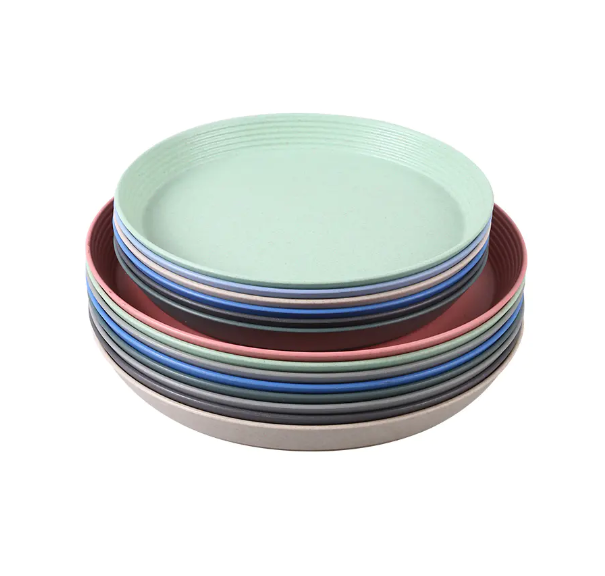
Modern kitchenware development is gradually shifting toward materials that combine usability, safety, and reduced environmental impact. Among these emerging materials, Wheat Straw Material Tableware has become widely used in households, outdoor dining, and food service applications due to its balance of performance and material origin.
Wheat straw is an agricultural byproduct collected after wheat harvesting. Instead of being burned or discarded, the stalk fibers are processed into usable raw material. The fiber content typically includes cellulose, hemicellulose, and lignin, which together provide structural strength and flexibility. In many commercial formulations, wheat straw fiber content ranges from approximately 30% to 70%, blended with food-grade binders such as polypropylene (PP) or polylactic acid (PLA), depending on product requirements and manufacturing standards.
Material structure and technical composition
Wheat Straw Material Tableware is typically produced through a heat-press molding process. The raw fibers are first cleaned and ground into fine particles of around 80–120 mesh size. These fibers are then combined with binding agents under controlled temperature conditions of approximately 170°C to 220°C. High-pressure molding ensures that the final products maintain shape stability and resistance to daily mechanical stress.
Density values of finished tableware usually fall between 0.8 g/cm³ and 1.2 g/cm³, depending on fiber ratio. Higher fiber content generally results in a slightly lighter structure, while higher polymer content improves rigidity and heat resistance.
Most products are designed to withstand temperature ranges from -20°C to 120°C, making them suitable for refrigeration and microwave reheating. Dishwasher compatibility is also common, although repeated high-temperature cycles may gradually affect surface texture over time.
Daily usability and functional performance
One of the key advantages of Wheat Straw Material Tableware is its lightweight structure. Compared with ceramic dishes, the weight reduction can reach up to 40%–60%, which makes handling easier for children and outdoor users. The material also provides a slightly matte surface texture, improving grip and reducing slipping risk during use.
Impact resistance is another notable feature. Instead of shattering like glass or ceramic, wheat straw composites absorb impact energy and deform slightly under stress. This makes them suitable for environments where breakage risk must be minimized, such as school cafeterias or travel kits.
Odor retention is relatively low due to the semi-porous fiber structure, though strongly colored foods such as curry or tomato-based sauces may leave light staining if not cleaned promptly.
Safety and material considerations
Food-contact safety is an important factor in production. Most Wheat Straw Material Tableware products are BPA-free and comply with food-grade standards such as FDA or LFGB certifications. However, performance varies depending on the ratio of natural fiber to synthetic binder.
Products with higher PLA content are generally more heat-resistant but may have slightly reduced long-term durability under humid conditions. PP-based blends offer better mechanical stability but are less biodegradable.
Environmental perspective
From a lifecycle perspective, wheat straw utilization reduces agricultural waste and lowers dependency on petroleum-based plastics. In many regions, wheat straw was previously burned after harvest, contributing to air pollution. Converting this biomass into tableware materials adds value to what would otherwise be discarded.
Decomposition behavior depends heavily on processing type. Pure fiber-based products degrade faster under composting conditions, while composite materials require industrial composting environments or remain stable in landfill conditions.
Summary
Wheat Straw Material Tableware represents a practical balance between traditional plastics and natural fiber materials. Its mechanical performance, temperature resistance, and lightweight structure make it suitable for daily dining applications. While it is not fully biodegradable in all formulations, it provides a more resource-efficient alternative compared to conventional petroleum-based tableware.

 English
 Arabic
 French
 Spanish
 Portuguese
 Deutsch
 Turkish
 Dutch
Dutch
 Russian
 Romaian
 Portuguese (Brazil)
 Greek
Greek