
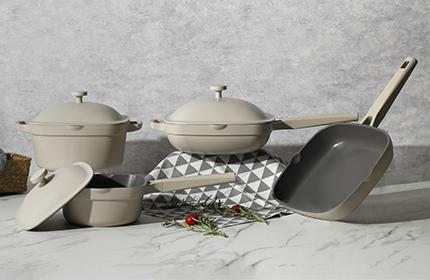
A Practical Aluminum Pot Set is widely used in household and light commercial kitchens due to its balance of lightweight structure, heat responsiveness, and multi-size cooking flexibility. Built mainly from aluminum alloys such as 3003 or 5052 series, these cookware sets are designed to support daily cooking tasks like boiling, stewing, simmering, and reheating without requiring complex maintenance routines.
One of the core technical advantages of aluminum cookware is its thermal conductivity, typically around 200–235 W/m·K, which is significantly higher than stainless steel. This allows heat to spread quickly and evenly across the pot base and sidewalls. As a result, temperature stabilization happens faster, reducing uneven cooking zones and minimizing the risk of localized overheating.
A Practical Aluminum Pot Set usually includes multiple pots ranging from 1.5L small sauce pots to 5–8L stock pots, offering flexibility for different meal sizes. Many modern sets adopt a 2.5–3.0 mm thick base structure, which improves deformation resistance under repeated heating cycles. Some upgraded versions also integrate an encapsulated bottom layer (aluminum + stainless steel composite) to enhance compatibility with induction cooktops.
From a usability perspective, aluminum’s low density (about 2.7 g/cm³) makes the cookware significantly lighter than cast iron alternatives. This is especially useful in fast-paced kitchens where lifting, pouring, and transferring hot liquids must be done frequently. Ergonomic heat-resistant handles, often made of Bakelite or stainless steel riveted structures, further improve handling safety.
Surface treatment plays an important role in modern aluminum cookware design. Many Practical Aluminum Pot Set products feature anodized or non-stick coatings. Hard anodizing increases surface hardness to around HV 300+, improving scratch resistance and reducing oxidation. Non-stick coatings, often PTFE-based or ceramic-based, reduce oil usage and simplify cleaning.
In terms of cooking performance, aluminum pots respond quickly to flame adjustments. This makes them suitable for recipes requiring controlled simmering, such as sauces or soups. However, for acidic ingredients like tomato-based dishes, coated or anodized surfaces are preferred to reduce potential reactivity.
Storage efficiency is another advantage. Many pot sets are designed with stackable nesting structures, reducing cabinet space usage by up to 30–40% compared to individual cookware pieces. Matching lids are often flat or semi-dome shaped, improving space optimization.
Overall, a Practical Aluminum Pot Set is engineered for efficiency, adaptability, and everyday usability, making it a reliable choice for diverse kitchen environments.

 English
 Arabic
 French
 Spanish
 Portuguese
 Deutsch
 Turkish
 Dutch
Dutch
 Italiano
 Russian
 Portuguese (Brazil)
 Greek
Greek