
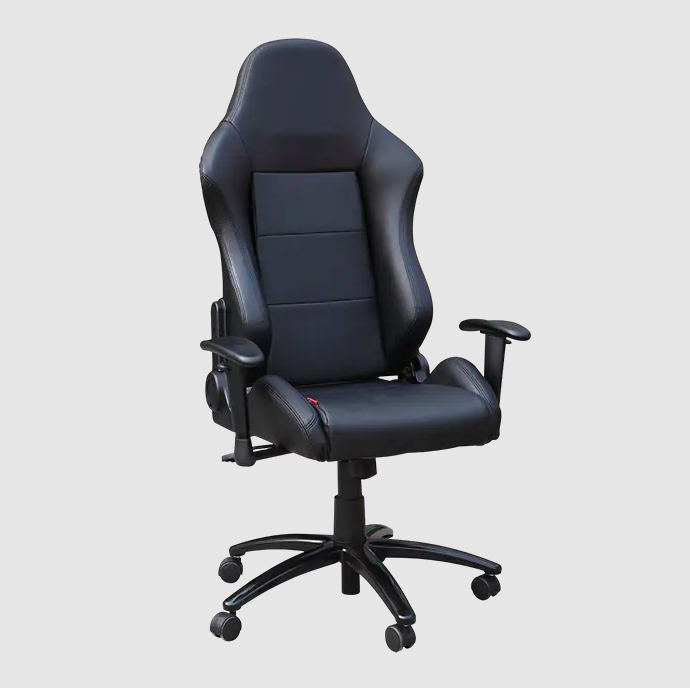
The development of an OEM Office Chair involves a structured manufacturing system where design intent, component selection, and production control are aligned to meet commercial and industrial seating requirements. Unlike standard retail models, OEM production emphasizes customization in frame structure, material specification, and functional mechanisms to satisfy different market needs such as corporate offices, training rooms, and co-working environments.
An OEM Office Chair typically begins with a technical drawing or sample confirmation provided by the buyer. Manufacturers then convert these requirements into production specifications covering frame geometry, seat ergonomics, load capacity, and functional adjustment systems. The seat height range is commonly designed between 420mm and 520mm, supported by a gas lift cylinder system that allows stepless adjustment for different user heights.
Frame Structure and Load Design
The internal structure of an OEM Office Chair usually consists of reinforced steel tubing or molded nylon composite frames. Steel frames often use 1.2–1.5mm wall thickness tubing for stability, while nylon frames are commonly blended with 30–40% glass fiber to enhance rigidity without adding excessive weight.
Load-bearing requirements are a key factor in OEM production. Standard commercial models are generally designed for 100kg–120kg load capacity, while reinforced versions can support higher ranges depending on base and gas lift selection. The connection points between backrest and seat are reinforced using metal brackets to reduce long-term deformation under continuous use.
Gas Lift System and Adjustment Function
The gas lift mechanism is a core component in any OEM Office Chair. Most models integrate Class 3 or Class 4 pneumatic cylinders, which use compressed nitrogen gas to provide smooth vertical movement. These cylinders typically operate within pressure ranges of 150–200 psi and are tested for thousands of lift cycles.
Height adjustment range is typically around 100mm, allowing users to align seating posture with desk height. The cylinder is paired with a tilt mechanism that enables reclining angles between 90° and 135°, depending on configuration. This combination supports both upright working posture and relaxed seating positions.
Seating Materials and Comfort Engineering
Seat cushioning in an OEM Office Chair often uses high-density molded foam with densities between 45–55 kg/m³. This ensures balance between softness and structural support. Mesh backrests use polyester or nylon woven mesh with tensile strength designed for continuous airflow and heat reduction.
Fabric options include polyester blends with abrasion resistance ratings suitable for daily office usage. PU leather alternatives are also used in executive-style OEM chairs, offering smoother surfaces but requiring careful material selection to maintain durability over time.
Armrests and Ergonomic Adjustment Systems
Armrest configurations vary widely in OEM production. Entry-level models may use fixed or 1D height-adjustable armrests, while advanced versions include 2D, 3D, or 4D adjustment systems. These allow movement in height, depth, width, and rotation, enabling ergonomic alignment with desk and keyboard positions.
Proper armrest positioning helps reduce shoulder strain by maintaining a 90-degree elbow angle during typing. OEM customization often includes different arm pad materials such as soft PU, molded foam, or hard polypropylene depending on target market preference.
Base, Casters, and Mobility Design
The base of an OEM Office Chair is typically constructed from nylon or aluminum alloy. Nylon bases are commonly reinforced with glass fiber, while aluminum bases are used in higher-load or premium configurations. The standard base diameter is around 640mm to ensure stability.
Casters are usually 50mm–60mm dual-wheel designs made from PU material, enabling smooth movement across carpet or hard flooring without excessive noise. Swivel rotation is achieved through a 360-degree mechanism integrated into the base plate.
OEM Production Control
During OEM Office Chair manufacturing, component matching is critical. Gas lift compatibility with base diameter, mechanism alignment, and seat-to-back angle consistency must be verified before mass production. Assembly lines follow standardized sequences to ensure repeatability and reduce structural variation between units.
Quality inspection includes load testing, tilt cycle testing, and height adjustment verification. Packaging is typically semi-disassembled to optimize shipping volume while protecting key components such as armrests, casters, and gas lift cylinders.
An OEM Office Chair represents a balance of ergonomic engineering, material science, and scalable production control, making it suitable for customized commercial furniture solutions.

 English
 Arabic
 French
 Spanish
 Portuguese
 Deutsch
 Turkish
 Dutch
Dutch
 Italiano
 Russian
 Portuguese (Brazil)
 Greek
Greek