
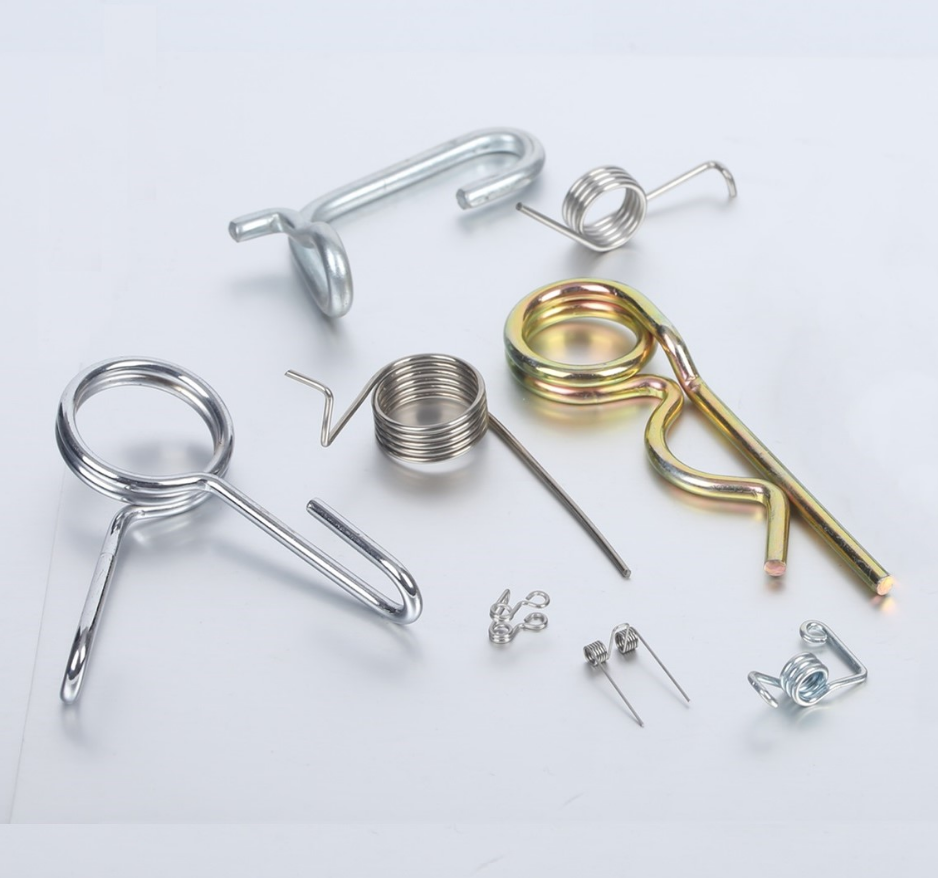
Mechanical systems that rely on controlled rotation often require a component capable of storing angular energy while maintaining consistent restoring force. Among the various elastic elements used in motion assemblies, torsional components built with a dual-helix configuration are increasingly applied in compact mechanisms where stability and repeatable motion are critical.
The concept behind Double Helix Torsion Springs is based on distributing torsional load across two intertwined helical wire paths rather than a single coil structure. This geometry allows torque to be shared, reducing localized stress concentration during angular displacement. Instead of one dominant load-bearing wire path, the torque is split into parallel load channels, which influences both fatigue resistance and angular response consistency.
A standard torsion spring typically works within an angular range that may extend from ±30° up to several hundred degrees depending on design constraints. In double helix configurations, the working range is often engineered with a focus on controlled deformation rather than extreme angular travel. A typical operating range for industrial applications is around 0° to 360°, though specialized designs may exceed this based on wire material and heat treatment conditions.
Key structural parameters influencing performance include:
Wire diameter commonly ranges from 0.4 mm to 8.0 mm depending on load demand.
Mean coil diameter is often designed as 6 to 12 times the wire diameter to balance stress distribution and flexibility.
Spring index values are typically maintained between 4 and 10 for manufacturability and stress control.
Leg length may vary from 5 mm in compact devices to over 80 mm in larger mechanical assemblies.
In Double Helix Torsion Springs, the dual-coil structure introduces an additional geometric factor: helix interaction spacing. This spacing must be carefully controlled to avoid coil interference during angular deflection. A typical clearance gap between the helices is maintained between 0.2 mm and 1.5 mm depending on wire thickness and torque requirements.
The torque behavior of torsion springs follows a near-linear relationship within elastic limits:
T = kθ + T₀
Where torque T increases proportionally with angular displacement θ, and k represents torsional stiffness. In double helix configurations, the effective stiffness is influenced by both coil paths, which can increase torque stability without proportionally increasing wire diameter.
Heat treatment plays a significant role in performance reliability. Most double helix springs are stress-relieved at temperatures between 250°C and 420°C. This process reduces residual forming stress and improves long-term dimensional stability during cyclic loading. Without proper treatment, torsional relaxation may occur, leading to torque drift after repeated cycles.
Applications for this spring configuration are commonly found in systems requiring controlled return motion. Examples include rotary switches, precision valve actuators, compact hinge systems, and mechanical timing devices. In these environments, consistent torque output is more important than achieving maximum force output.
Fatigue performance is another critical consideration. Under cyclic loading conditions, stress reversal occurs at each rotation cycle. The dual-helix structure helps distribute these stresses more evenly, reducing the likelihood of crack initiation at a single high-stress region. However, manufacturing precision becomes more demanding due to alignment requirements between the two helices.
From an engineering perspective, double helix designs are not intended to replace single torsion springs in all applications. Instead, they are selected when torque smoothness, reduced hysteresis, and improved load symmetry are required.

 English
 Arabic
 French
 Spanish
 Portuguese
 Turkish
 Dutch
Dutch
 Italiano
 Russian
 Romaian
 Portuguese (Brazil)
 Greek
Greek