
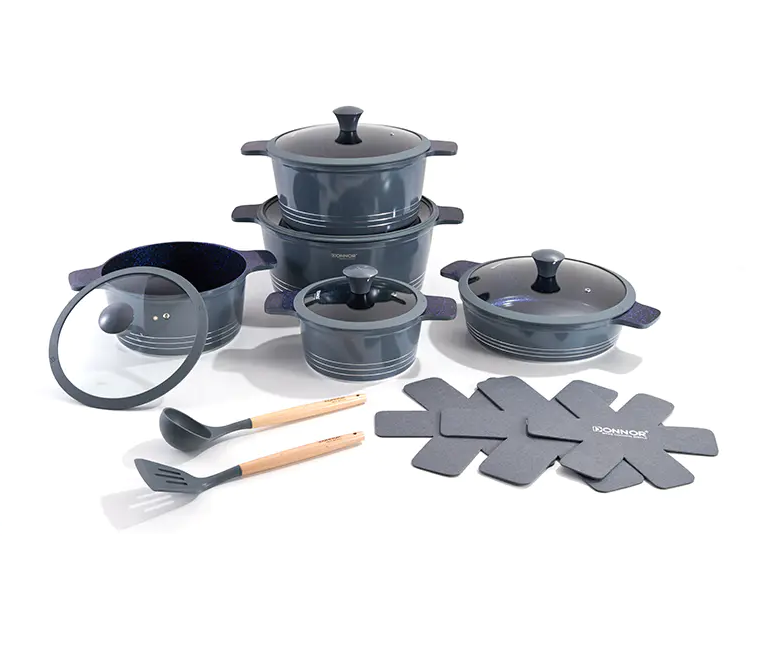
A modern kitchen depends heavily on cookware that balances heat performance, durability, and ease of use. Among different material options, the die cast aluminum cookware set has gained attention for its structural stability and thermal efficiency. This type of cookware is formed through a high-pressure casting process where molten aluminum is injected into a steel mold, producing a dense and uniform body without weak joints or uneven thickness.
A key technical advantage of die-cast aluminum is its thermal conductivity, which is significantly higher than stainless steel. Heat spreads quickly across the surface, reducing localized overheating. Typical thermal conductivity of aluminum alloys used in cookware ranges around 180–220 W/m·K, which supports faster response during cooking changes such as simmering or searing.
One important structural feature is the one-piece molding design. Unlike riveted or welded cookware, a die cast aluminum cookware set often has seamless construction. This reduces stress concentration points, making deformation less likely under repeated heating cycles. Many sets are designed with a base thickness of approximately 4.0–5.0 mm, which helps maintain heat stability while still keeping overall weight manageable.
Coating systems also play an important role. Most die cast aluminum cookware uses ceramic or multi-layer non-stick coatings. These coatings are typically rated for temperatures up to around 250–260°C. The purpose is to reduce food adhesion while protecting the aluminum core from direct food contact. This combination supports easier cleaning and more controlled cooking behavior.
Another technical benefit is heat distribution uniformity. Because aluminum reacts quickly to temperature input, heat spreads evenly across the pan surface. This reduces the risk of hot spots, which are common in lower conductivity materials. As a result, foods like sauces, eggs, or pan-fried items can cook more consistently.
Handles and lids are also part of the system design. Heat-resistant bakelite or silicone handles are commonly used, often rated for continuous exposure around 150–180°C. Glass lids with steam vents allow pressure release and moisture control, which improves cooking stability during long simmering processes.
A die cast aluminum cookware set is also compatible with multiple stovetop types when combined with an induction base layer. This is typically a stainless steel plate bonded to the bottom, enabling magnetic induction heating.
From a usage perspective, aluminum’s low density makes cookware lighter than cast iron alternatives. This improves handling comfort during repetitive cooking tasks, especially in commercial or high-frequency kitchen environments.
In summary, die cast aluminum cookware combines fast thermal response, structural stability, and modern coating technology. These characteristics make it suitable for a wide range of cooking styles, from high-heat frying to controlled simmering processes.

 English
 Arabic
 French
 Spanish
 Portuguese
 Turkish
 Dutch
Dutch
 Italiano
 Russian
 Romaian
 Portuguese (Brazil)
 Greek
Greek