
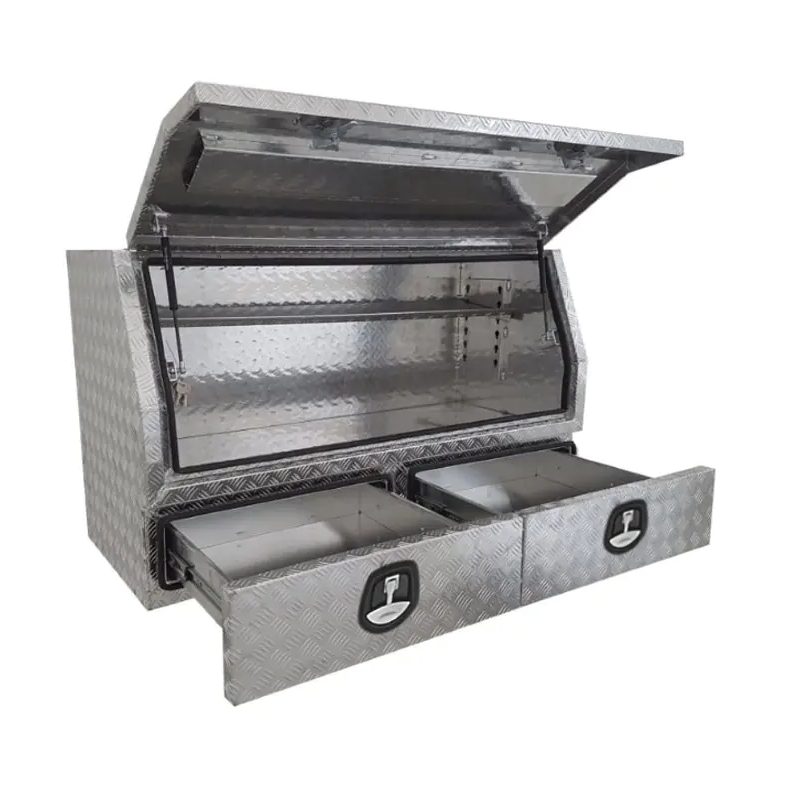
Aluminium trailer storage systems have become widely used across transport, construction, and maintenance environments where mobile storage is required. A key advantage comes from the combination of low weight and structural strength, allowing secure storage without significantly increasing trailer load. The Aluminium Trailers Toolbox category is commonly selected for this balance, especially in environments exposed to vibration, dust, and changing weather conditions.
Material structure plays an important role in durability. Most aluminium trailer toolboxes are manufactured using checker plate sheets with thickness ranging between 1.5 mm and 3.0 mm depending on application requirements. Thicker plates are usually used on base panels and load-bearing surfaces, while side walls may use slightly thinner sheets to reduce weight. Welded seam construction is frequently applied to improve rigidity and prevent deformation during long-term use.
A typical mid-size trailer toolbox may measure around 800 mm in length, 350 mm in width, and 300–500 mm in height. These dimensions allow installation on drawbars or trailer tongues without interfering with towing movement. Some designs also include reinforced lids supported by gas struts, improving accessibility while reducing stress on hinges during frequent opening cycles.
Weather resistance is another key consideration. Aluminium naturally forms an oxide layer that prevents rust formation, making it suitable for outdoor storage applications. Many designs include rubber sealing strips around lid edges, reducing water and dust ingress during transport. This feature is particularly important in off-road or long-distance trailer applications where exposure is continuous.
Internal organization has evolved significantly in modern designs. A growing number of users prefer integrated drawer systems rather than open compartments. This is where Aluminium Toolbox with Drawers configurations become relevant. Drawer-based systems allow separation of tools, fasteners, and accessories, improving accessibility and reducing time spent searching for items during field operations.
A typical drawer system may include steel or aluminium slide rails rated for 30–50 kg per drawer. Ball-bearing slides are commonly used to ensure smooth extension under load. Drawer depths often range from 80 mm to 150 mm, depending on toolbox height. Multi-layer configurations can include 2 to 5 drawers stacked vertically within a single enclosure.
In many applications, an Aluminium Toolbox with Drawers is installed inside a larger trailer storage unit. This setup allows separation between bulk storage and precision tools. Heavy items such as straps, jacks, or mechanical parts can be stored in lower compartments, while frequently used tools are placed in upper drawers for quick access.
Locking systems are another structural feature. Cam locks or stainless steel latch systems are commonly used to secure contents during transport. Some models integrate dual-lock mechanisms for improved stability on uneven terrain, preventing accidental drawer opening due to vibration.
From a design perspective, load distribution is important. Toolboxes mounted on trailers must withstand dynamic forces caused by braking, acceleration, and road vibration. Reinforced mounting brackets are often welded or bolted to trailer frames, ensuring the toolbox remains stable even under continuous movement conditions.
In summary, aluminium trailer toolboxes provide a combination of corrosion resistance, structural strength, and modular storage flexibility. Their integration with drawer systems further improves usability, making them suitable for both professional and recreational trailer setups.

 English
 Arabic
 French
 Spanish
 Portuguese
 Deutsch
 Turkish
 Italiano
 Russian
 Romaian
 Portuguese (Brazil)
 Greek
Greek