
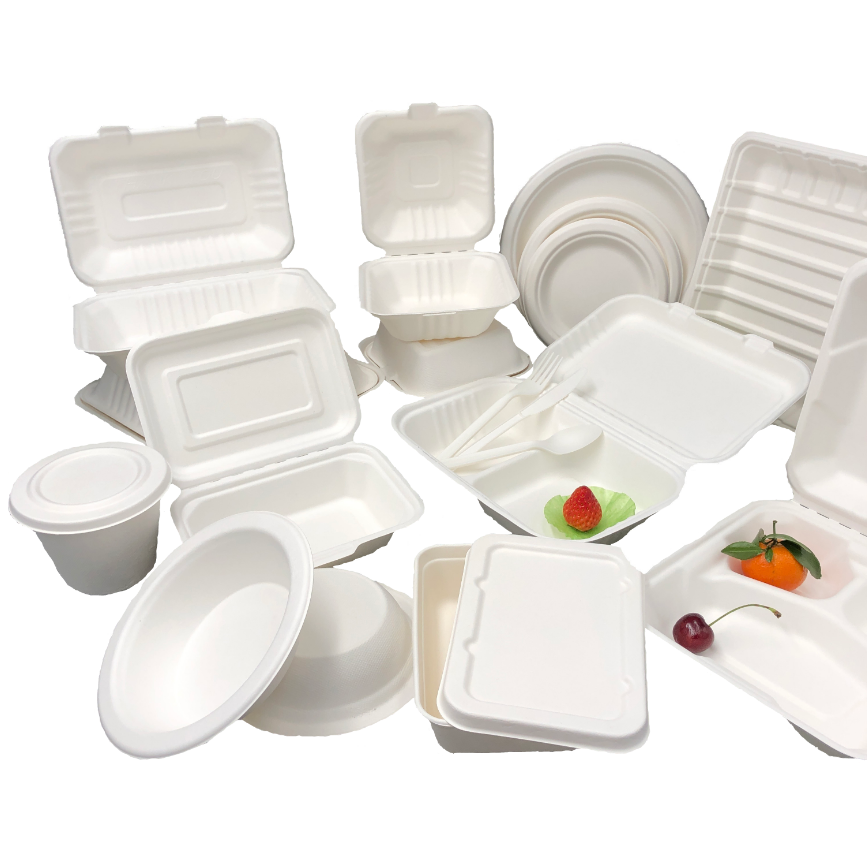
A biodegradable paper plate manufacturer plays a key role in transforming renewable plant fibers into functional disposable tableware used across foodservice, catering, and retail packaging industries. The manufacturing process is not limited to simple paper forming; it involves pulp engineering, high-pressure molding, and controlled drying systems designed to achieve structural strength and compostable performance.
The main raw material used in modern production is sugarcane bagasse, recycled paper pulp, or wood-free plant fiber. Bagasse is widely used because it is a byproduct of sugar extraction and contains long cellulose fibers that improve rigidity and heat resistance. According to industrial processing data, sugarcane fiber plates can tolerate temperatures close to 120°C while maintaining shape stability during hot food contact .
Fiber Preparation and Pulping System
The production begins with fiber selection and pulping. Raw bagasse or recycled pulp is mixed with clean water at controlled ratios, typically 1:10 to 1:15 fiber-to-water dilution depending on target thickness. The mixture is refined through hydraulic pulping equipment to ensure uniform fiber dispersion. This step directly influences surface smoothness and mechanical strength.
Some manufacturers adjust fiber composition by blending 70%–90% sugarcane fiber with additional plant fibers to improve stiffness and edge strength . The slurry is then filtered to remove impurities such as dust, sand, and oversized particles.
Molding and High-Temperature Pressing
Once pulp consistency is stabilized, vacuum forming molds shape the wet fiber into plate geometry. Mold cavities are designed according to product dimensions such as 6-inch, 9-inch, or compartment plates. The forming process uses suction pressure to extract water while retaining fiber structure.
After forming, the wet plates undergo hot pressing at temperatures between 180°C and 220°C. Pressure ranges from 3 to 5 MPa depending on thickness. This step compresses fiber density, improves oil resistance, and enhances structural rigidity. Molded fiber tableware produced under hot pressing shows higher durability compared with standard paper plates due to densified fiber bonding .
Drying and Surface Finishing
Drying systems remove residual moisture using controlled airflow or thermal tunnels. Moisture content is typically reduced below 8% to prevent deformation. Edge trimming ensures uniform shape and stackability for packaging efficiency.
Surface finishing is sometimes enhanced with food-safe additives for water resistance and grease control. These additives are generally below 2% concentration and ensure performance stability during hot oil exposure tests.
Functional Performance Characteristics
Finished biodegradable paper plates are designed for:
Hot food holding up to 120°C
Oil resistance for 30–60 minutes depending on density
Microwave and freezer compatibility
Decomposition within 60–180 days in compost environments
The structural strength is achieved not through plastic coating but through fiber densification and mechanical compression, making the product suitable for both home and commercial foodservice use.
A biodegradable paper plate manufacturer must also maintain strict compliance with food-contact safety standards such as FDA and EN certification systems to ensure global market usability.
Manufacturing Applications
These plates are widely applied in catering services, takeaway packaging, institutional dining, and outdoor events. Demand continues to grow as industries shift away from plastic-based disposables toward compostable alternatives.
The evolution of molded fiber technology demonstrates how agricultural waste can be converted into durable packaging solutions without synthetic materials, aligning production with circular economy principles.

 English
 Arabic
 French
 Spanish
 Portuguese
 Deutsch
 Turkish
 Dutch
Dutch
 Italiano
 Russian
 Portuguese (Brazil)
 Greek
Greek