
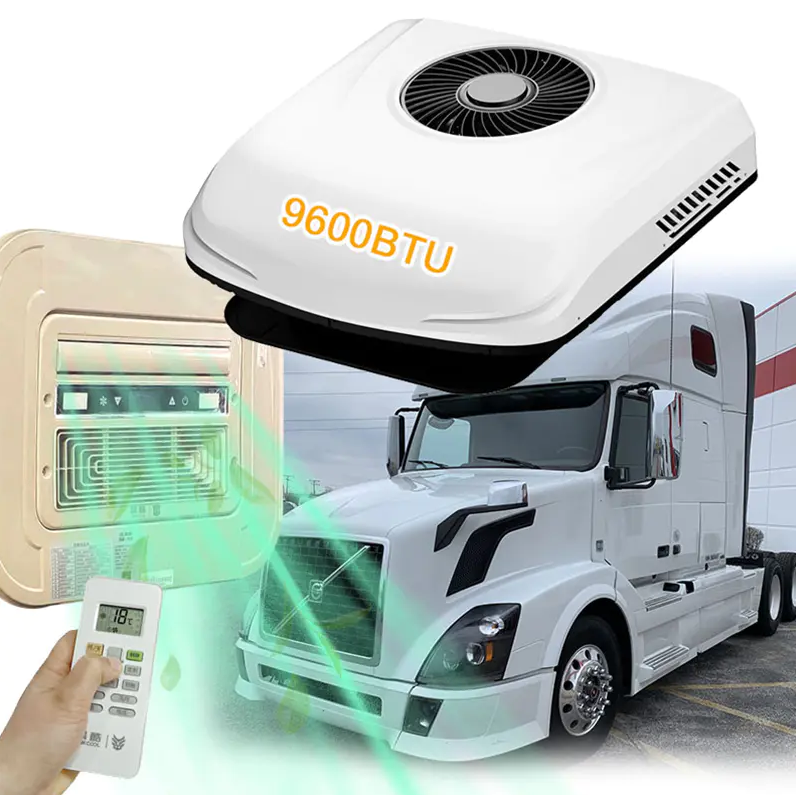
Long-distance freight transport places heavy demands on driver comfort during rest periods. Cabin temperature often rises quickly when engines are off, especially in hot climates or enclosed parking environments. A dedicated cooling solution installed on the roof has become a practical approach for maintaining a stable internal environment without engine idling. The Rooftop Parking Truck Tractor Air Conditioner is designed specifically for this requirement, combining compact installation with independent electric operation.
Modern rooftop systems typically operate on DC 12V or 24V electrical architecture, matching common truck electrical systems. Cooling capacity ranges between 2000W and 3000W for standard cab applications, while heavy-duty configurations may reach around 5000W depending on compressor design. Most units use rotary or scroll compressors paired with high-efficiency condensers to maintain continuous heat exchange during long parking periods.
One of the core technical advantages is low idle power consumption. A typical system may draw approximately 600W to 1000W during steady operation. This allows usage directly from truck batteries or auxiliary lithium battery packs. Many systems integrate low-voltage protection, automatically shutting down when battery voltage drops near 11V–21V depending on configuration, protecting starting capability.
Airflow design also plays a key role. Rooftop evaporators often deliver air volume around 400–600 m³/h, ensuring even distribution inside sleeper cabins. Adjustable vents help direct airflow toward sleeping zones, reducing thermal stratification where hot air accumulates near the roof. Noise levels are usually controlled within 50–60 dB(A), allowing rest without significant disturbance.
Thermal efficiency depends heavily on insulation and external heat load. Metal truck cabins can reach internal temperatures above 50°C when exposed to direct sunlight. With a properly installed system, internal temperature can be stabilized around 22°C–26°C under moderate ambient conditions. The performance is influenced by insulation thickness, door sealing, and cabin volume.
The structure of a Rooftop Parking Truck Tractor Air Conditioner is usually integrated, meaning compressor, condenser, evaporator, and control module are housed in a single rooftop shell. This reduces installation complexity and eliminates long refrigerant piping. Typical dimensions are around 800–1000 mm in length, 700–900 mm in width, and 150–200 mm in height, keeping aerodynamic impact relatively low.
From a mechanical reliability perspective, vibration resistance is important. Truck operation involves continuous road shock, so internal components are mounted with reinforced brackets and rubber damping systems. Refrigerant commonly used includes R134a or R410A depending on environmental design requirements.
Battery management is another critical aspect. A standard 200Ah battery system can support several hours of cooling, while larger lithium battery packs significantly extend runtime. Some configurations estimate 8–10 hours of continuous operation under controlled power draw conditions.
Overall, rooftop-mounted parking cooling systems offer a practical alternative to engine idling. They reduce fuel consumption, minimize engine wear, and provide stable rest conditions. As transport regulations increasingly restrict idle time, these systems continue to gain relevance in long-haul logistics operations.

 Arabic
 French
 Spanish
 Portuguese
 Deutsch
 Turkish
 Dutch
Dutch
 Italiano
 Russian
 Romaian
 Portuguese (Brazil)
 Greek
Greek