
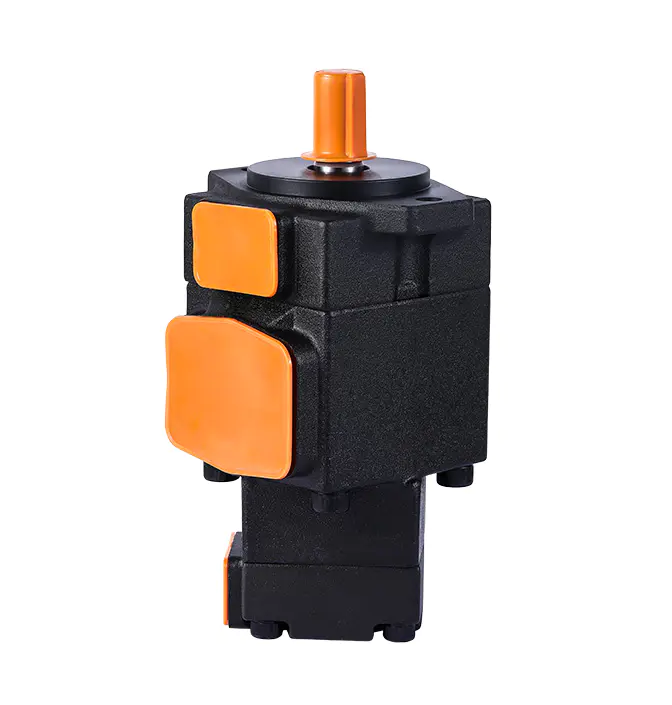
Hydraulic equipment used in manufacturing often operates under demanding conditions where stable pressure and continuous oil delivery are essential. Machine builders and maintenance engineers pay close attention to the pump because it directly affects the performance of the entire hydraulic circuit. A PV2R Series Vane Pump has become a familiar choice in many industrial applications due to its balanced vane structure and steady flow characteristics.
The working principle of a vane pump differs from that of gear and piston pumps. A rotor rotates inside a cam ring while sliding vanes move outward under centrifugal force and hydraulic pressure. Chambers formed between the vanes increase and decrease in volume, drawing hydraulic oil into the inlet and pushing it toward the outlet. This positive displacement action creates a relatively smooth flow with limited pressure fluctuation. General vane pump technology is known for low pulsation and stable output.
Balanced Hydraulic Design
A balanced structure helps reduce radial load on the shaft and bearings. This arrangement supports longer operating cycles and smoother rotation.
Typical technical characteristics of a PV2R Series Vane Pump include:
Rated pressure up to 21 MPa
Operating speed range around 600–1800 rpm
Multiple displacement options
Low flow pulsation
Compact installation dimensions
Available displacements vary according to pump size.
These specifications allow engineers to match pump output with hydraulic cylinder and motor requirements.
Stable Oil Delivery
Pressure variation can create vibration in hydraulic systems. Stable oil delivery helps maintain accurate actuator movement and smoother machine operation.
A PV2R Series Vane Pump produces consistent displacement during each revolution. This characteristic benefits:
Hydraulic presses
Plastic molding equipment
CNC machinery
Material handling systems
Forging equipment
Steady oil flow can improve motion control while reducing unnecessary mechanical shock.
Lower Noise During Operation
Noise reduction has become an important consideration in factory environments. Several factors influence pump sound levels:
Rotor balance
Surface machining quality
Internal leakage control
Vane movement
Hydraulic oil condition
The vane mechanism generates relatively smooth fluid movement compared with some other positive displacement pump designs. Lower pulsation may help reduce vibration transmitted through pipes and machine frames.
Proper oil viscosity also contributes to quieter operation. Hydraulic oils within recommended viscosity ranges help maintain lubrication between moving components.
Flexible Hydraulic Circuit Design
Industrial equipment often requires different flow capacities. Instead of redesigning the entire hydraulic system, engineers can select different displacement versions within the same pump family.
Typical installation configurations include:
Foot mounting
Flange mounting
Various shaft sizes
Multiple port orientations
This flexibility can simplify equipment design and maintenance planning.
Material Selection
The internal components of a PV2R Series Vane Pump are designed to withstand repeated pressure cycles.
Key parts generally include:
Rotor:
High-strength alloy steel with precision machining.
Vanes:
Wear-resistant materials capable of maintaining contact with the cam ring.
Cam Ring:
Heat-treated steel surface to reduce wear.
Bearings:
Support shaft rotation while handling hydraulic loads.
These components work together to maintain dimensional stability during long operating periods.
Hydraulic Fluid Compatibility
Different hydraulic systems require different working fluids.
Common options include:
Mineral hydraulic oil
Anti-wear hydraulic oil
Water glycol fluids
Water-in-oil emulsions
Phosphate ester fluids
Some special fluids may require lower operating speeds. Technical data for the PV2R family indicates that water-containing and phosphate ester fluids may have speed limitations around 1200 rpm.
Industrial Applications
A PV2R Series Vane Pump can be found in many sectors.
Typical applications include:
Plastic machinery:
Stable clamping and injection pressure.
Machine tools:
Hydraulic fixture operation and tool positioning.
Forging equipment:
Reliable hydraulic force transmission.
Rubber processing:
Continuous hydraulic power for production lines.
Construction equipment:
Auxiliary hydraulic functions.
Many industrial hydraulic stations also use vane pumps for centralized oil supply.
Maintenance Considerations
Regular maintenance helps maintain pump performance.
Recommended inspections include:
Oil cleanliness
Filter condition
Shaft seal leakage
Coupling alignment
Operating temperature
Pressure stability
Hydraulic oil contamination remains a common source of vane wear. Clean oil can reduce friction and protect internal surfaces.
Future Demand for Balanced Hydraulic Pumps
Manufacturing facilities continue to pursue stable operation, reduced downtime, and controlled energy consumption. Hydraulic systems still play an important role in heavy-duty industrial equipment, making pump selection an important engineering decision.
A PV2R Series Vane Pump combines balanced hydraulic design, multiple displacement choices, moderate operating pressure, and smooth flow characteristics. Its ability to support different machine types allows equipment designers to adapt hydraulic circuits without major structural changes. With proper installation, clean hydraulic fluid, and scheduled maintenance, this vane pump design can contribute to reliable industrial production across a wide range of applications.

 English
 Arabic
 French
 Spanish
 Portuguese
 Turkish
 Dutch
Dutch
 Italiano
 Russian
 Romaian
 Portuguese (Brazil)
 Greek
Greek