
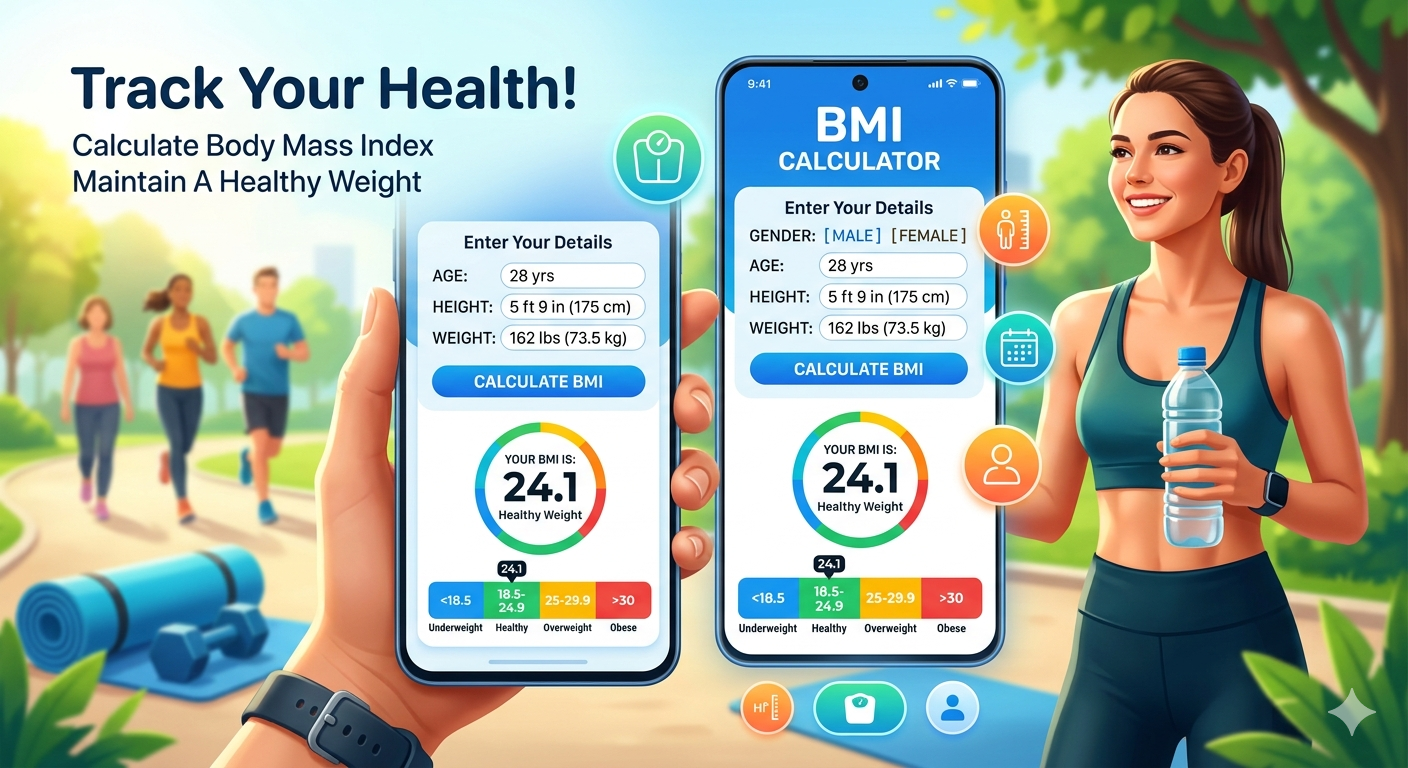
BMI Calculator: Your Complete Guide to Body Mass Index
Whether you are trying to lose weight, maintain your current figure, or simply understand your overall health better, a BMI Calculator is one of the most accessible and widely used tools available today. From doctors' offices to fitness apps, the Body Mass Index has become a standard benchmark for assessing whether a person's weight is in a healthy range relative to their height. In this comprehensive guide, you will learn exactly what BMI is, how the calculator works, how to interpret your results, and the important limitations you should be aware of.
What Is BMI (Body Mass Index)?
Body Mass Index, commonly abbreviated as BMI, is a numerical value derived from a person's weight and height. It was first developed in the 19th century by Belgian mathematician Adolphe Quetelet and has since been adopted globally as a simple screening tool by healthcare professionals, researchers, and public health organizations including the World Health Organization (WHO). BMI does not directly measure body fat, but it provides a reliable indirect estimate that correlates reasonably well with body fat in most adults. Because it requires only two easily measurable values weight and height the BMI calculator has become a practical first-step assessment tool used in billions of routine health checkups worldwide.
How Does a BMI Calculator Work?
A BMI Calculator takes your weight and height as inputs and applies a simple mathematical formula to produce a single number your BMI score. There are two versions of the formula depending on the unit system you use.
Metric Formula (kg & cm): BMI = Weight (kg) divided by Height (m) squared. For example, a person who weighs 70 kg and is 1.75 m tall has a BMI of 70 divided by (1.75 x 1.75) = 22.86.
Imperial Formula (lbs & inches): BMI = [Weight (lbs) divided by Height (inches) squared] x 703. For example, a person who weighs 154 lbs and is 5 ft 9 in (69 inches) tall: BMI = (154 / 69²) x 703 = 22.74. Online BMI calculators perform this calculation instantly, saving you time and ensuring accuracy.
BMI Categories: What Your Score Means
Once your BMI is calculated, it falls into one of the following standard categories defined by the World Health Organization (WHO):
• Below 18.5 Underweight: May indicate malnutrition or other underlying health issues.
• 18.5 to 24.9 Normal / Healthy Weight: Associated with the lowest risk of weight-related health problems.
• 25.0 to 29.9 Overweight: Increased risk of cardiovascular disease and metabolic conditions.
• 30.0 to 34.9 Obese Class I: High risk for Type 2 diabetes, hypertension, and joint problems.
• 35.0 to 39.9 Obese Class II: Very high health risks requiring medical attention.
• 40.0 and above Obese Class III (Morbid Obesity): Extremely high health risks; immediate intervention recommended.
Why Use a BMI Calculator?
There are several compelling reasons to use a BMI calculator as part of your health monitoring routine:
• Quick health screening: BMI calculators provide an instant snapshot of whether your weight may be posing health risks.
• Free and accessible: Most BMI calculators are completely free to use online, with no special equipment required.
• Track progress over time: Monitoring your BMI periodically helps you gauge the effectiveness of diet and exercise changes.
• Doctor consultations: Many healthcare providers use BMI as a starting point for discussions about weight management.
• Fitness planning: Personal trainers and nutritionists use BMI alongside other metrics to customize health plans.
BMI for Different Groups
While BMI is widely used, its interpretation can vary across different population groups. For children and teenagers under 18, standard BMI categories do not apply. Instead, BMI-for-age percentiles are used, comparing a child's BMI against peers of the same age and sex. For older adults over 65, research suggests a slightly higher BMI (around 25 to 27) may actually be associated with lower mortality risk, as some extra weight can protect against bone density loss. Additionally, studies show that people of Asian descent may face higher health risks at lower BMI values, with the WHO suggesting lower cut-off points for these populations for example, a BMI of 23 as the overweight threshold.
Limitations of the BMI Calculator
Despite its widespread use, the BMI calculator has important limitations to keep in mind. It does not measure body fat directly two people with the same BMI can have very different body compositions. A muscular athlete may have a high BMI without carrying excess fat. BMI also ignores fat distribution, which matters greatly since abdominal (visceral) fat carries greater health risks than fat stored in the hips or thighs. Furthermore, it does not account for bone density, and different standards apply to children and the elderly. Because of these limitations, healthcare professionals often use BMI alongside other assessments such as waist-to-hip ratio and skinfold measurements for a more complete picture of health.
How to Improve Your BMI
If your BMI falls outside the healthy range, there are practical steps you can take:
• Adopt a balanced diet: Focus on whole foods, lean proteins, vegetables, fruits, and whole grains while reducing processed foods and added sugars.
• Increase physical activity: Aim for at least 150 minutes of moderate aerobic exercise per week, combined with strength training.
• Stay hydrated: Drinking adequate water supports metabolism and helps manage appetite.
• Get quality sleep: Poor sleep is linked to weight gain and difficulty maintaining a healthy BMI.
• Manage stress: Chronic stress elevates cortisol, which promotes fat storage especially around the abdomen.
• Consult a professional: A registered dietitian or physician can provide personalized guidance tailored to your goals.
Read More : Bottleneck calculator
Conclusion
A BMI Calculator is a powerful yet simple tool that gives you an immediate insight into whether your weight is within a healthy range. While it has well documented limitations, it remains one of the most widely used and globally recognized health screening metrics. By understanding your BMI, interpreting it correctly, and taking informed action, you put yourself firmly in control of your long term health. Use the BMI calculator as a starting point, combine it with professional medical advice, and take consistent steps toward a healthier, more vibrant life.
Frequently Asked Questions (FAQs)
What is a normal BMI for adults?
A normal or healthy BMI for adults is between 18.5 and 24.9. Values below 18.5 indicate underweight, 25 to 29.9 is considered overweight, and 30 or above falls into the obese category according to WHO standards.
Is BMI accurate for everyone?
BMI is a useful screening tool but has limitations. It may overestimate body fat in muscular individuals and underestimate it in those who have lost muscle mass. It should be used alongside other measurements for a more accurate health assessment.
How often should I check my BMI?
For most adults, checking your BMI every 3 to 6 months is sufficient to track trends over time. If you are actively working on weight management, monthly checks can help you stay motivated and assess progress.
Can a high BMI cause health problems?
Yes. A BMI in the overweight or obese range is associated with an increased risk of Type 2 diabetes, heart disease, high blood pressure, stroke, sleep apnea, certain cancers, and joint problems. However, BMI alone is not a diagnosis consult your doctor for a full health assessment.
Is BMI the same for men and women?
The BMI formula and categories are the same for both men and women. However, women naturally carry a higher percentage of body fat than men at the same BMI, which is why some experts advocate for gender-specific adjustments in clinical assessments.
What is a healthy BMI for children?
Children's BMI is assessed using age and sex specific percentile charts. A healthy BMI falls between the 5th and 85th percentile for a child's age and sex. Parents should consult a pediatrician for proper interpretation.
Can I lose weight just by monitoring my BMI?
Monitoring your BMI is a helpful motivational tool, but weight loss requires sustained lifestyle changes including a calorie controlled diet and regular physical activity. BMI tracking shows your direction, but the journey requires real effort and often professional guidance.

 English
 Arabic
 Spanish
 Portuguese
 Deutsch
 Turkish
 Dutch
Dutch
 Italiano
 Russian
 Romaian
 Portuguese (Brazil)
 Greek
Greek