
Introduction
Every winter, millions of students go to bed hoping to wake up to a snow day. Parents plan their mornings around school schedules, and teachers prepare lessons that may never be taught. The big question on everyone's mind is always the same: will school be canceled tomorrow?
That question has sparked a whole category of tools, websites, and apps designed to answer it. But with so many options available, it is natural to wonder what is the most accurate snow day predictor you can actually trust.
In this guide, we break down how snow day predictors work, which ones are the most reliable, and what factors schools use when deciding to close. Whether you are a student crossing your fingers or a parent trying to plan ahead, this article has everything you need.
How Snow Day Predictors Work
Snow day predictors are tools, usually online or app-based, that combine weather data with local school policies to estimate the likelihood of a school cancellation. They do not simply look at snowfall totals. The best predictors take multiple factors into account to give you a percentage-based probability of a snow day.
Key Inputs Used by Snow Day Predictors
Most accurate snow day predictor pull from several data sources, including:
- Local weather forecasts: Temperature, snowfall amounts, wind speed, and timing of the storm
- Historical data: How often a specific school district has canceled school under similar conditions
- Geographic location: Rural schools often close more easily than urban ones due to road conditions
- School district policies: Some districts have stricter thresholds than others
- Day of the week: Schools are more likely to cancel on Fridays or before holidays
The combination of these factors is what separates a truly accurate predictor from a simple weather app.
The Most Accurate Snow Day Predictors Available Today
1. Snow Day Calculator (snowdaycalculator.com)
The Snow Day Calculator is one of the most popular and well-known tools for predicting school closures. It was created by David Sukhin when he was a student, and it has grown into a widely used resource across the United States and Canada.
How it works:
You enter your ZIP code or city, select your school type (public or private), and the tool gives you a percentage chance of a snow day. It uses National Weather Service data combined with a proprietary algorithm that accounts for local conditions.
Why it is trusted:
- It updates predictions in real time as weather forecasts change
- It uses historical cancellation data for your area
- It has been featured in major media outlets as a reliable resource
Accuracy rating: Generally considered one of the more accurate free tools available, though no predictor is perfect.
2. Weather.gov (National Weather Service)
While not a dedicated snow day predictor, the National Weather Service (NWS) is the gold standard for raw weather data in the United States. School administrators, transportation departments, and emergency officials all rely on NWS forecasts when making closure decisions.
What to look for on weather.gov:
- Winter Storm Warnings vs. Winter Storm Watches
- Snowfall accumulation forecasts
- Wind chill advisories
- Timing of precipitation (overnight vs. morning rush hour)
If the NWS issues a Winter Storm Warning for your area overnight, that is a strong signal that school delays or closures are likely.
3. Local News Station Weather Apps
Your local TV news station likely has its own weather app, and these are often highly accurate for hyperlocal conditions. Local meteorologists know the geography of your area, including which roads ice over first, which valleys get the most snow, and how storms move through your region.
Best practice: Follow two or three local meteorologists on social media. They often post school-related weather alerts before official announcements go out.
4. Closings and Cancellations Websites
Sites like schoolclosings.com, closings.com, and local television station closing pages aggregate official school closure announcements as soon as they are made. While these do not predict closures ahead of time, they are the most accurate source once a decision has been made.
Check your snow day chances now: Snow Day Predictor
Tip: Many of these sites allow you to set up alerts for specific school districts, so you get notified the moment a closure is posted.
5. School District Websites and Apps
The most accurate source of all is your own school district. Most districts now have dedicated apps, robocall systems, text alert systems, and social media accounts that push notifications directly to parents and students.
Sign up for your district's communication system at the start of every school year. When a snow day is called, you will be among the first to know.
What Factors Schools Actually Consider
Understanding what administrators look at can help you predict snow days on your own. Here are the most common factors school officials weigh:
Road and Bus Safety
Transportation is the number one concern. School buses travel on rural routes where conditions can be far worse than in town. If roads are icy, plowed improperly, or visibility is dangerously low, districts prioritize student safety over attendance.
Timing of the Storm
A snowstorm that hits at 2 AM and ends by 5 AM gives plows time to clear roads before buses run. A storm that hits at 6 AM is far more likely to result in a delay or cancellation. Timing matters enormously.
Temperature and Wind Chill
Even without snow, extreme cold can cause school closures. Many districts have policies about canceling school when wind chill temperatures fall below a certain threshold, often around -20 degrees Fahrenheit, to protect students who wait outside for buses.
Power Outages and Building Conditions
If the school building itself loses power or the heating system fails, classes cannot safely proceed regardless of weather conditions.
Neighboring District Decisions
School administrators often communicate with neighboring districts. If the surrounding areas are closing, it adds social and logistical pressure to follow suit.
Tips for Using Snow Day Predictors Effectively
Getting the most out of any snow day prediction tool requires a little strategy. Here are some practical tips:
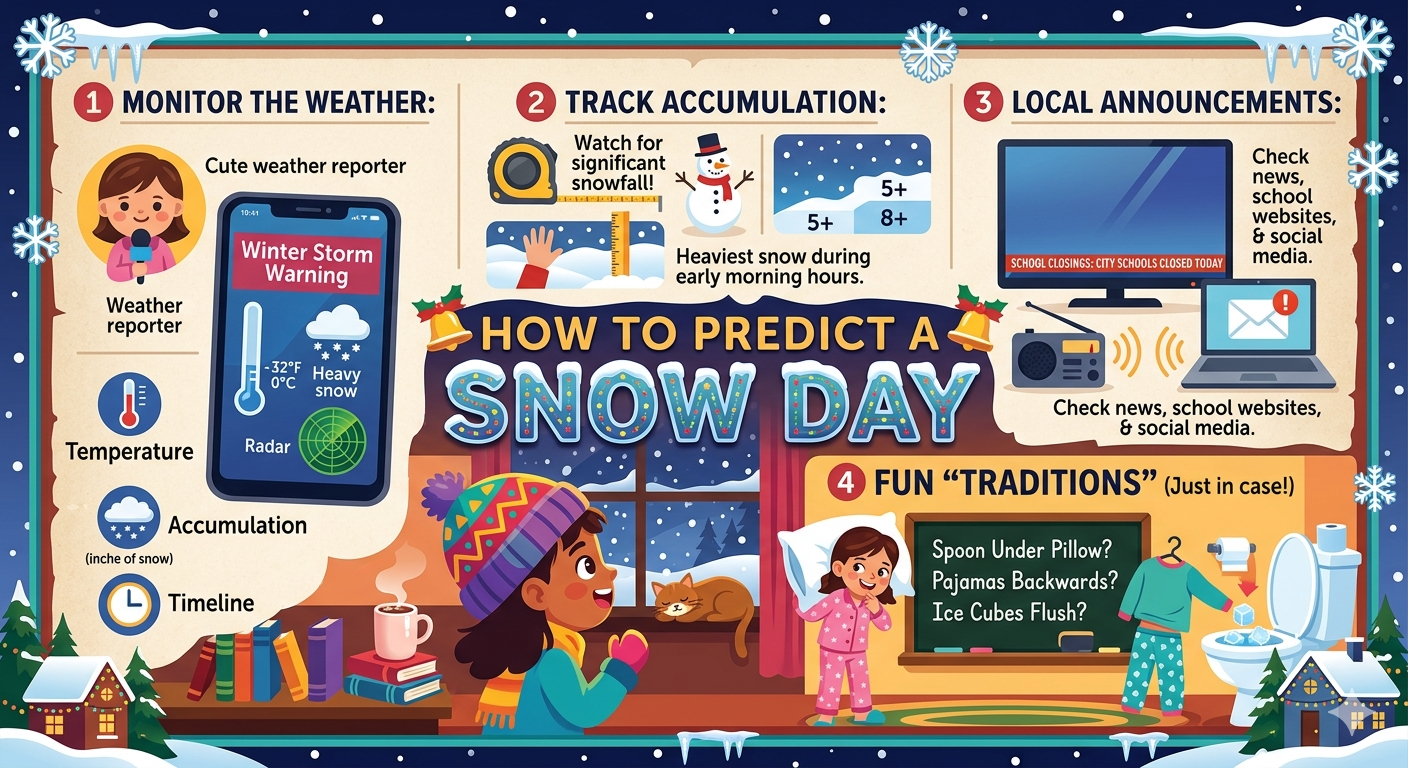
- Check the forecast the evening before, not the morning of. Most closure decisions are made by 5 AM or 6 AM. By then, the storm is already unfolding. Checking forecasts the night before gives you more lead time.
- Use multiple tools. No single predictor is always right. Compare the Snow Day Calculator with your local weather app and NWS forecast for a fuller picture.
- Pay attention to storm timing. A forecast of 6 inches of snow means very different things depending on whether it falls at midnight or at 7 AM.
- Monitor your district's social media. Many superintendents and principals post updates directly to Facebook or X (formerly Twitter) before the automated phone calls go out.
- Set up text alerts. Almost every major school district now offers text or email alerts. This is the single most reliable way to find out about a snow day quickly.
Common Mistakes People Make When Predicting Snow Days
Even with the best tools, people often misread the signs. Here are a few common errors to avoid:
- Relying only on total snowfall predictions. Six inches of light, fluffy snow is very different from six inches of wet, heavy snow. Ice is often more disruptive than snow.
- Ignoring wind chill. Cold temperatures without snow can still close schools.
- Assuming urban schools close as easily as rural ones. City schools often stay open longer because roads are plowed and salted more quickly.
- Checking predictions too early. Forecasts 48 to 72 hours out carry much more uncertainty than forecasts 12 to 24 hours out.
FAQ: What Is the Most Accurate Snow Day Predictor?
Q1: Is the Snow Day Calculator accurate?
The Snow Day Calculator is one of the most widely used tools for this purpose and is generally considered reliable. It uses real-time weather data and local historical patterns to generate percentage probabilities. However, no tool can guarantee accuracy because final decisions rest with school administrators who consider many local factors.
Q2: What percentage on a snow day predictor means school will be canceled?
There is no universal threshold, but most users treat a prediction of 70% or higher as a strong sign that a snow day is likely. A prediction below 30% suggests school will likely remain open. The range in between is uncertain territory where local conditions and district policies play a decisive role.
Q3: Can I use a snow day predictor for school districts outside the United States?
The Snow Day Calculator supports some Canadian locations, but most tools are designed primarily for the United States. International users may find local weather authority websites, such as Environment Canada or the UK Met Office, more helpful for predicting school closures in their regions.
Q4: How early do schools decide to cancel for a snow day?
Most school administrators make the decision between 4 AM and 6 AM on the morning in question. Some may decide the night before if a major storm is certain and well-forecasted. The earlier the decision is made, the more time families have to arrange childcare or adjust plans.
Q5: Do snow day predictors work for college campuses?
Snow day predictors like the Snow Day Calculator do have options for colleges and universities. However, colleges are generally less likely to cancel classes than K-12 schools. When they do, announcements are made through campus alert systems, official websites, and student email rather than general closing databases.
Conclusion
So, what is the most accurate snow day predictor? The honest answer is that no single tool is perfectly accurate every time. The most reliable approach is to combine multiple sources: the Snow Day Calculator for a probability estimate, the National Weather Service for raw forecast data, local meteorologists for regional expertise, and your school district's official channels for confirmed announcements.
Understanding what schools look at when making closure decisions, such as road safety, storm timing, and temperature, puts you in a much better position to make your own informed prediction. And setting up official alerts from your school district is the single best thing you can do to stay informed in real time.
Winter weather is unpredictable by nature. But with the right tools and a little knowledge, you can make a much more educated guess about whether tomorrow is a snow day.

 English
 Arabic
 French
 Portuguese
 Deutsch
 Turkish
 Dutch
Dutch
 Italiano
 Russian
 Romaian
 Portuguese (Brazil)
 Greek
Greek