
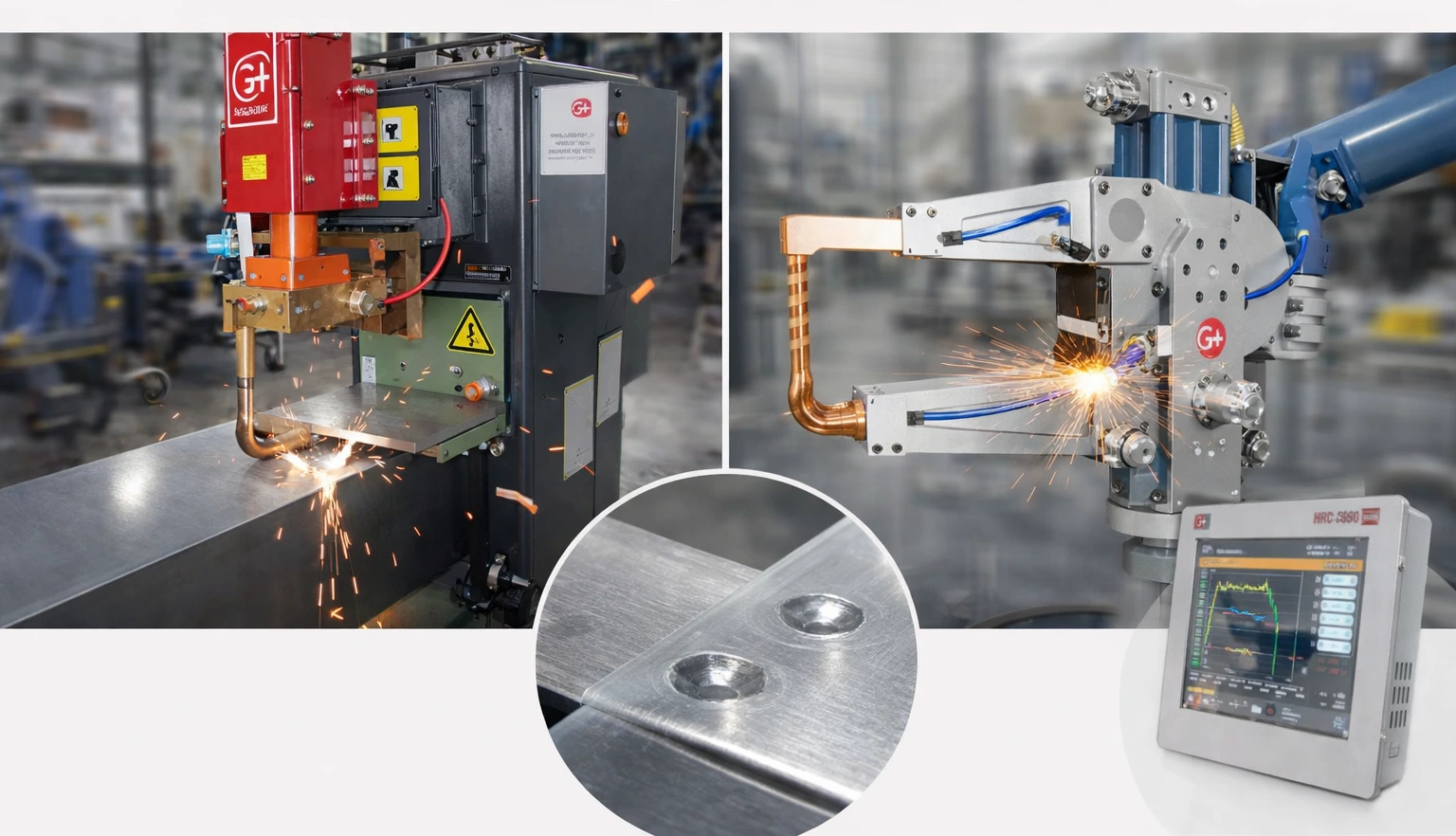
In modern manufacturing, high-speed, repeatable, and strong metal joining is essential for mass production. Among all resistance welding technologies, the spot resistance welder stands out as one of the most widely used and reliable solutions for joining sheet metals in automotive, appliance, aerospace, and electrical industries.
At Heron Welder, advanced resistance welding systems are engineered to deliver precision, stability, and automation-ready performance for demanding production environments.
What is a Spot Resistance Welder?
A spot resistance welder is a type of resistance welding machine that joins two or more overlapping metal sheets by applying pressure and high electrical current through copper electrodes at a specific point (spot).
The heat generated at the contact interface melts the metal locally, forming a solid “weld nugget” once cooled and solidified.
The entire process is extremely fast often completed in milliseconds making it ideal for high-volume industrial production lines.
Working Principle of Spot Resistance Welding
The process is based on Joule heating (I²R principle), where:
- I = current
- R = resistance at the contact point
- t = time
When high current passes through the metal sheets, resistance at the interface generates heat, creating localized melting.
Step-by-step process:
1. Clamping Stage
Two copper electrodes press the metal sheets together under controlled force.
2. Current Application
A high-amperage current flows through the electrodes into the workpiece.
3. Heat Generation
Resistance at the interface produces intense heat, melting a small area.
4. Nugget Formation
The molten metal fuses and forms a weld nugget.
5. Cooling Under Pressure
Current stops, but pressure remains to solidify the weld and ensure strength.
This cycle can be repeated hundreds of times per minute in automated systems.
Key Components of a Spot Resistance Welder
A modern industrial spot welder typically includes:
- Welding transformer (AC or MFDC)
- Copper alloy electrodes
- Pneumatic or servo force system
- Welding controller (timing & current control)
- Cooling system (water-cooled electrodes)
- Machine frame or robotic arm integration
Advanced systems from manufacturers like Heron Welder integrate MFDC technology and automation controls for higher efficiency and energy savings.
Industrial Applications of Spot Resistance Welding
Spot welding is widely used wherever thin metal sheets require fast and reliable joining.
Automotive Manufacturing
- Car body panels
- Doors, roofs, and chassis assemblies
- EV battery packs
Home Appliances
- Refrigerators
- Washing machines
- Air conditioner housings
Electronics & Electrical Industry
- Battery tabs
- Busbars and connectors
- Control cabinets
Aerospace & Rail
- Lightweight structural assemblies
- Cabin panels and enclosures
Metal Fabrication & OEM Production
- Sheet metal enclosures
- Industrial cabinets
- HVAC components
As noted in industrial studies, automotive production alone may use thousands of spot welds per vehicle body, showing its critical role in mass production systems.
Advantages of Spot Resistance Welders
Spot resistance welding remains a preferred joining method because it offers:
1. High Production Speed
Weld cycles take milliseconds, enabling mass manufacturing.
2. No Filler Materials Required
No need for electrodes, rods, or additional consumables.
3. Automation Compatibility
Easily integrated into robotic arms and production lines.
4. Clean and Precise Welds
Minimal distortion and localized heat-affected zone.
5. Cost Efficiency
Reduced labor, consumables, and post-processing costs.
Limitations to Consider
Despite its advantages, spot resistance welding has certain constraints:
- Best suited for thin sheet metals
- Requires precise control of pressure, current, and timing
- Surface cleanliness is critical (oxides or coatings affect weld quality)
- Not ideal for thick or irregular geometries
This is why advanced process control systems are essential in industrial environments.
Best Practices for High-Quality Spot Welding
To achieve consistent weld quality in production:
- Maintain correct electrode force
- Ensure clean and oxide-free surfaces
- Optimize current and weld time settings
- Use water-cooled electrodes for stability
- Regularly dress or replace electrode tips
- Implement real-time monitoring systems
Modern MFDC-based systems, such as those developed by Heron Welder, improve consistency by stabilizing current delivery and reducing energy fluctuation.
Spot Resistance Welding vs Other Welding Methods
Compared to MIG, TIG, or laser welding:
- Faster cycle times for mass production
- Lower operating complexity
- More suitable for automated sheet metal joining
- Lower energy consumption per weld point
However, arc welding methods may still be preferred for thicker or structural components.
Why Industries Choose Heron Spot Resistance Welding Systems
Heron Welder focuses on industrial-grade resistance welding automation, offering:
- MFDC spot welding machines
- Projection and seam welding systems
- Fully automated welding production lines
- Custom-engineered welding guns and controllers
- Integration-ready solutions for OEM factories
With a strong focus on reliability and repeatability, Heron systems are designed for 24/7 industrial manufacturing environments where precision cannot be compromised.
Frequently Asked Questions (FAQs)
1. What materials can a spot resistance welder join?
It is commonly used for steel, stainless steel, aluminum alloys, and coated sheet metals, depending on machine power and electrode design.
2. Is spot welding strong enough for automotive use?
Yes, it is widely used in automotive manufacturing for structural sheet metal joints and safety-critical assemblies.
3. What is the main difference between spot welding and seam welding?
Spot welding creates individual weld points, while seam welding produces continuous welds along a joint.
4. Can spot welding be automated?
Yes, it is one of the most automation-friendly welding processes and is commonly used in robotic production lines.
5. What industries use spot resistance welding the most?
Automotive, appliance manufacturing, electronics, HVAC, aerospace, and metal fabrication industries.
Conclusion
The spot resistance welder remains a cornerstone of modern manufacturing due to its speed, simplicity, and automation compatibility. From automotive body production to precision electronic assemblies, it continues to enable scalable and cost-effective metal joining solutions.
As production demands grow, advanced technologies like MFDC control, robotic integration, and intelligent monitoring are redefining the efficiency of spot welding systems.
Request a Custom Solution from Heron Welder
At Heron Welder, we specialize in designing and manufacturing advanced resistance welding systems tailored for industrial production needs. Whether you require spot welding machines, automated welding lines, or custom joining solutions, our engineering team can support your project from concept to deployment.
Contact Heron Welder today to request a quote or discuss your customized welding automation solution.

 English
 Arabic
 French
 Spanish
 Portuguese
 Deutsch
 Turkish
 Dutch
Dutch
 Russian
 Romaian
 Portuguese (Brazil)
 Greek
Greek