
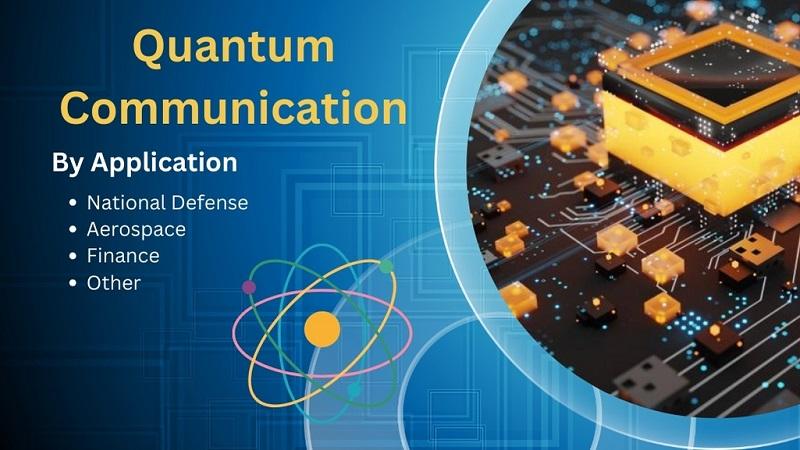
The Quantum Communication Market is growing as governments and critical industries invest in next-generation security and resilience. Quantum key distribution is a primary driver, offering a physics-based approach to secure key exchange for high-value links. National security strategies and public funding programs accelerate market development through research, pilot networks, and procurement. Financial institutions and data center operators also explore QKD to protect sensitive transactions and interconnects, especially where long-term confidentiality is important. The market includes QKD hardware, quantum network components, secure key management integration, and professional services for deployment and testing. Growth is also supported by rising awareness of future cryptographic risk from quantum computing, though timelines remain uncertain. Importantly, market growth is not only about technology; it includes ecosystem building—standards, interoperability, and trusted supply chains. Early deployments focus on metropolitan fiber networks and controlled environments where stability and physical security can be ensured. As pilots demonstrate operational feasibility, market adoption may broaden in targeted segments.
Key market drivers include critical infrastructure protection and regulatory pressure for stronger security. Organizations that manage sensitive data and national systems want defense-in-depth and long-term confidentiality. QKD is attractive for certain backbone links because it can detect eavesdropping attempts on key exchange. Another driver is the rise of data center interconnect needs, where high-volume traffic between facilities requires robust encryption and key management. Some markets also explore free-space QKD and satellite-based links to extend distance beyond fiber limitations. However, most near-term market activity is in fiber-based metropolitan networks. Procurement is often influenced by government funding and strategic technology programs, which can accelerate vendor development and deployment references. The market also includes component suppliers—single-photon detectors, photon sources—and system integrators who assemble solutions. Operational services are significant because quantum systems require calibration and monitoring. Buyers increasingly evaluate not only theoretical security but also operational practicality: key rate stability, uptime, and integration with existing encryption infrastructure. These practical requirements shape which vendors win contracts and how quickly projects move from labs to production.
Competition spans specialized quantum technology firms, telecom equipment vendors expanding into QKD, research spin-offs, and systems integrators. Differentiation often comes from key generation rates, distance performance, stability, and ease of integration with enterprise key management. Buyers also evaluate security assurance, including certification and mitigation of implementation-level vulnerabilities. Standards and interoperability are emerging competitive factors, as governments and operators want multi-vendor networks over time. Deployment models influence buying: point-to-point QKD links, trusted-node networks, and future quantum repeater concepts. Many projects require fiber leasing, physical security planning, and operational governance, increasing the importance of integration partners. Pricing is a barrier for broader adoption, so vendors compete on total cost of ownership and maintenance requirements. Some providers offer managed QKD services bundled with telecom connectivity, which can reduce customer complexity. However, trust and sovereignty concerns may require local hosting and domestic supply chain options in some regions. Therefore, market competition is shaped by both technical performance and geopolitical procurement constraints.
Market outlook suggests gradual expansion with continued concentration in high-security sectors. Wider adoption depends on cost reduction, better interoperability, and clearer operational playbooks. Post-quantum cryptography deployment will occur in parallel, and many organizations may prioritize PQC broadly while using quantum communication selectively for the highest-risk links. Satellite QKD and free-space experiments may expand, but commercialization will require stable operations and regulatory alignment. Standards development and certification programs may increase buyer confidence. The market will also benefit from better integration with existing encryption systems, making QKD easier to adopt without redesigning networks. Over time, quantum communication may become part of national secure network infrastructure, especially where long-term confidentiality is critical. Vendors that can demonstrate reliable performance, secure implementation, and manageable operations will capture market growth as quantum communication moves from pilots to targeted production deployments.
Top Trending Reports:
Virtual Meeting Software Market

 English
 Arabic
 French
 Spanish
 Portuguese
 Deutsch
 Dutch
Dutch
 Italiano
 Russian
 Romaian
 Portuguese (Brazil)
 Greek
Greek