
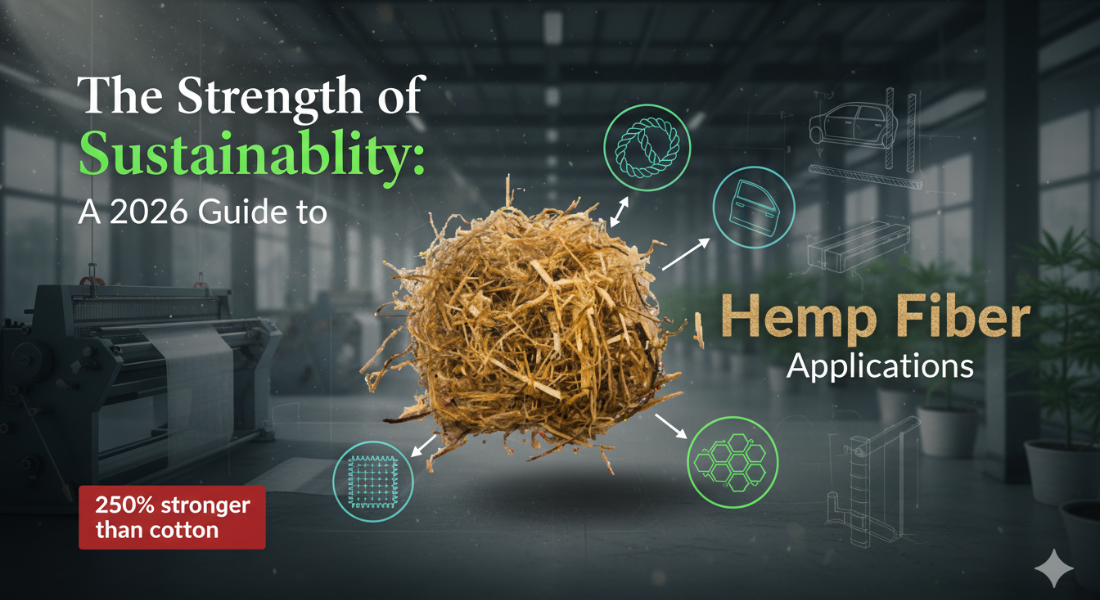
The Fiber of the Future: Why Hemp is Revolutionizing American Industry
In 2026, the global push toward a circular economy has transformed raw material sourcing from a logistical afterthought into a core competitive advantage. At the heart of this shift is hemp fiber, a high-performance, carbon-sequestering powerhouse that is rapidly replacing synthetic and resource-heavy alternatives. As industries from automotive to high-fashion seek to meet aggressive ESG (Environmental, Social, and Governance) goals, hemp has moved from a niche crop to an industrial essential.
At Dakota Hemp, we provide the high-tensile, clean-processed fiber required to fuel this revolution. Grown in the nutrient-rich soils of the American heartland, our hemp represents a "Made in the USA" commitment to quality, resilience, and environmental stewardship.
Unlocking the Potential: Diverse Hemp Fiber Uses
The versatility of the hemp plant is its greatest strength. While the woody inner core (the hurd) is famous for its absorbency, the long, outer "bast" fibers are prized for their extraordinary tensile strength—comparable to glass fiber but with a significantly lower carbon footprint. In 2026, hemp fiber uses have expanded into sectors once dominated by plastics and heavy pollutants.
1. The New Era of Hemp Fiber Textiles
The fashion industry is undergoing a massive transformation. Modern consumers, particularly Millennials and Gen Z, are increasingly rejecting "fast fashion" in favor of durable, biodegradable materials. Hemp fiber textiles are leading this charge because they are:
-
Naturally Antimicrobial: Resisting odors and bacteria without chemical treatments.
-
UV Resistant: Protecting the wearer while maintaining the structural integrity of the garment.
-
Highly Breathable: Keeping users cool in the summer and warm in the winter.
2. Hemp Fiber Composite Materials in Automotive & Aerospace
In 2026, weight reduction is the key to extending the range of Electric Vehicles (EVs). Major automakers like BMW and Mercedes-Benz have integrated hemp fiber composite materials into door panels, dashboards, and seatbacks. These biocomposites can reduce vehicle weight by up to 25% compared to traditional plastics, all while offering superior impact resistance and recyclability.
3. Sustainable Construction and Infrastructure
While hempcrete utilizes the hurd for insulation, the bast fiber is increasingly used as a reinforcement in "hemp-mortars" and non-woven geotextiles. These materials prevent soil erosion and provide a biodegradable solution for civil engineering projects that traditionally relied on petroleum-based meshes.
The Strategic Advantage: Why Buy Hemp Fiber USA?
In the current industrial hemp market, supply chain reliability is just as important as the material itself. Relying on international shipments often leads to "supply chain nightmares"—long lead times, high carbon emissions from shipping, and inconsistent quality control.
When you buy hemp fiber USA from Dakota Hemp, you are tapping into a localized, transparent supply chain. Our 2026 technology ensures that every bale is processed with precision decortication, separating the bast fiber from the hurd with minimal damage. This preserves the fiber’s natural length and strength, making it ideal for high-performance industrial applications.
Securing Your Hemp Fiber Bulk Supply
For manufacturers, the ability to scale is non-negotiable. Dakota Hemp specializes in hemp fiber bulk orders, providing the consistent volume needed for large-scale production runs. By sourcing in bulk, businesses can:
-
Lower Unit Costs: Achieving better margins on sustainable product lines.
-
Ensure Uniformity: Reducing variability in composite manufacturing.
-
Support American Farmers: Every acre of Dakota Hemp supports the revitalization of the American heartland.
Conclusion: A Multi-Industrial Solution
As we look toward the 2030s, the reliance on fossil-fuel-based fibers is becoming a liability. The shift toward natural, regenerative materials is not just a trend—it is the new standard of excellence. Whether you are developing the next generation of eco-friendly apparel or engineering lightweight components for the aerospace industry, the diverse range of industrial hemp uses provides a solution that is as robust as it is responsible.
At Dakota Hemp, we invite you to explore our premium fiber offerings. Let us help you transition your supply chain into a carbon-negative force for good. Experience the strength, the quality, and the reliability of American-grown hemp.
Frequently Asked Questions
What is the difference between bast fiber and tow?
Bast fiber refers to the long, high-quality outer fibers used for high-end hemp fiber textiles. "Tow" consists of shorter, tangled fibers often used for rope, paper, or as a reinforcement in hemp fiber composite materials.
How does hemp fiber compare to cotton?
Hemp is significantly more sustainable, requiring about half the land and far less water than cotton to produce the same amount of fiber. Additionally, hemp is much stronger and more durable over time.
Can hemp fiber be used in 3D printing?
Yes! In 2026, hemp-reinforced filaments are a popular choice for 3D printing. The fiber adds strength and heat resistance to the printed parts while remaining biodegradable.
Is your hemp fiber chemically processed?
No. At Dakota Hemp, we use mechanical decortication to separate our fibers. This ensures that the natural properties of the plant remain intact without the use of harsh chemical baths.
Where can I find bulk pricing for industrial projects?
You can contact Dakota Hemp directly through our website to request a quote for hemp fiber bulk shipments. We offer logistics support to deliver directly to your manufacturing facility.

 Arabic
 French
 Spanish
 Portuguese
 Deutsch
 Turkish
 Dutch
Dutch
 Italiano
 Russian
 Romaian
 Portuguese (Brazil)
 Greek
Greek