
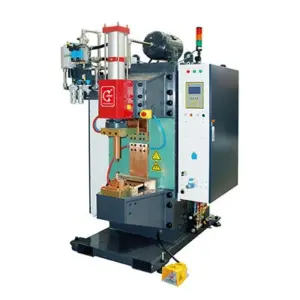
In today’s competitive manufacturing landscape, achieving high-quality, repeatable, and efficient metal joining is critical. Resistance spot welding (RSW) has emerged as a cornerstone technology for industries ranging from automotive to appliance manufacturing, offering speed, consistency, and cost-effective production. As a global leader in industrial welding solutions, Heron Welder provides advanced resistance spot welding machines, automation solutions, and technical expertise to empower manufacturers and OEMs worldwide.
What is Resistance Spot Welding?
Resistance spot welding is a metal joining process that uses electrical resistance and pressure to create localized welds between two or more metal sheets. The process involves passing a high electric current through metal surfaces held together under force by copper alloy electrodes. The resistance to the electrical flow generates heat, causing the metal to melt and form a strong weld nugget at the contact point.
Unlike traditional arc welding, RSW is fast, precise, and produces minimal distortion, making it ideal for thin sheet metals and high-volume production environments.
How Resistance Spot Welding Works
The fundamental principles of resistance spot welding include:
-
Clamping – Copper electrodes grip the metal sheets tightly to ensure proper current flow and contact pressure.
-
Current Flow – A controlled electric current passes through the electrodes, generating heat at the interface due to electrical resistance.
-
Heat Generation – The heat melts the metal locally, forming a weld nugget without affecting surrounding areas.
-
Cooling & Solidification – After the current stops, the weld nugget cools under pressure, creating a strong metallurgical bond.
Heron’s MFDC (Medium-Frequency Direct Current) and capacitor discharge spot welders allow precise control over current, pulse duration, and force, ensuring consistent weld quality for even the most challenging applications.
Applications of Resistance Spot Welding
Resistance spot welding is widely used across industries that require high-speed, repeatable metal joining. Typical applications include:
-
Automotive Manufacturing: Body panels, chassis assemblies, and battery packs in electric vehicles.
-
Appliance Production: Washing machines, refrigerators, and HVAC units requiring consistent and aesthetic welds.
-
Aerospace Components: Sheet metal assemblies where precision and structural integrity are critical.
-
Electrical Equipment: Enclosures, transformers, and metal frames needing reliable joints.
Heron’s automated spot welding solutions can integrate with robotic arms and conveyor systems, enabling manufacturers to increase throughput while maintaining safety and quality standards.
Advantages Over Other Welding Methods
Compared to other welding techniques, resistance spot welding offers several advantages:
| Feature | Resistance Spot Welding | MIG/TIG Welding |
|---|---|---|
| Speed | Extremely fast | Slower, manual process |
| Automation | Fully automatable | Requires skilled operator |
| Heat Affected Zone | Minimal distortion | Larger HAZ, more warping |
| Material Thickness | Ideal for thin sheets | Can handle thick metals but slower |
| Repeatability | High, consistent quality | Operator-dependent |
These advantages make RSW particularly suitable for OEMs, high-volume factories, and automation integrators looking for efficient and reliable metal-joining solutions.
Best Practices for Resistance Spot Welding
To achieve consistent weld quality, manufacturers should follow these best practices:
-
Electrode Maintenance: Regularly clean and dress copper electrodes to prevent contamination and improve weld consistency.
-
Proper Force and Current Settings: Adjust electrode force and current based on sheet thickness, material type, and desired nugget size.
-
Material Preparation: Ensure surfaces are free from oxides, coatings, or debris that can affect current flow and heat generation.
-
Weld Scheduling: Implement automated welding schedules for uniform pulse duration and cooling cycles.
-
Monitoring & Quality Control: Use integrated sensors and monitoring systems, like those offered by Heron, to detect anomalies and prevent defects.
Why Choose Heron for Resistance Spot Welding Solutions
Heron Welder is not just a manufacturer of resistance spot welding machines; we are a partner in modern manufacturing innovation. Our solutions provide:
-
Customizable Automation: From standalone machines to fully automated welding cells, designed to meet specific production needs.
-
Advanced Control Systems: MFDC and capacitor discharge controllers for precise weld parameters.
-
Global Support: Expert installation, training, and after-sales service for manufacturers worldwide.
-
Integration with Manufacturing Lines: Seamless compatibility with robotic arms, conveyor systems, and production monitoring software.
By partnering with Heron, factories gain access to state-of-the-art welding technology that improves efficiency, quality, and ROI.
Frequently Asked Questions (FAQs)
1. Can resistance spot welding join different metals?
Yes, RSW is most effective on similar metals such as steel-to-steel or aluminum-to-aluminum, but special techniques and controls are needed for dissimilar metals.
2. What thickness of metal is suitable for spot welding?
RSW is ideal for thin to medium gauge sheet metals, typically ranging from 0.5 mm to 6 mm, depending on material and machine capabilities.
3. How long does a spot weld take?
Typical spot weld cycles range from 0.1 to 0.5 seconds per weld, making it highly suitable for high-volume production lines.
4. How can I ensure consistent weld quality?
Regular electrode maintenance, proper parameter settings, and integrated monitoring systems ensure consistent nugget formation and minimal defects.
5. Is resistance spot welding suitable for automation?
Absolutely. RSW is fully automatable and integrates seamlessly with robotic arms, conveyors, and automated production lines, reducing labor costs and improving throughput.
Conclusion
Resistance spot welding is a fast, precise, and cost-effective solution for modern manufacturing. By leveraging Heron Welder’s advanced machines, automation expertise, and global support, manufacturers and OEMs can achieve high-quality, repeatable welds while optimizing production efficiency.
For factories looking to implement or upgrade their spot welding capabilities, Heron offers customized solutions, including automated cells, MFDC and capacitor discharge machines, and integrated control systems.
Request a quote or consult with Heron today to discover how our resistance spot welding solutions can transform your production line with efficiency, quality, and reliability.

 English
 Arabic
 Spanish
 Portuguese
 Deutsch
 Turkish
 Dutch
Dutch
 Italiano
 Russian
 Romaian
 Portuguese (Brazil)
 Greek
Greek