
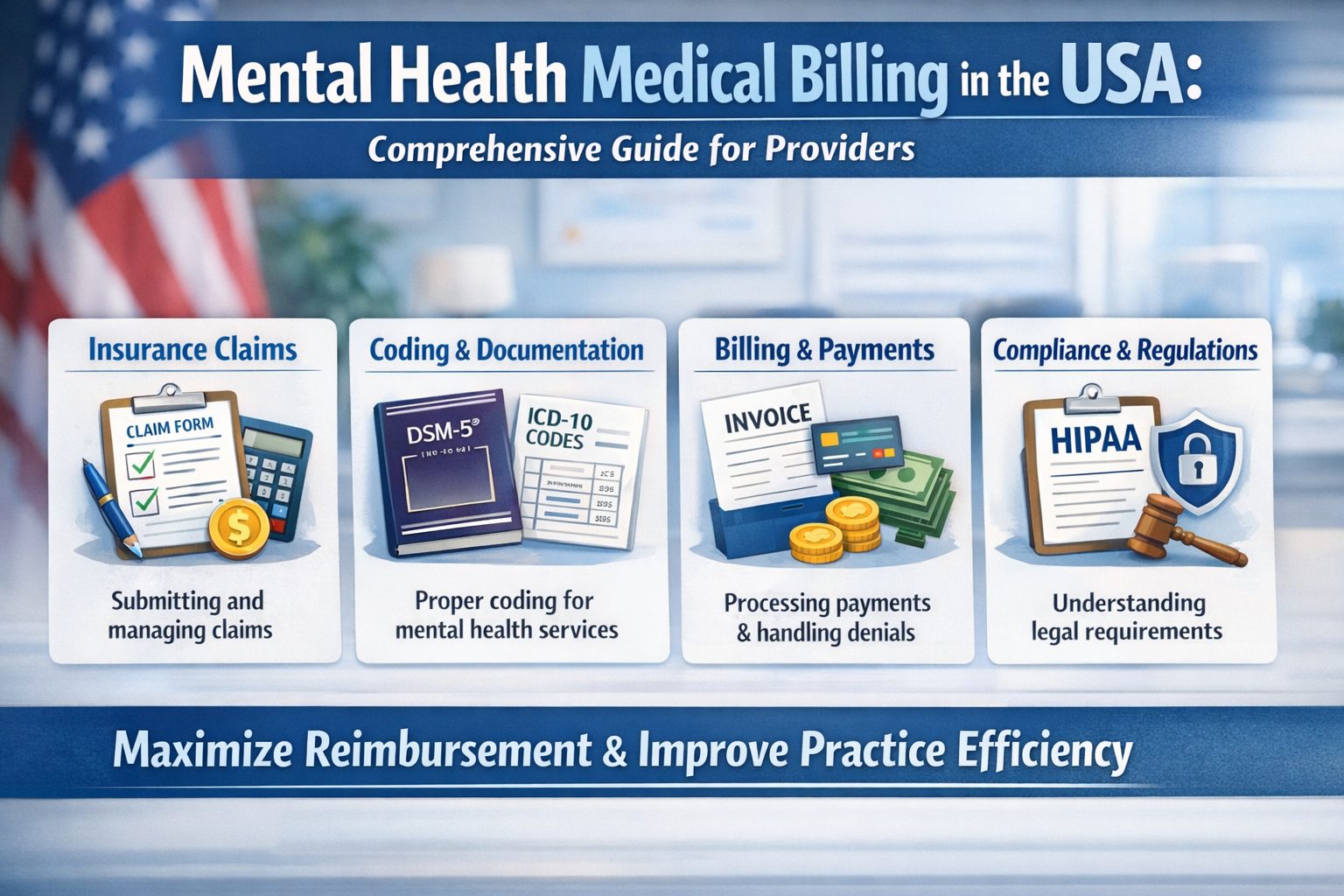
Mental health care has become a critical component of modern healthcare in the United States. As demand for therapy, psychiatric treatment, and behavioral health services increases, providers must also understand the complexities of billing Medicare for mental health services. Accurate billing ensures providers receive timely reimbursement while maintaining compliance with federal regulations.
Medicare reimbursement rules for psychotherapy, psychiatric evaluations, and related services can be complicated. Providers must follow strict documentation standards, apply the correct CPT codes, and understand coverage limitations. Because of these complexities, many clinics rely on specialized mental health billing services to manage their revenue cycle effectively.
This guide explains how Medicare billing works for mental health providers, common challenges, coding requirements, and how professional billing support can improve financial performance.
Why Medicare Billing for Mental Health Is Important
Mental health treatment is covered under Medicare Part B, but providers must meet specific requirements for reimbursement. Whether a practice offers psychotherapy, counseling, psychiatric assessments, or substance use treatment, accurate coding and billing for mental health services is essential.
Key factors that make Medicare billing complex include:
-
Strict documentation requirements for therapy sessions
-
Specific CPT and ICD-10 coding rules for behavioral health treatment
-
Coverage limitations for certain therapy types and providers
-
Frequent policy updates affecting reimbursement rules
-
Coordination with secondary insurance or supplemental plans
Because of these challenges, many clinics work with billing companies for mental health that specialize in behavioral health reimbursement.
Understanding Medicare Coverage for Mental Health Services
Medicare covers a wide range of outpatient mental health services when provided by qualified professionals. Providers eligible to bill Medicare include psychiatrists, psychologists, clinical social workers, nurse practitioners, and certain licensed therapists.
Common services covered by Medicare include:
-
Psychiatric diagnostic evaluations
-
Individual psychotherapy sessions
-
Family therapy sessions when medically necessary
-
Medication management
-
Substance use disorder treatment
-
Telehealth behavioral therapy in eligible situations
Accurate billing for mental health services requires the correct combination of CPT codes, diagnosis codes, and documentation supporting medical necessity.
Many clinics depend on mental health billing specialist companies to ensure these claims are submitted correctly and meet Medicare guidelines.
Common Challenges in Billing Medicare for Mental Health Services
Even experienced providers face difficulties when billing mental health claims to Medicare. Small documentation errors or incorrect coding can lead to claim denials, delayed payments, or compliance risks.
Some of the most common challenges include:
Incorrect CPT coding
Psychotherapy services use multiple CPT codes depending on session length and treatment type. Selecting the wrong code can result in underpayment or rejection.
Medical necessity documentation
Medicare requires detailed clinical notes demonstrating the need for therapy or psychiatric services.
Credentialing and enrollment issues
Providers must be properly enrolled and credentialed before submitting Medicare claims.
Frequent claim denials
Many practices struggle with denied claims because of missing modifiers, incorrect diagnoses, or incomplete documentation.
Coordination with secondary insurance
Some patients have supplemental plans, making billing for mental health providers more complicated.
Because of these challenges, practices often rely on a mental health billing company or outsourced billing for mental health to streamline the process.
Key Coding Requirements for Mental Health Billing
Accurate coding is one of the most important aspects of medical billing for mental health. Medicare uses CPT codes for procedures and ICD-10 codes for diagnoses.
Some commonly used psychotherapy CPT codes include:
90791 – Psychiatric diagnostic evaluation
90832 – Psychotherapy, 30 minutes
90834 – Psychotherapy, 45 minutes
90837 – Psychotherapy, 60 minutes
90853 – Group therapy
In addition to procedure codes, providers must include accurate diagnosis codes that justify the service being billed.
This is why many practices use coding and billing for mental health services managed by trained professionals or mental health medical billing teams.
Benefits of Professional Mental Health Billing Services
As mental health practices grow, managing billing internally becomes increasingly difficult. Hiring specialized billing services for mental health can help practices reduce administrative burdens and improve revenue.
Key benefits include:
Improved claim accuracy
Experienced billing professionals understand Medicare policies and coding requirements.
Faster reimbursement cycles
Efficient claim submission and follow-up reduce payment delays.
Reduced administrative workload
Providers can focus on patient care instead of paperwork.
Denial management and appeals
Professional billing teams track denied claims and resubmit them quickly.
Compliance with Medicare regulations
A mental health billing services company ensures claims meet federal billing standards.
Many providers choose outsourcing mental health billing and coding because it allows them to access expert billing support without hiring in-house staff.
Why Outsourcing Mental Health Billing Is Growing
The demand for behavioral health services has increased significantly across the United States. At the same time, Medicare compliance requirements continue to evolve.
As a result, outsourcing mental health billing has become a practical solution for many clinics and therapy practices.
Outsourcing offers several advantages:
Access to experienced billing professionals
Lower operational costs compared to in-house billing teams
Scalable solutions for growing practices
Reduced claim denial rates
Improved financial reporting and revenue tracking
Many clinics partner with the best mental health billing services company to ensure consistent reimbursement and compliance with Medicare rules.
How to Choose the Right Mental Health Billing Company
Selecting the right partner is essential for maintaining financial stability in a behavioral health practice. The best mental health billing company should understand the unique requirements of behavioral healthcare providers.
Important factors to consider include:
Experience with Medicare behavioral health billing
Knowledge of psychotherapy CPT coding and modifiers
Transparent reporting and revenue tracking
Strong denial management processes
Support for credentialing and compliance
Top providers often work with mental health billing specialist companies that focus exclusively on behavioral health revenue cycle management.
Some clinics also look for affordable options such as a cheap outsource mental health billing company while still ensuring service quality.
Billing Solutions for Mental Health Clinics
Modern technology and experienced billing teams have made mental health billing solutions more efficient than ever. Advanced billing systems allow providers to automate claim submission, track payments, and monitor revenue performance.
Billing services for mental health clinics typically include:
Claims submission and tracking
Insurance eligibility verification
Payment posting and reconciliation
Denial management and appeals
Financial reporting and analytics
These services help therapists, psychologists, and psychiatric clinics maintain a stable revenue cycle while focusing on patient care.
Many practices rely on behavioral and mental health billing services designed specifically for psychiatric and therapy practices.
Best Practices for Accurate Mental Health Billing
To ensure successful billing medicare for mental health services, providers should follow several key practices.
Maintain detailed documentation
Therapy notes should clearly describe the patient’s condition, treatment plan, and session duration.
Use correct CPT and ICD codes
Coding accuracy is essential for successful reimbursement.
Verify patient eligibility before appointments
Checking coverage helps prevent claim denials.
Submit claims promptly
Timely claim submission ensures faster payment processing.
Work with experienced billing professionals
Many providers partner with the best outsource mental health billing and coding services to avoid costly errors.
These practices can significantly improve billing efficiency and reduce administrative stress.
How Professional Billing Support Improves Revenue
When clinics partner with a professional mental health billing company, they gain access to specialized expertise that improves financial performance.
Professional billing teams handle every aspect of billing for mental health therapists and psychiatric providers. This includes claim submission, insurance follow-up, denial resolution, and compliance monitoring.
Working with experienced billing companies for mental health also helps practices scale their operations. As patient volumes increase, outsourced billing teams can manage higher claim volumes without increasing administrative costs.
Supporting Mental Health Providers with Comprehensive Billing Services
For healthcare organizations looking to improve their revenue cycle, working with an experienced partner is essential. A reliable mental health billing services company provides specialized expertise in behavioral health reimbursement and Medicare compliance.
Companies like 247 Medical Billing Services support healthcare providers with comprehensive solutions including medical billing services, medical coding services, medical billing and coding services, revenue cycle management, and credentialing services. These services help practices manage claims efficiently, reduce denials, and maintain steady cash flow while delivering quality patient care.
Conclusion
Understanding billing medicare for mental health services is essential for therapists, psychologists, psychiatrists, and behavioral health clinics. Medicare has strict billing rules, detailed documentation requirements, and specific coding standards that must be followed to receive reimbursement.
Because of these complexities, many practices rely on professional mental health billing services to manage their claims and maintain compliance. Whether through outsourced billing for mental health or dedicated billing specialists, the right support can significantly improve revenue cycle performance.
By implementing accurate coding, maintaining proper documentation, and partnering with experienced billing professionals, mental health providers can focus on delivering effective care while ensuring their financial stability.
Frequently Asked Questions
What does Medicare cover for mental health services?
Medicare typically covers psychiatric evaluations, individual psychotherapy, group therapy, medication management, and substance use disorder treatment when provided by qualified professionals.
Who can bill Medicare for mental health services?
Psychiatrists, psychologists, clinical social workers, nurse practitioners, and certain licensed therapists can submit claims for Medicare-covered mental health treatments.
Why do mental health claims get denied by Medicare?
Claims may be denied due to incorrect CPT codes, missing documentation, eligibility issues, or incomplete provider credentialing.
Is outsourcing mental health billing beneficial for small clinics?
Yes. Outsourcing mental health billing helps small practices reduce administrative workload, improve claim accuracy, and maintain consistent revenue.
How do billing services help mental health providers?
Professional billing services for mental health handle coding, claims submission, denial management, insurance follow-up, and revenue reporting, allowing providers to focus on patient care.

 English
 Arabic
 French
 Spanish
 Portuguese
 Deutsch
 Dutch
Dutch
 Italiano
 Russian
 Romaian
 Portuguese (Brazil)
 Greek
Greek