
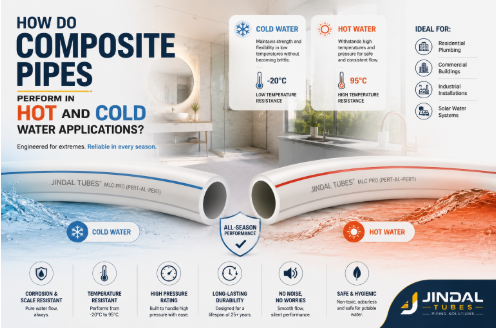
Composite pipes are well suited to both hot and cold water applications because their multilayer construction combines the corrosion resistance and flexibility of polymers with the strength and dimensional stability of aluminium. PE-AL-PE systems are specifically covered by IS 15450:2022 for hot and cold water supplies, including domestic, industrial, municipal, heating, and building plumbing applications.
What Makes Composite Pipes Suitable for Hot and Cold Water?
A typical PE-AL-PE composite pipe contains polymer layers on the inside and outside with an aluminium layer between them. Adhesive layers bond the materials together to form a single multilayer structure.
Each layer performs a different function:
-
Inner polymer layer: Provides a smooth, corrosion-resistant surface for water flow.
-
Aluminium layer: Adds strength, dimensional stability, and resistance to thermal movement.
-
Outer polymer layer: Protects the aluminium core from the surrounding environment.
This combination allows composite pipes to provide characteristics that are difficult to achieve with a single-layer plastic pipe.
How Do Composite Pipes Perform With Hot Water?
Hot-water plumbing exposes pipes to elevated temperatures and repeated thermal cycles. These conditions can cause conventional plastic pipes to expand and contract significantly.
The aluminium layer in a multilayer composite pipe helps control this movement and improves dimensional stability.
This can help:
-
Reduce thermal expansion
-
Minimize movement between pipe supports
-
Reduce stress on joints
-
Maintain pipe shape
-
Improve long-term system stability
For example, Jindal Tubes lists its standard MLC pipe for hot and cold water applications with a temperature range of -20°C to 82°C, with pressure ratings that vary according to operating temperature.
The important point is that temperature and pressure ratings must always be checked for the specific pipe being installed.
How Do Composite Pipes Perform With Cold Water?
Cold-water systems generally place less thermal stress on pipe materials, but long-term corrosion resistance, pressure performance, and dimensional stability remain important.
Composite pipes provide several useful characteristics for cold-water distribution:
-
Corrosion-resistant polymer contact surfaces
-
Smooth internal surfaces
-
Low weight
-
Good flexibility
-
Stable dimensions
-
Reliable pressure performance
India's Ministry of Housing and Urban Affairs describes PE-AL-PE composite pipe as a lightweight, strong, non-corroding option suitable for water-supply service connections.
Why Thermal Expansion Matters in Hot-Water Systems
Temperature changes cause most piping materials to expand and contract. Excessive movement can place additional stress on supports and connections.
Multilayer composite pipes address this challenge through the aluminium core, which restricts thermal movement compared with many single-layer plastic pipes.
CIBSE notes that the aluminium layer improves pressure resistance and makes multilayer pipework more dimensionally stable than simple flexible plastic pipes.
This makes composite pipes particularly useful where exposed pipe movement needs to be controlled.
What Happens to Pressure Performance at Higher Temperatures?
Pipe pressure ratings generally decrease as operating temperature increases. Therefore, a pipe that can withstand a particular pressure at room temperature may have a lower allowable pressure at elevated temperatures.
For example, Jindal's published ratings for its standard MLC pipe are:
-
13.8 bar at 23°C
-
11.0 bar at 60°C
-
6.9 bar at 82°C
This illustrates why plumbing designers should never evaluate a hot-water pipe using its room-temperature pressure rating alone.
Are All Composite Pipes Suitable for the Same Temperature?
No. Composite pipes use different polymer materials, and their temperature capabilities can vary.
For example, PE-AL-PE and PE-RT-AL-PE systems may have different operating limits.
Jindal's MLC Pro range uses PE-RT in the inner and outer layers and is specified for applications requiring higher temperatures, with a published temperature range up to 95°C.
Therefore, selection should consider:
-
Continuous operating temperature
-
Maximum temperature
-
System pressure
-
Pipe construction
-
Applicable standards
-
Intended application
How Does the Smooth Inner Surface Help Water Flow?
The internal polymer layer provides a smooth surface for water movement.
A smooth internal surface can help reduce resistance to flow and limit the accumulation of deposits compared with rougher or corroding internal surfaces.
CIBSE reports that multilayer pipe can have very low internal surface roughness, which can support hydraulic performance and reduce the tendency for contaminants such as limescale to accumulate.
This characteristic can be useful in both hot- and cold-water distribution.
Why Corrosion Resistance Matters
Cold and hot water systems can both be affected by corrosion depending on the pipe material and water chemistry.
The polymer layers of composite pipes provide a corrosion-resistant surface in contact with the water. The aluminium layer is also enclosed within the multilayer structure rather than being directly exposed to the transported water.
This helps reduce concerns associated with conventional metallic pipe corrosion.
However, material compatibility and local water conditions should always be considered during system design.
Composite Pipes for Hot and Cold Water: Key Differences
| Factor | Hot Water | Cold Water |
| Thermal movement | More significant | Lower |
| Pressure-temperature relationship | Important | Generally less demanding |
| Corrosion resistance | Important | Important |
| Dimensional stability | Highly beneficial | Beneficial |
| Smooth internal surface | Supports efficient flow | Supports efficient flow |
| Product selection | Temperature and pressure rating are critical | Pressure and application rating remain important |
What Applications Can Use Composite Pipes?
Composite pipes can be used across a range of building and infrastructure applications when the selected product is rated for the intended service.
Common applications include:
-
Domestic hot and cold water
-
Residential plumbing
-
Commercial buildings
-
Heating systems
-
HVAC applications
-
Solar water systems
-
Underfloor heating and cooling
Jindal's MLC product information lists hot and cold water, drinking water, solar water, HVAC, and underfloor heating and cooling among its applications.
Installation Quality Still Matters
Even a high-performance pipe can experience premature problems if it is incorrectly installed.
Long-term performance depends on:
-
Correct bending techniques
-
Proper pipe support
-
Appropriate pressure ratings
-
Compatible fittings
-
Correct joining procedures
-
Protection from mechanical damage
-
Compliance with applicable standards
For multilayer systems, using compatible press-fit components is particularly important. Composite press-fit fittings can be used as part of an integrated pipe-and-fitting system where the products are specified for compatibility.
What Should Builders Consider Before Selecting a Composite Pipe?
The phrase "composite pipe" covers several different constructions, so material selection should be based on technical requirements rather than the product category alone.
Before specifying a system, check:
-
Operating temperature
-
Maximum temperature
-
Working pressure
-
Pipe diameter
-
Application requirements
-
Relevant certification
-
Fitting compatibility
-
Installation conditions
For Indian projects, IS 15450:2022 specifically covers polyethylene-aluminium-polyethylene composite pressure pipes for hot and cold water supplies.
Frequently Asked Questions
Can composite pipes be used for both hot and cold water?
Yes. PE-AL-PE composite pressure pipes are specifically covered for hot and cold water applications under IS 15450:2022, provided the selected product meets the required temperature and pressure conditions.
Do composite pipes expand when heated?
Yes, all piping materials experience some thermal movement. However, the aluminium layer in multilayer composite pipe significantly helps control expansion compared with many single-layer plastic pipes.
Are composite pipes suitable for high-temperature water?
Some are. The suitability depends on the specific construction and its rated temperature and pressure. Higher-temperature applications may require PE-RT-based multilayer systems rather than standard PE-AL-PE.
Are composite pipes suitable for drinking water?
Certain composite pipes are manufactured and certified for potable-water applications. The specific product should always have the appropriate certification for the intended use.
Can composite pipes be used in residential plumbing?
Yes. They are used for residential hot- and cold-water distribution, provided the pipe and fittings meet the applicable technical and regulatory requirements.
Final Insight
Composite pipes perform well in both hot and cold water applications because their multilayer construction addresses several important plumbing challenges at once. The polymer layers provide a smooth, corrosion-resistant water-contact surface, while the aluminium layer improves dimensional stability and controls thermal expansion.
However, not every composite pipe has the same temperature or pressure capability. The correct approach is to select the pipe according to the application's operating conditions, relevant standards, and compatible fitting system.
For modern building projects where durability, controlled thermal movement, corrosion resistance, and installation efficiency are important, properly specified composite piping can provide a strong long-term solution for hot- and cold-water distribution.

 English
 Arabic
 French
 Spanish
 Deutsch
 Turkish
 Dutch
Dutch
 Italiano
 Russian
 Romaian
 Portuguese (Brazil)
 Greek
Greek