
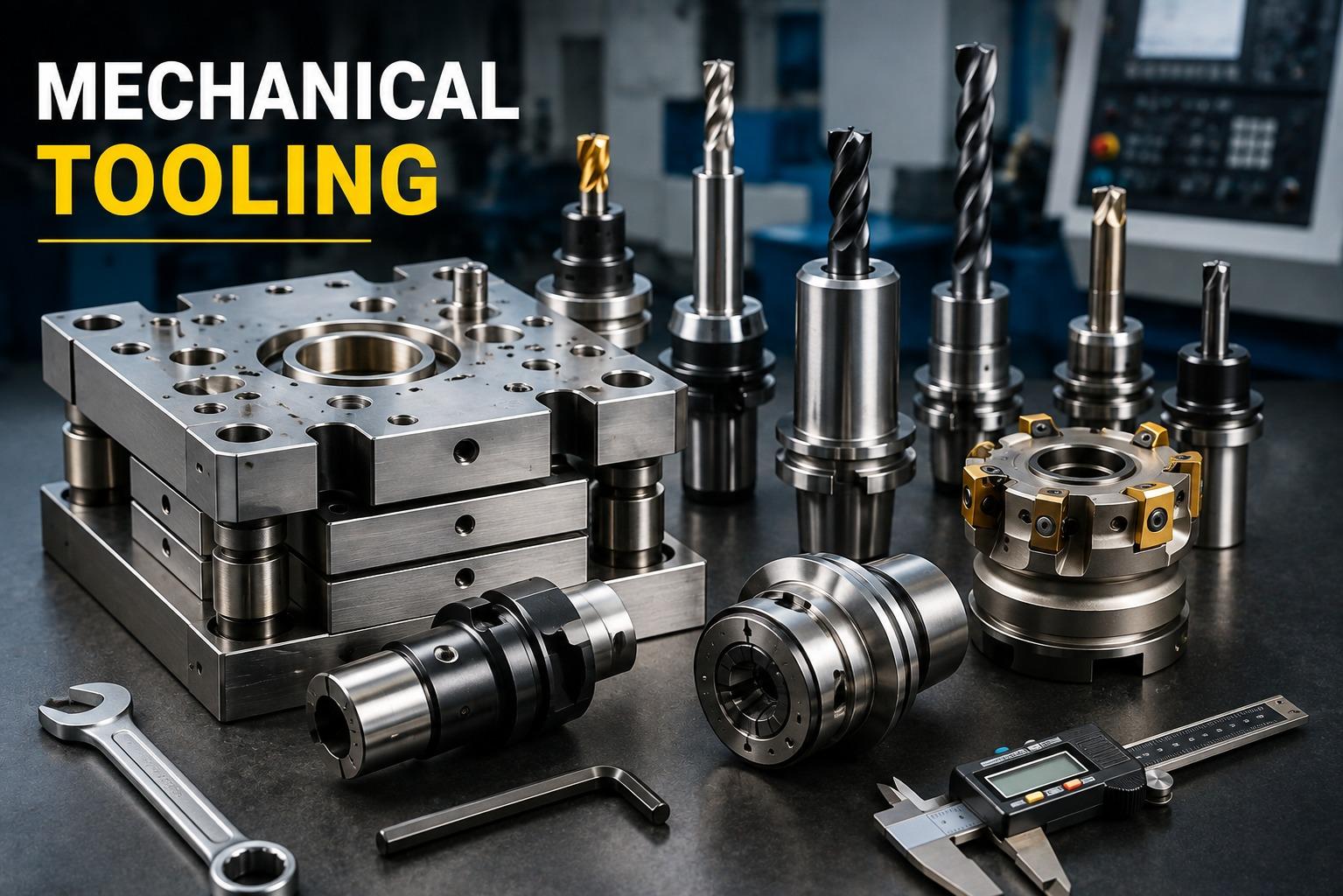
Modern manufacturing is built around precision. Whether producing aerospace components, automotive parts, semiconductor assemblies, optical products, or industrial equipment, manufacturers need tooling that can deliver accurate results repeatedly and efficiently. As materials become harder and production requirements become more demanding, traditional tooling solutions are increasingly being complemented by advanced materials and manufacturing technologies.
Mechanical Tooling plays a fundamental role in this environment. From cutting and drilling to grinding, shaping, polishing, and finishing, the right tooling directly influences product quality, production speed, tool life, and operating costs. With the integration of advanced diamond materials, modern Mechanical Tooling can provide exceptional wear resistance and precision for applications involving demanding materials.
What Is Mechanical Tooling?
Mechanical Tooling refers to the tools and supporting equipment used to manufacture, shape, process, or finish components. It includes a broad range of solutions designed for specific production requirements.
Common examples include:
-
Cutting tools
-
Drilling tools
-
Milling tools
-
Grinding tools
-
Dies and molds
-
Fixtures
-
Jigs
-
Precision finishing tools
-
Specialized machining components
The purpose of tooling is not simply to remove or shape material. High-quality tooling helps manufacturers maintain dimensional accuracy, achieve consistent surface finishes, reduce production interruptions, and improve overall manufacturing efficiency.
Why Tooling Quality Matters
A manufacturing process can have sophisticated machinery and high-quality raw materials, but poor tooling can still compromise the final result. Tool wear, vibration, inaccurate cutting geometry, and inconsistent performance can lead to defects and unnecessary production costs.
Well-designed Mechanical Tooling can help manufacturers achieve:
-
Consistent dimensional accuracy
-
Better surface quality
-
Longer production runs
-
Reduced tool replacement
-
Lower downtime
-
Improved process stability
For industries working with expensive or difficult-to-machine materials, these advantages can have a significant impact on productivity.
The Role of Diamond in Mechanical Tooling
Diamond has exceptional hardness and wear resistance, making it highly valuable for specific tooling applications. Engineered diamond materials can maintain their cutting or finishing characteristics when used appropriately with abrasive and non-ferrous materials.
Diamond-based tooling is particularly relevant when manufacturers require:
-
High wear resistance
-
Precision machining
-
Excellent surface finishing
-
Extended tool life
-
Stable tool geometry
Synthetic diamond technologies have further expanded these possibilities by allowing manufacturers to develop diamond materials with controlled characteristics for specialized applications.
Key Benefits of Advanced Mechanical Tooling
1. Improved Precision
Precision is essential when manufacturing components with tight tolerances. Even small dimensional variations can affect assembly, performance, or product reliability.
High-quality tooling with appropriate geometry and wear resistance can help maintain consistent dimensions throughout the machining process. Diamond tooling can be particularly useful in applications where maintaining a sharp and stable cutting edge is important.
2. Enhanced Tool Life
Tool wear is a common challenge in manufacturing. As tooling gradually wears, cutting performance and dimensional accuracy can decline.
Advanced diamond tooling can provide excellent resistance to abrasive wear in suitable applications. Longer tool life may result in:
-
Fewer tool changes
-
Reduced machine downtime
-
More consistent production
-
Lower tooling consumption
3. Better Surface Finishing
Surface quality is an important factor in many industries. Components may require smooth, precise surfaces before assembly or further processing.
Properly engineered Mechanical Tooling can help achieve controlled surface finishes while minimizing unnecessary secondary operations.
4. Increased Productivity
Reliable tooling contributes directly to production efficiency. When tools maintain their performance for longer periods, manufacturers can operate with fewer interruptions.
This can support:
-
Higher production output
-
More predictable production schedules
-
Reduced downtime
-
Improved resource utilization
Applications of Mechanical Tooling
Aerospace Industry
Aerospace manufacturing requires extremely precise components and reliable production processes. Advanced materials such as composites and specialized alloys can be challenging to machine.
Mechanical Tooling is used for drilling, trimming, cutting, grinding, and finishing aerospace components. Diamond-based solutions can be valuable for selected applications involving abrasive materials and precision requirements.
Automotive Manufacturing
The automotive sector depends on high-volume production and repeatable quality. Tooling is used extensively in machining and forming operations.
Advanced Mechanical Tooling can support the manufacturing of components made from:
-
Aluminum alloys
-
Composite materials
-
Non-ferrous metals
-
Engineered materials
Longer tool life and consistent cutting performance can be particularly valuable in high-volume environments.
Electronics and Semiconductor Manufacturing
Electronic components increasingly require tight tolerances and specialized machining processes. Mechanical Tooling supports precision drilling, cutting, grinding, and finishing operations used in various electronic manufacturing processes.
Diamond tooling may be suitable for applications where minimal material damage and high dimensional precision are required.
Glass and Ceramic Processing
Glass and ceramics are hard and brittle materials that require carefully controlled machining. Diamond is widely used in tools designed for cutting, grinding, drilling, and finishing these materials.
Its hardness allows the tool to process abrasive materials while maintaining an effective cutting surface.
MPCVD and the Development of Advanced Diamond Tooling
Microwave Plasma Chemical Vapor Deposition (MPCVD) has become an important technology for producing high-quality synthetic diamond materials. Through controlled diamond growth, manufacturers can develop materials suitable for advanced industrial applications.
MPCVD-grown diamond can offer characteristics such as:
-
High purity
-
Excellent hardness
-
Controlled crystal quality
-
High wear resistance
-
Thermal stability
As MPCVD technology continues to develop, its contribution to specialized diamond tooling is expected to increase.
Choosing the Right Mechanical Tooling
Selecting tooling should always begin with the requirements of the specific manufacturing process. Several factors should be considered.
Workpiece Material
The hardness, abrasiveness, thermal characteristics, and composition of the material being machined influence tooling selection.
Required Tolerance
High-precision applications may require specialized tooling geometries and materials capable of maintaining dimensional stability.
Production Volume
High-volume production generally benefits from tooling that offers long service life and predictable performance.
Surface Finish
If the final component requires a highly refined surface, tooling design and material selection become particularly important.
Operating Conditions
Cutting speed, feed rate, temperature, machine rigidity, coolant conditions, and tool geometry can all influence tooling performance.
Future of Mechanical Tooling
The future of Mechanical Tooling is closely connected to automation, advanced materials, precision machining, and intelligent manufacturing.
Emerging developments include:
-
Advanced diamond cutting technologies
-
Automated tool-condition monitoring
-
Computer-controlled machining
-
AI-assisted process optimization
-
Customized tool geometries
-
Hybrid diamond tooling
-
More efficient synthetic diamond production
These technologies are helping manufacturers move toward more predictable, efficient, and sustainable production processes.
Conclusion
Mechanical Tooling is a critical foundation of modern manufacturing, directly influencing precision, productivity, surface quality, and operational efficiency. As manufacturers increasingly work with advanced and difficult-to-machine materials, the importance of durable and high-performance tooling continues to grow.
The integration of engineered diamond materials provides an opportunity to improve wear resistance, tool life, and machining performance in suitable applications. Advances in MPCVD and other synthetic diamond technologies are further expanding the possibilities for specialized tooling solutions.
From aerospace and automotive manufacturing to electronics, ceramics, optics, and precision engineering, advanced Mechanical Tooling will continue to support the development of more efficient and reliable production systems.
For manufacturers focused on quality and long-term productivity, selecting the right Mechanical Tooling is not simply a matter of choosing a tool - it is an important investment in precision, consistency, and overall manufacturing performance.

 English
 Arabic
 Spanish
 Portuguese
 Deutsch
 Turkish
 Dutch
Dutch
 Italiano
 Russian
 Romaian
 Portuguese (Brazil)
 Greek
Greek