
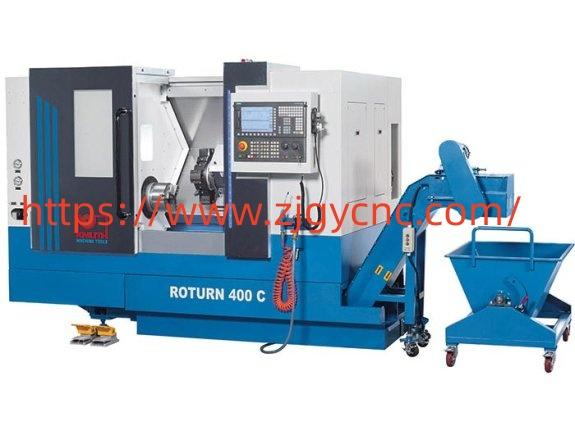
CNC Lathe with Automation combines computer controlled turning functions with automatic material handling and part transfer to reduce repetitive operator involvement during production. A typical arrangement can include a bar feeder, parts catcher, robotic loader, or other material handling device. The machine follows programmed cutting instructions while supporting systems manage routine loading and unloading tasks. Automatic bar feeders can supply stock into the spindle and advance material for successive parts, reducing the need for manual loading between cycles.
Where Does Manual Time Usually Go?
In repetitive production, operators may spend considerable time performing actions that do not directly involve cutting. These tasks can include loading raw stock, positioning components, removing completed pieces, clearing work areas, checking material supply, and preparing the next cycle.
When the same component is produced repeatedly, these actions can occur dozens or hundreds of times during a production run. A suitable automated arrangement can take over some of these routine movements.
The goal is not to remove operator involvement entirely. Instead, the production team can shift attention toward activities that require judgment, such as inspection, setup changes, tool condition checks, and process supervision.
How Does Automatic Material Feeding Work?
A bar feeder stores raw stock and moves it into the spindle according to programmed requirements. After one component has been completed and separated from the material, the feeder advances the remaining stock for the next cycle.
This creates a repeating sequence:
Raw material enters the spindle
The workpiece is secured
Programmed cutting begins
The finished component is separated
New stock advances
The next cycle starts
Because the feeding process can occur automatically, operators do not need to manually position every individual piece. This can be particularly useful for repeated small component production.
What Role Does Part Collection Play?
Material feeding is only part of the process. Once a component has been completed, it also needs to leave the working area.
A parts catcher can receive completed pieces after separation from the raw material. Depending on the production arrangement, robotic handling can also transfer finished components into trays, bins, inspection areas, or another processing station.
This creates a more continuous material flow. Instead of requiring an operator to open the enclosure and collect every finished component, the transfer process can occur as part of the programmed cycle.
For larger production runs, this can reduce interruptions and allow operators to supervise several activities rather than remain beside one machine throughout the entire cycle.
How Can Automation Affect Operator Work?
The largest practical change is often the shift from constant handling toward supervision.
An operator may previously have needed to remain near the machine to load stock and remove finished pieces. After suitable material handling systems are installed, the operator can spend more time checking dimensions, monitoring tool condition, preparing the next order, or attending another production task.
Industry sources note that automatic bar feeding can allow longer periods of unattended operation and can reduce the need for repeated loading and unloading.
The exact benefit depends on component design, cycle duration, material type, production quantity, and the selected handling arrangement.
Which Production Jobs Suit This Approach?
Repetitive production is generally easier to automate than highly variable work. Parts made from bar stock can be particularly suitable because the material can be supplied continuously.
Examples include shafts, pins, bushings, spacers, fittings, sleeves, connectors, and other rotational components. When the same geometry is produced repeatedly, automatic feeding can support a predictable sequence.
Shorter batches may also benefit, although the setup time must be considered. A highly automated cell may require additional preparation when products change frequently. The right arrangement therefore depends on the relationship between setup time and production volume.
Can Robotic Loading Handle Different Materials?
Robotic handling can provide another route when standard bar feeding does not match the production process. A robot can pick raw blanks, position them in the chuck, remove completed parts, and transfer them to another location.
This can be useful for castings, forgings, cut blanks, and components that cannot easily pass through a spindle.
However, product variation matters. A flexible robotic cell may require additional programming, grippers, fixtures, sensors, and product recognition. Manufacturers should therefore define the actual range of components before deciding whether robotic handling is appropriate.
What Should Manufacturers Check Before Automating?
A practical evaluation can begin with several questions:
How many components are produced per batch?
How long does one cycle take?
How frequently must raw stock be loaded?
How are completed parts removed?
What materials and dimensions are involved?
Can one operator supervise several machines?
How often do products change?
What inspection tasks still require human attention?
What maintenance is required?
How will the new system fit the existing workshop layout?
These questions help manufacturers decide whether automatic handling can provide a useful improvement for a specific production process.
How Can Zjgycnc Support Automated Production Planning?
Zjgycnc provides machining solutions for manufacturers handling repetitive component production and varied industrial turning applications. Its product range can be considered by businesses producing shafts, bushings, pins, fittings, sleeves, and other rotational components.
When planning a project, buyers can share information about component dimensions, material, production volume, cycle duration, loading method, part collection requirements, and operator workflow. This gives the supplier a clearer basis for discussing a suitable configuration.
For manufacturers reviewing available machining solutions and considering material handling options, the Zjgycnc product range is available through https://www.zjgycnc.com/product/

 English
 Arabic
 French
 Spanish
 Portuguese
 Deutsch
 Turkish
 Dutch
Dutch
 Italiano
 Romaian
 Portuguese (Brazil)
 Greek
Greek