
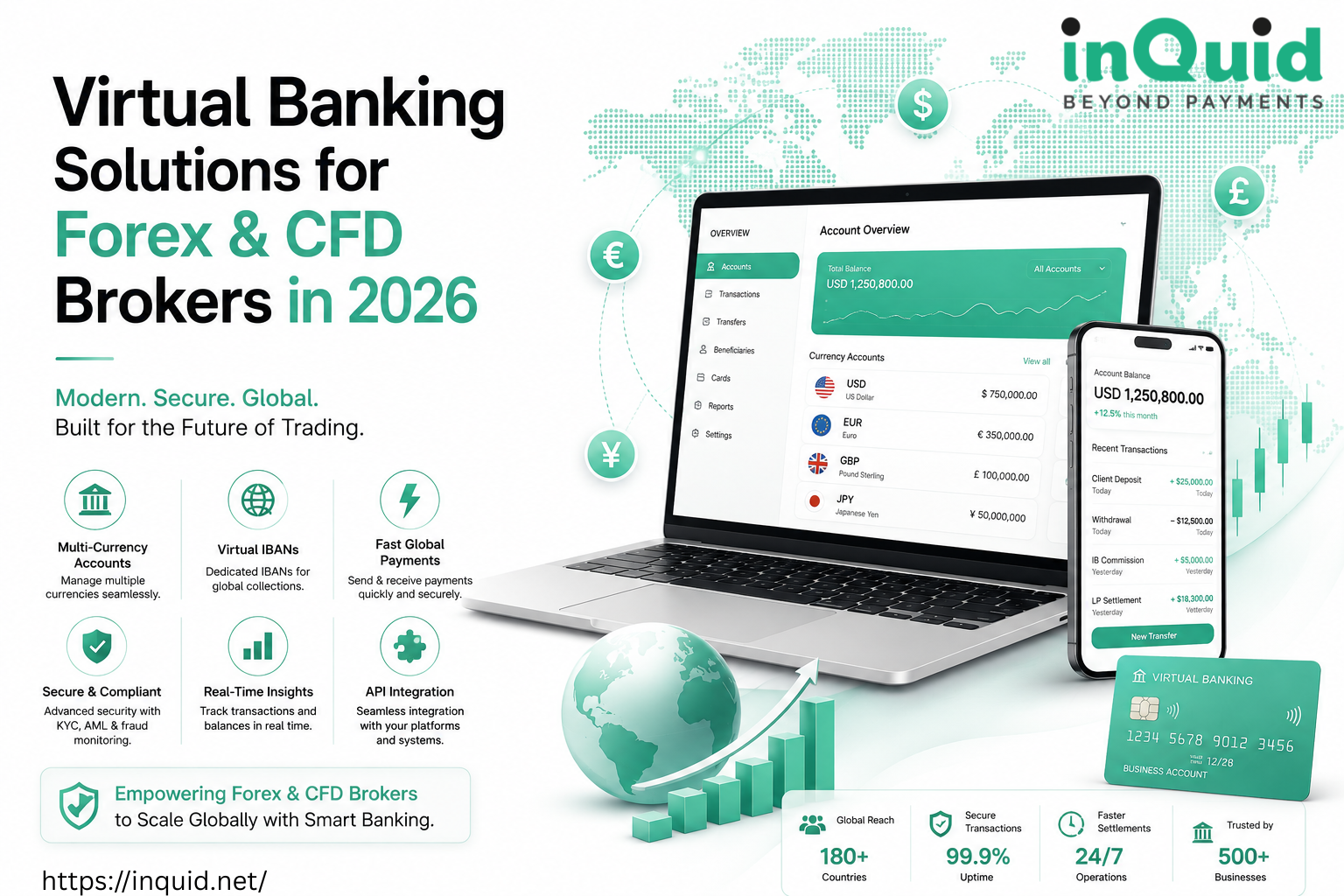
The global forex and CFD industry continues to evolve as brokers expand into new markets, onboard international clients, and manage increasingly complex financial operations. While trading technology has advanced rapidly, banking remains one of the biggest operational challenges for many brokers.
Traditional banks often hesitate to work with forex and CFD businesses due to regulatory requirements, cross-border transactions, higher compliance obligations, and perceived financial risk. As a result, many brokers experience delayed account approvals, restricted banking services, or limited international payment capabilities.
This is where virtual banking solutions for forex & CFD brokers have become an important part of modern financial infrastructure. Rather than relying solely on conventional banking models, virtual banking enables brokers to manage international payments, support multiple currencies, improve operational efficiency, and provide a smoother experience for both clients and partners.
Drawing on our team's direct experience onboarding regulated forex and CFD brokerages onto digital banking infrastructure, this guide covers how virtual banking works, why it's increasingly valuable for brokers, its key benefits, potential challenges, and the features businesses should evaluate before choosing a provider.
What Is Virtual Banking?
Virtual banking refers to digital banking services that allow businesses to access essential banking functions without depending entirely on physical bank branches.
For forex and CFD brokers, virtual banking solutions typically include:
- Business payment accounts
- Multi-currency accounts
- Virtual IBANs
- International transfers
- Payment collection
- Currency conversion
- Online account management
- API connectivity
- Transaction reporting
Unlike traditional banking, virtual banking focuses on speed, automation, and global accessibility. Many providers integrate directly with payment gateway solutions and merchant account solutions, creating a unified financial ecosystem for international businesses.
Why Forex & CFD Brokers Need Virtual Banking
Operating a forex brokerage involves significantly more than processing deposits and withdrawals. Brokers must manage international client payments, multiple currencies, regulatory compliance, liquidity provider settlements, operational expenses, partner commissions, affiliate payouts, and vendor payments.
Using multiple traditional bank accounts across different countries often increases operational complexity. Virtual banking helps centralize these financial activities within one digital platform.
Common Banking Challenges for Forex Brokers
Limited banking access. Some traditional banks maintain strict policies regarding forex-related businesses, classifying them alongside other high-risk merchant accounts — which can make opening or maintaining accounts more difficult.
International payment delays. Cross-border wire transfers may require additional processing time, particularly when intermediary banks are involved.
Multi-currency management. Serving clients across different countries often means handling multiple currencies simultaneously. Without appropriate banking infrastructure, currency management becomes inefficient and expensive.
Compliance requirements. Forex businesses are expected to maintain robust KYC, AML, and transaction monitoring processes — standards banking partners typically expect to be well established.
Operational complexity. Managing numerous banking relationships across jurisdictions creates unnecessary administrative work for finance teams. Virtual banking helps simplify these operations through centralized account management.
Key Benefits of Virtual Banking for Forex & CFD Brokers
Multi-currency accounts. Hold multiple currencies within a single platform to reduce conversion costs, accept international payments, improve settlement efficiency, and simplify treasury management.
Virtual IBANs. Receive payments through dedicated account numbers assigned to specific currencies, clients, or business units — enabling easier reconciliation, improved transaction tracking, faster payment allocation, and better operational visibility.
Faster international transfers. Quicker cross-border payment processing compared with traditional banking models improves both client experience and business cash flow.
Simplified financial operations. Consolidate payment collection, transfers, reporting, and account management into one digital platform, reducing administrative overhead while improving financial visibility.
Improved scalability. As forex businesses expand internationally, virtual banking makes it easier to onboard new markets, support additional currencies, and manage growing transaction volumes without significantly increasing overhead.
Better customer experience. Clients appreciate smooth deposits, timely withdrawals, and multiple payment options — a modern banking infrastructure contributes directly to customer satisfaction.
Enhanced financial visibility. Real-time dashboards and automated reporting give finance teams better control over business performance.
Essential Features to Look for in a Virtual Banking Provider
Not all virtual banking providers offer the same level of functionality. Forex and CFD brokers should evaluate providers based on their ability to support international operations, regulatory requirements, and business scalability.
1. Multi-Currency Business Accounts
Forex brokers deal with clients from multiple countries, making multi-currency support essential — the ability to hold multiple currencies, send and receive international payments, reduce FX conversion costs, and improve payment flexibility.
2. Virtual IBANs
Dedicated account numbers for different currencies, business units, or clients simplify reconciliation, tracking, accounting, and reporting.
3. International Payment Support
Look for global payment capabilities including SWIFT transfers, SEPA payments, faster international settlements, and cross-border payment management.
4. API Integration
Modern forex businesses rely heavily on automation. Look for providers offering APIs that integrate with trading platforms, CRM systems, accounting software, payment gateways, and credit card processing — reducing manual work while improving operational efficiency.
5. Security & Compliance
Since forex businesses operate in regulated financial environments, security should be a top priority. Important features include PCI DSS compliance (where applicable), strong encryption, two-factor authentication, AML monitoring support, KYC verification capabilities, and fraud detection tools.
6. Real-Time Reporting
A robust platform should provide transaction history, balance monitoring, payment tracking, downloadable reports, audit trails, and dashboard analytics.
Virtual Banking vs. Traditional Banking
| Feature | Virtual Banking | Traditional Banking |
| Account Opening | Faster digital onboarding | Longer approval process |
| International Payments | Excellent | Good |
| Multi-Currency Support | Strong | Limited |
| Virtual IBANs | Available | Often unavailable |
| API Integrations | Extensive | Limited |
| Online Account Management | Advanced | Standard |
| Global Accessibility | 24/7 | Depends on branch availability |
| Business Automation | High | Moderate |
For international forex businesses, virtual banking generally offers greater flexibility and scalability than traditional banking, particularly for cross-border operations.
Potential Challenges
Although virtual banking provides many advantages, businesses should also consider potential limitations.
Compliance requirements. Virtual banking providers conduct comprehensive KYC and AML checks before onboarding businesses. Preparing accurate documentation in advance helps streamline approval.
Service availability. Not every provider supports every country or business model. Before selecting a provider, verify supported jurisdictions, currency availability, industry acceptance, and payment methods.
Pricing. Fees vary depending on international transfers, currency exchange, monthly account maintenance, and additional banking services. Compare overall value rather than focusing only on the lowest price.
Real-World Example
Imagine a regulated forex brokerage serving traders across Europe, Asia, and the Middle East. Previously, the company relied on multiple traditional bank accounts, creating delays in international settlements and increasing operational complexity.
After adopting a virtual banking solution, the brokerage was able to:
- Consolidate multiple currencies into one platform
- Improve payment reconciliation using virtual IBANs
- Simplify cross-border payment management
- Automate reporting through API integrations
- Streamline treasury operations as transaction volumes increased
The result was a more efficient payment infrastructure that supported international growth and improved operational visibility.
How to Choose the Right Virtual Banking Provider
Before selecting a provider, ask:
- Does the provider support forex and CFD businesses?
- Which countries and currencies are supported?
- Are virtual IBANs available?
- What international payment methods are offered?
- Does the platform integrate with your existing systems?
- What compliance and security measures are in place?
- How responsive is customer support?
- Are pricing and settlement terms transparent?
- Can the solution scale with your business growth?
Choosing a provider with experience serving regulated financial businesses can help reduce implementation challenges and support long-term operational needs.
Future Trends in Virtual Banking
The virtual banking landscape continues to evolve. In 2026 and beyond, several trends are expected to shape the industry:
- AI-powered fraud detection and transaction monitoring
- Increased adoption of embedded finance and open banking solutions
- Faster cross-border payment networks
- Expanded multi-currency capabilities
- Greater automation through API-driven banking
- Enhanced compliance technology (RegTech)
- Improved real-time financial reporting and analytics
These innovations are helping businesses operate more efficiently while meeting evolving regulatory expectations.
Conclusion
Virtual banking has become an essential financial solution for forex and CFD brokers operating in a fast-paced global market. As businesses expand internationally, managing cross-border transactions, multiple currencies, and regulatory obligations becomes increasingly complex — and traditional banking often struggles to keep pace.
By adopting the right virtual banking solution, brokers can streamline financial operations, improve payment efficiency, simplify international settlements, and enhance the overall client experience. Features such as multi-currency accounts, virtual IBANs, API integrations, real-time reporting, and advanced security help businesses operate more effectively while supporting long-term growth.
Selecting the right provider matters just as much as adopting the technology. Forex brokers should evaluate banking partners based on industry expertise, regulatory compliance, payment capabilities, security standards, and scalability — not price alone.
Frequently Asked Questions
1. What is virtual banking for forex & CFD brokers? Virtual banking provides digital financial services such as multi-currency accounts, virtual IBANs, international payments, and online account management, helping forex and CFD brokers manage business finances more efficiently.
2. Why do forex brokers use virtual banking? Forex brokers use virtual banking to simplify cross-border payments, support multiple currencies, improve operational efficiency, and manage international financial transactions through a centralized digital platform.
3. What are the benefits of virtual banking? Key benefits include multi-currency accounts, virtual IBANs, faster international transfers, online account management, API integrations, improved reporting, better scalability, and enhanced operational efficiency.
4. Is virtual banking secure? Reputable virtual banking providers implement strong security measures such as encryption, two-factor authentication, transaction monitoring, and compliance procedures. Businesses should evaluate each provider's security framework and regulatory status before choosing a solution.
5. Can virtual banking support international business growth? Yes. Virtual banking is designed to facilitate international operations by enabling businesses to manage multiple currencies, receive global payments, and streamline cross-border financial activities.
6. How do I choose the right virtual banking provider? Consider industry experience, supported countries and currencies, virtual IBAN availability, API integrations, security standards, compliance capabilities, transparent pricing, customer support, and scalability.
Why Trust This Guide
This guide was compiled by our payments and banking research team, who work directly with regulated forex and CFD brokerages on onboarding, cross-border payment infrastructure, and compliance requirements. It was reviewed by our compliance advisory group to confirm alignment with current KYC/AML expectations and international payment standards. Because virtual banking regulations and provider capabilities change frequently, we recommend confirming specifics — supported jurisdictions, fee schedules, licensing — directly with any provider before onboarding.
Ready to Modernize Your Brokerage's Banking Infrastructure?
Whether you're launching a new brokerage or expanding into international markets, choosing the right virtual banking solution can make a significant difference in your operational efficiency and payment capabilities.
Explore our virtual banking solutions built specifically for forex and CFD businesses, with support for multi-currency accounts, virtual IBANs, and API-driven payment infrastructure. If you're also evaluating card acceptance or payment collection, our payment gateway solutions and merchant account solutions are designed to work alongside your banking setup.


 English
 Arabic
 French
 Spanish
 Portuguese
 Deutsch
 Turkish
 Dutch
Dutch
 Italiano
 Russian
 Romaian
 Greek
Greek