
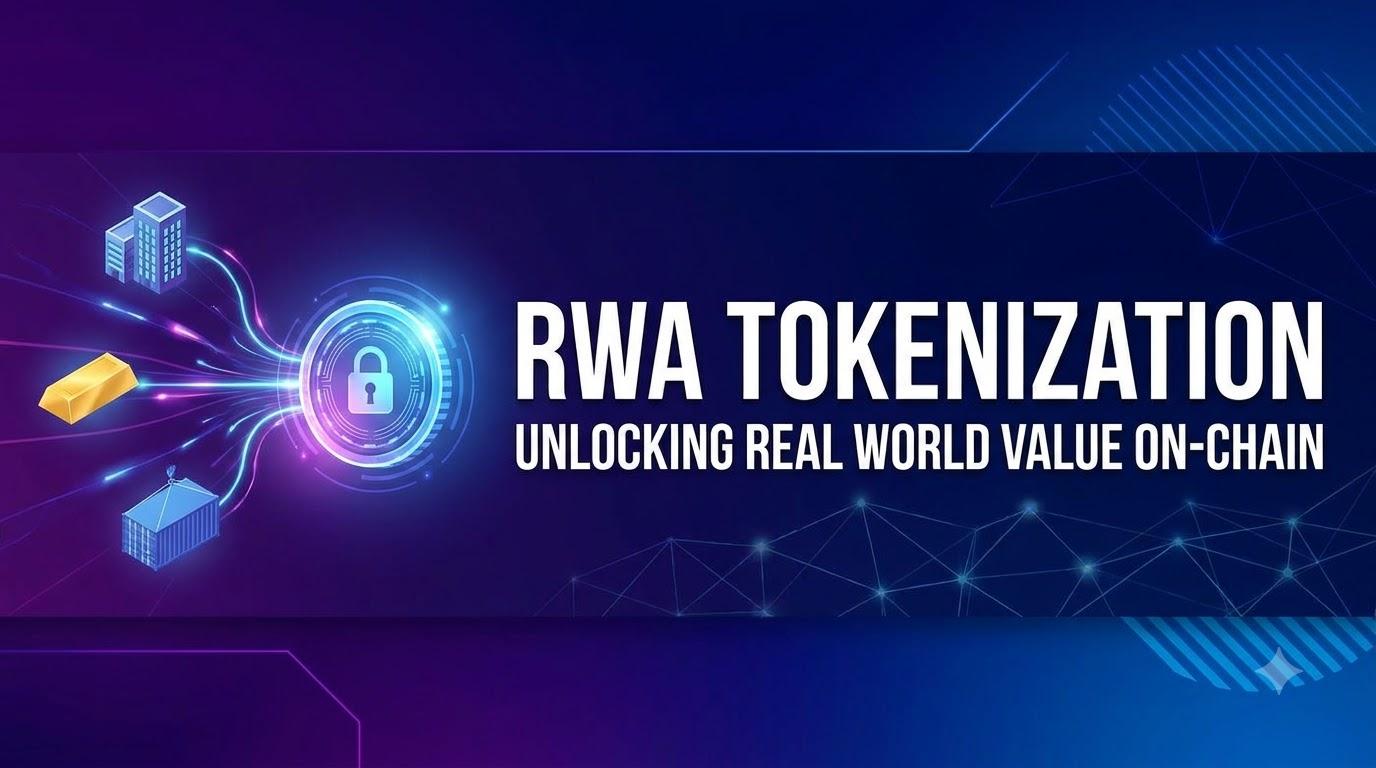
Real-world asset (RWA) tokenization is moving blockchain technology beyond cryptocurrencies and into areas such as real estate, government securities, private credit, commodities, art, and other traditionally illiquid assets. Instead of representing ownership through conventional paper-based or database records alone, tokenization creates blockchain-based representations of assets or legally enforceable claims connected to those assets.
The opportunity is becoming increasingly significant. Tokenized assets had already surpassed $30 billion in market value during 2025, while tokenized U.S. Treasury products represented a substantial portion of the market. More importantly, financial institutions are increasingly experimenting with on-chain issuance, settlement, custody, and secondary trading. In 2026, for example, Securitize announced regulatory approval supporting custody and atomic settlement for tokenized securities, demonstrating how tokenization infrastructure is expanding beyond simple token issuance.
Building an RWA tokenization platform, however, is considerably more complex than creating a cryptocurrency token. A successful platform must connect blockchain infrastructure with legal ownership, asset custody, compliance, investor onboarding, valuation, and sometimes secondary-market liquidity.
What Is an RWA Tokenization Platform?
An RWA tokenization platform is a software ecosystem that enables businesses or asset owners to convert rights associated with physical or financial assets into blockchain-based tokens.
For example, suppose a commercial property is valued at $10 million. Rather than requiring a single investor to purchase the entire property, a legally structured entity could issue 100,000 digital tokens representing defined economic or ownership interests. Investors could potentially purchase smaller portions, subject to the applicable securities, property, and investment regulations.
The important distinction is that the blockchain token itself does not automatically create legal ownership. The legal structure connecting the token to the underlying asset determines what the token holder actually owns or is entitled to receive. Recent academic research similarly describes RWA systems as predominantly hybrid architectures in which blockchain handles representation, transfers, compliance controls, and programmability while legal rights, custody, and verification remain partly off-chain.
This makes legal architecture just as important as technical architecture.
Why Businesses Are Building RWA Tokenization Platforms
Traditional assets often suffer from high entry barriers, fragmented ownership records, lengthy settlement processes, and limited liquidity. Tokenization attempts to address some of these limitations by introducing programmable ownership records and automated transaction workflows.
A tokenized real estate platform, for instance, can potentially allow investors to purchase fractional interests instead of acquiring an entire property. Similarly, tokenized Treasury products can provide blockchain-based access to instruments that traditionally depend on conventional financial infrastructure.
The benefits can include:
- Fractional ownership
- Faster settlement
- Programmable asset management
- Transparent ownership records
- Automated distributions
- Broader investor access where legally permitted
- Improved operational efficiency
- Integration with blockchain-based financial applications
However, tokenization does not eliminate the underlying risks of an asset. A tokenized property remains exposed to property-market risk, vacancy, maintenance costs, valuation changes, and legal disputes. The technology improves the infrastructure around ownership and transactions rather than magically making the underlying investment risk-free.
Essential Features of an RWA Tokenization Platform
The feature set should be designed around the complete asset lifecycle rather than simply token creation.
1. Asset Onboarding and Verification
The platform should allow asset issuers to submit information about the underlying asset, including ownership documents, valuation reports, certificates, financial records, and other supporting documentation.
For example, a real estate issuer may need to provide title information, property valuation, insurance documentation, tax records, and details about the legal entity holding the property.
Document verification and asset due diligence are critical because the blockchain can record a token perfectly while the underlying asset information could still be inaccurate.
2. Token Creation and Management
The platform needs a tokenization engine capable of creating and managing tokens according to the asset's legal and economic structure.
Depending on the use case, tokens may represent equity, debt, revenue participation, fund interests, or another contractual claim. The token contract can include supply controls, transfer restrictions, investor eligibility requirements, redemption mechanisms, and distribution logic.
For regulated securities, permissioned transfers and wallet whitelisting can be particularly important. The SEC has noted that tokenized securities remain subject to applicable securities and other laws, with legal requirements potentially governing how ownership and transfers are recognized.
3. KYC, AML, and Investor Onboarding
An RWA platform cannot treat investor onboarding like a conventional permissionless crypto application when regulated assets are involved.
The system may need:
- Identity verification
- KYC checks
- AML screening
- Accreditation or eligibility verification
- Sanctions screening
- Jurisdiction checks
- Investor risk profiling
- Wallet verification
Once an investor is approved, the platform can associate the verified identity with an approved blockchain wallet.
4. Investor Dashboard
Investors need a clear interface to view their holdings and transactions.
A professional dashboard can display token balances, asset information, valuation data, transaction history, distributions, maturity dates, ownership documents, and compliance status.
For income-producing assets, investors may also receive automated rental income, interest, dividend, or other distributions according to the legal terms of the offering.
5. Marketplace and Secondary Trading
Issuance is only one part of tokenization. Liquidity is arguably one of the most important long-term challenges.
A platform can include a compliant marketplace where eligible investors can buy and sell tokenized assets. Trading rules should be embedded into the infrastructure so that restricted tokens cannot simply be transferred to an unauthorized wallet.
The development of regulated on-chain trading infrastructure illustrates this direction. Securitize announced in 2026 that it had launched fully on-chain regulated trading of tokenized equities with institutional liquidity and distribution partners.
6. Distribution and Corporate Actions
The platform should support automated financial events such as interest payments, dividends, rental distributions, redemptions, maturity events, and token burns.
Smart contracts can automate portions of these workflows, reducing manual reconciliation. However, off-chain data and banking infrastructure are still required whenever real-world money or asset conditions are involved.
RWA Tokenization Platform Architecture
A scalable RWA platform typically uses a multi-layer architecture rather than placing every function directly on a blockchain.
Presentation Layer
This includes the web application, mobile interface, investor dashboard, issuer dashboard, administrator panel, and marketplace interface.
Application Layer
The application layer handles user management, asset onboarding, investment workflows, portfolio calculations, notifications, reporting, and business logic.
Compliance Layer
This is one of the most important components. It connects KYC/AML providers, identity verification systems, sanctions screening, investor eligibility checks, jurisdiction restrictions, and wallet whitelisting.
For security tokens, compliance logic can also be incorporated into smart contracts to prevent unauthorized transfers.
Blockchain Layer
The blockchain layer provides token issuance, ownership records, transactions, smart contracts, and settlement infrastructure. Depending on requirements, developers may use Ethereum-compatible networks, Layer-2 networks, or permissioned blockchain environments.
Smart Contract Layer
Smart contracts control the behavior of tokenized assets. Typical contracts can include:
- Token issuance contracts
- Transfer-control contracts
- Whitelist contracts
- Distribution contracts
- Redemption contracts
- Governance contracts
- Marketplace contracts
For regulated assets, smart contracts should be designed around the legal rules rather than treating compliance as an afterthought.
Oracle and Data Layer
Blockchains cannot independently know the current value of a property, commodity, fund, or other off-chain asset. Oracles and trusted data services can therefore connect external information to blockchain applications.
For example, a tokenized property platform might require property valuation updates, rental information, or other verified data.
Custody and Banking Layer
The platform may need integrations with qualified custodians, banks, payment providers, stablecoin infrastructure, and fiat on/off-ramp services.
This hybrid model is already visible in institutional tokenization platforms. Securitize, for example, has integrated fiat and USDC funding rails to support deposits and withdrawals for tokenized-asset investors.
How to Build the Platform Step by Step
The development process should begin with the asset and jurisdiction, not the blockchain.
First, identify what will be tokenized and determine the legal rights represented by each token. A property token, private-credit token, commodity token, and fund token may require very different structures.
Next, establish the legal entity, custody model, investor eligibility rules, and regulatory framework.
After that, design the token economics and smart-contract architecture. The development team can then build the onboarding, compliance, asset management, wallet, marketplace, and administrative components.
Before launch, smart contracts and critical platform components should undergo security testing and independent audits. The system should also be tested against unauthorized transfers, wallet attacks, oracle manipulation, access-control failures, and incorrect distribution calculations.
Finally, the platform can be deployed gradually. Starting with one asset class and a limited investor group can make it easier to identify operational and compliance issues before expanding into multiple markets.
How Much Does It Cost to Build an RWA Tokenization Platform?
The cost depends heavily on the platform's regulatory requirements, asset class, blockchain architecture, integrations, and trading capabilities.
A basic platform with token issuance, investor dashboards, wallet integration, and administrative tools might cost approximately $40,000–$80,000.
A more advanced platform incorporating KYC/AML, compliance automation, asset management, smart contracts, payment integrations, and marketplace functionality can range from approximately $80,000–$150,000.
An institutional-grade, multi-chain RWA ecosystem with advanced compliance, custody integrations, secondary trading, oracle infrastructure, extensive auditing, and customized legal workflows can exceed $150,000–$300,000+.
These are development estimates rather than fixed market prices. Legal structuring, licensing, third-party compliance providers, custody, audits, infrastructure, and ongoing maintenance can create substantial additional expenses.
Key Challenges to Consider
The biggest challenge is regulatory fragmentation. Tokenization can involve securities laws, property laws, tax regulations, AML requirements, custody rules, and financial-market regulations simultaneously. The applicable requirements depend heavily on the jurisdiction and asset.
Another challenge is the oracle problem. Blockchain records can prove that a token moved from one wallet to another, but they cannot independently prove that a physical building still exists, that a borrower made a payment, or that a commodity reserve has not changed.
Liquidity is another major concern. Creating 100,000 tokens does not automatically create 100,000 buyers. Secondary-market infrastructure, investor demand, compliant trading venues, and appropriate market-making arrangements may all be necessary.
Finally, security must be treated as a continuous process. A platform managing valuable tokenized assets can become an attractive target for smart-contract exploits, compromised administrator accounts, fraudulent identity verification, and wallet attacks.
Real-World Direction of the Market
Institutional activity provides a useful indication of where the industry is heading. Securitize describes its infrastructure as supporting regulated issuance, trading, and management of digital securities, while its 2026 initiatives demonstrate increasing integration between traditional financial-market structures and blockchain settlement.
The broader lesson is that successful RWA platforms are unlikely to be simple token-launch websites. They are becoming financial infrastructure platforms combining blockchain, compliance, custody, legal frameworks, asset servicing, and investor interfaces.
Conclusion
Building an RWA tokenization platform requires much more than developing a smart contract or creating digital tokens. The strongest platforms connect legally enforceable asset rights with secure blockchain infrastructure, investor verification, compliance controls, custody, data services, and efficient settlement. Businesses planning such projects can work with an experienced RWA tokenization development company to design the architecture according to their asset class and regulatory requirements. Blockchain App Factory provides best services for RWA tokenization platform development, offering solutions designed to help businesses tokenize real-world assets, implement blockchain infrastructure, develop smart contracts, integrate compliance features, and create scalable tokenization ecosystems. Choosing the right RWA tokenization company can therefore be an important step toward building a secure, compliant, and commercially viable platform.

 English
 Arabic
 French
 Portuguese
 Deutsch
 Turkish
 Dutch
Dutch
 Italiano
 Russian
 Romaian
 Portuguese (Brazil)
 Greek
Greek