
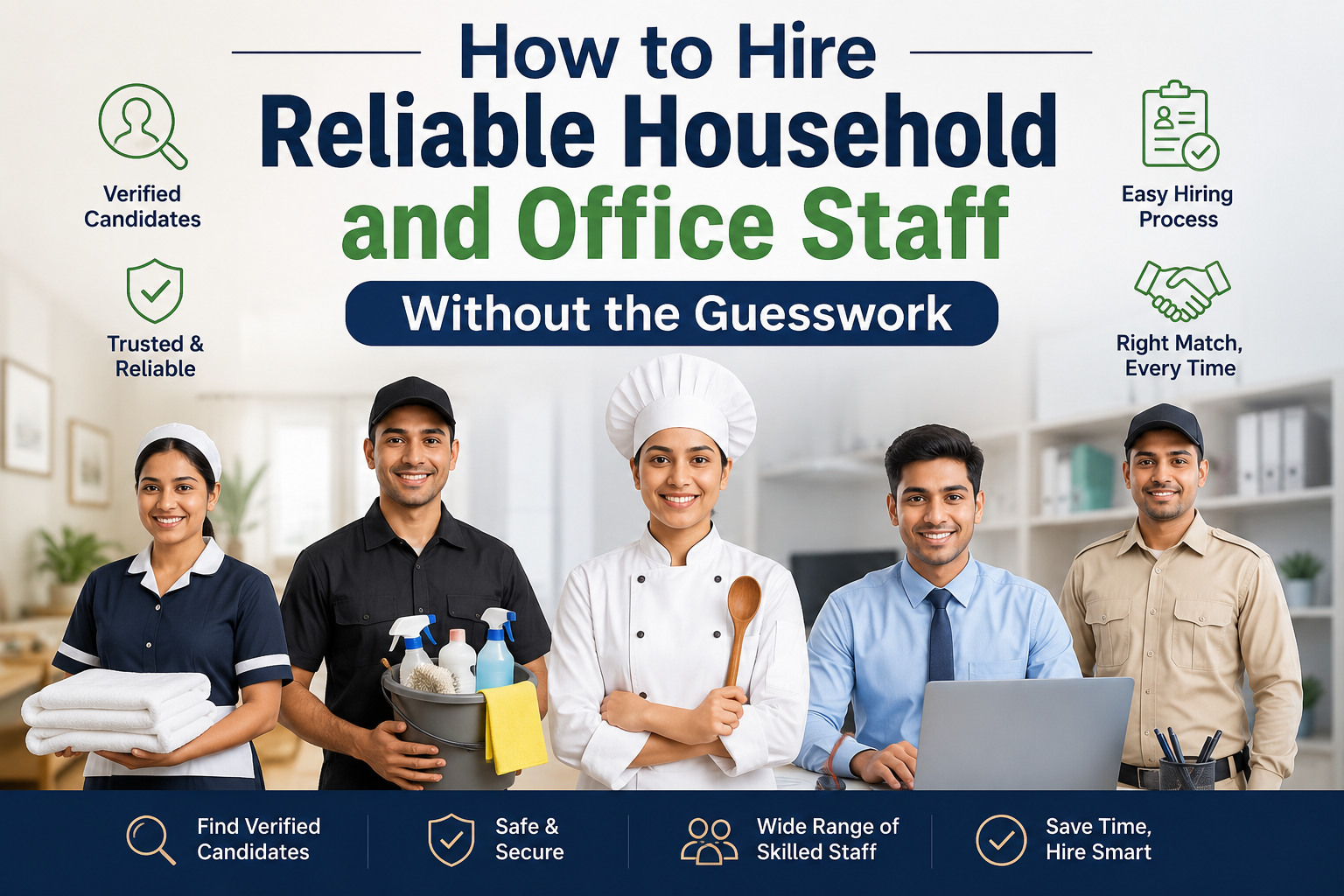
Hiring someone to work in your home or office is one of those decisions that feels small right up until it isn't. A driver who shows up late every day, a maid who quits after two weeks, an office assistant who can't actually do half of what their CV claims — none of these are dramatic disasters on their own, but they pile up fast. And by the time you notice the pattern, you've usually already spent weeks re-interviewing, re-training, or just quietly doing the work yourself because it's easier than explaining it again.
So let's talk about what actually goes wrong when people hire staff, and what tends to work better.
Why "gut feeling" hiring keeps backfiring
Most people hire household or office staff the same way: ask around, post in a WhatsApp group, maybe put up a notice, and pick whoever seems decent in a fifteen-minute chat. It's fast, and sometimes it works out fine. But a short conversation tells you almost nothing about whether someone shows up on time, handles a kitchen safely, or actually knows how to drive in traffic rather than just having a license.
The real cost isn't the bad hire itself — it's everything that comes after. Retraining. Re-advertising. The awkward stretch where you're not sure if you should say something or just wait it out. Multiply that by every role you're filling, and "quick and informal" ends up being neither.
The mistakes that show up again and again
A few patterns come up constantly when hiring goes badly:
- Skipping reference checks entirely. A phone call that takes five minutes can save you months of frustration. Most people skip it because it feels awkward to ask.
- Judging solely on the interview. Someone can be great at interviews and mediocre at the actual job — or the reverse. Nervous candidates who'd be excellent often get passed over because they didn't perform well under pressure.
- Not verifying identity or documents. This matters more for household staff than people realize, especially when they'll have access to your home while you're not there.
- No trial period. A short paid trial tells you more in three days than any interview will in three hours.
- Vague expectations. If you haven't written down working hours, days off, and what the job actually includes, don't be surprised when there's a disagreement about it a month in.
None of these are complicated fixes. They just require slowing down slightly at the start, which is hard to do when you need someone now.
A simple checklist before you hire anyone
Before you commit to hiring a driver, cook, maid, technician, or office assistant, run through this:
- Ask for at least one verifiable reference — and actually call them.
- Confirm ID and, where relevant, any certifications they claim to have.
- Be specific about the role — hours, tasks, days off, pay, probation period — in writing if possible.
- Start with a short trial, paid, before making it permanent.
- Trust consistency over charm. Someone who answers questions plainly and shows up on time to the interview is a better sign than someone who's smooth-talking but vague on details.
It sounds obvious written out like this. In practice, most people skip at least two or three of these steps because hiring feels urgent and checklists feel slow.
Where you actually look matters
This is the part people underestimate. If your entire search radius is "people I already know" or one Facebook post, you're choosing from a tiny, random pool — not necessarily a good one. Widening the search matters, but so does where you widen it to.
There's a real difference between an open classified board where anyone can post anything, and a platform where candidates are actually reviewed before they're listed. This is especially true in cities like Lahore, where hiring drivers, maids, and office staff is largely still word-of-mouth — which means most people are choosing from whoever their neighbor or cousin happens to know, not from whoever's actually best for the job.
For household and office roles specifically — driver, maid, cook, office assistant, technician, and similar — a candidate directory where profiles go through some form of verification cuts out a lot of the guesswork before you even get to the interview stage. Dostyy is a Pakistan-based career networking platform built around exactly this. It's set up as a searchable directory of pre-interviewed candidates across dozens of household and office roles, so employers in Lahore and other cities aren't starting from zero every time they need to fill a position.
That doesn't replace doing your own checks — you should still call references and run a trial period regardless of where you found someone. But starting from a smaller, more filtered pool beats starting from an open, unfiltered one.
The bottom line
Bad hires rarely happen because someone was careless on purpose. They happen because hiring feels urgent, checklists feel slow, and it's tempting to trust a good first impression. A little structure — references, clear expectations, a trial period, and a decent starting pool of candidates — fixes most of what goes wrong, without turning hiring into a huge production.
It's not about overcomplicating something simple. It's about not skipping the five-minute steps that save you five weeks later.

 English
 Arabic
 French
 Spanish
 Portuguese
 Deutsch
 Turkish
 Dutch
Dutch
 Italiano
 Russian
 Romaian
 Portuguese (Brazil)