
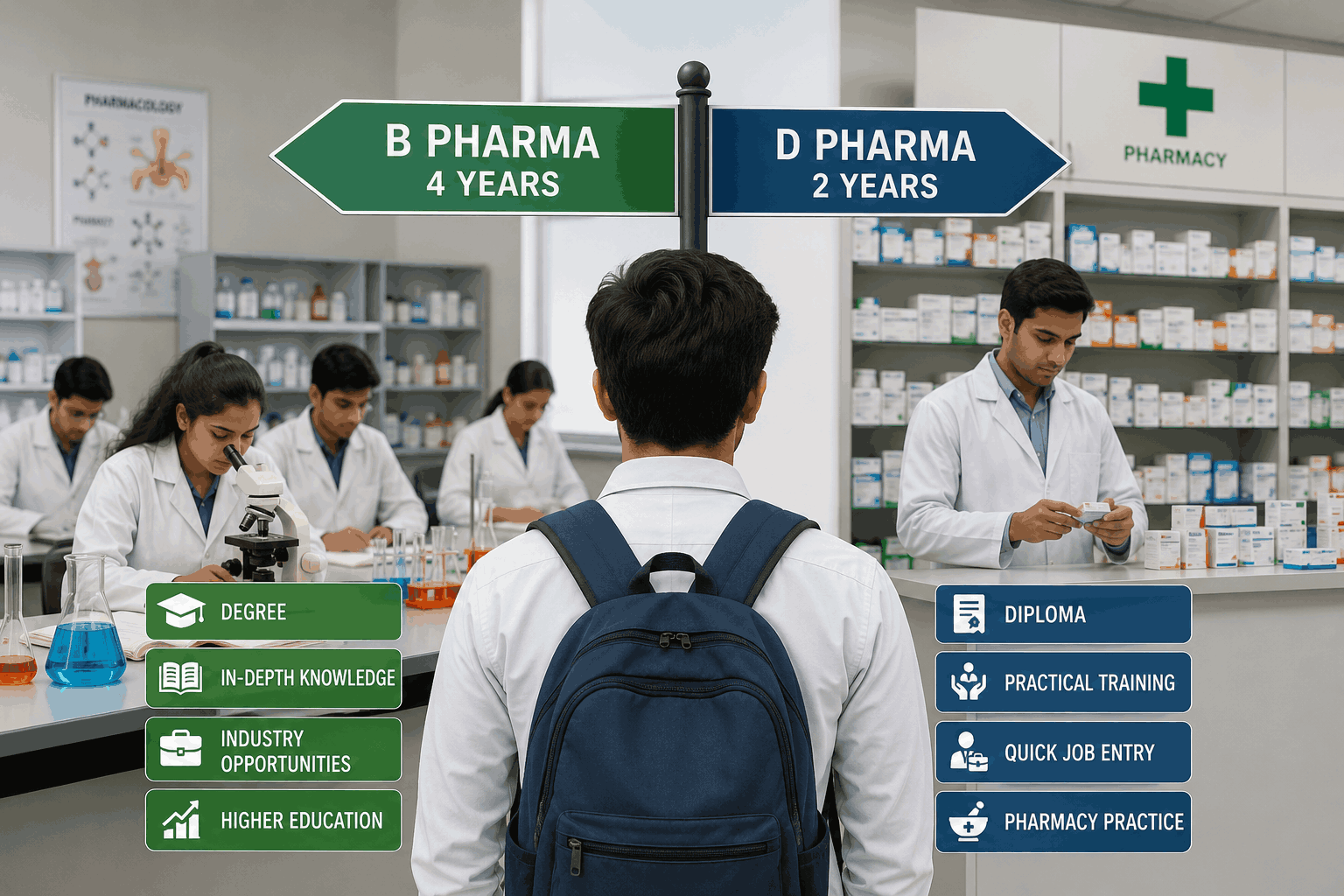
The Two Routes Into Pharmacy — How Students in Lucknow Are Choosing Between B Pharma and D Pharma
Every year, thousands of students in Uttar Pradesh complete their 10th or 12th standard and face the pharmacy admission decision. The conversation in most households sounds similar: B Pharma or D Pharma? Four years or two? Degree or diploma? Which one leads to a better job? Which one is right for our situation?
These are the right questions. But the answers depend on context that generic admission advice rarely provides — the student's actual career interests, the family's financial and time constraints, the kind of work the student wants to do five years from now, and how much flexibility they want to maintain as their career develops.
This guide is for students and families in Lucknow who want a clearer picture of both routes before making a decision that will shape the next several years.
The Fundamental Difference Between the Two Programs
B Pharma and D Pharma both produce registered pharmacists. That much is true. But the professional capabilities, career ceilings, and industry positioning of graduates from each program are meaningfully different.
B Pharma is a four-year undergraduate degree that covers the full breadth of pharmaceutical science — chemistry, pharmacology, biopharmaceutics, drug delivery systems, pharmaceutical technology, and clinical pharmacy. The depth of coverage across these subjects produces graduates who are equipped for roles across the pharmaceutical industry, not just in pharmacy practice. Manufacturing companies, clinical research organisations, quality assurance departments, and regulatory affairs teams all hire B Pharma graduates.
D Pharma is a two-year diploma that covers the foundational content needed to practise as a registered pharmacist — pharmaceutical chemistry, pharmacology, pharmacognosy, hospital pharmacy, and community pharmacy. It produces graduates who are ready to work in pharmacy practice settings — retail pharmacies, hospital dispensaries, and entry-level manufacturing roles — in a significantly shorter timeframe.
The simplest frame for the distinction: D Pharma produces a practising pharmacist. B Pharma produces a pharmacy professional with a wider range of industry options.
When D Pharma Is the Smarter Choice
D Pharma's two-year duration is its most obvious practical advantage, but the strategic reasons to choose it go further than simply finishing sooner.
For students from families with pharmacy backgrounds — where retail pharmacy is an established family livelihood — D Pharma provides the formal qualification that legitimises and professionalises practice that may already be happening in some form. The diploma's focus on retail, dispensing, and community pharmacy is directly applicable to this context in a way that B Pharma's broader industrial content isn't.
For students who need to begin earning within two years — whether for family financial reasons or simply because four years feels like an unnecessarily long delay before entering the workforce — D Pharma provides a real, deployable qualification in half the time.
The lateral entry pathway also makes D Pharma strategically flexible in a way students often don't consider during the initial decision. D Pharma graduates can apply for lateral entry into the second year of a B Pharma program, reducing the total time to a degree. A student who completes D Pharma and then uses lateral entry into B Pharma finishes a full pharmacy degree in five years from 10th standard rather than six — and enters the workforce with income from the diploma years while completing the degree. This is not a theoretical pathway; it's an active route that many students across UP have used successfully.
For students in Lucknow specifically, researching d pharma in lucknow institutions should focus on the hospital attachment quality and PCI examination preparation — the two factors that most directly determine how job-ready a D Pharma graduate feels on the first day of work.
When B Pharma Is the Right Investment
B Pharma's four-year commitment makes most sense for students who have a clear directional interest in the pharmaceutical industry beyond retail pharmacy practice.
If a student's career interest is in pharmaceutical manufacturing — the sector that makes India the world's largest generic medicine supplier — B Pharma is the baseline qualification that most manufacturing companies require for entry-level technical roles. Quality assurance, production, and regulatory functions in established pharmaceutical companies consistently require a degree rather than a diploma.
If the eventual goal is M Pharma, Pharm D, or any postgraduate qualification in pharmacy — including academic and research pathways — B Pharma is the necessary foundation. D Pharma does not provide direct access to most postgraduate pharmacy programs.
If the student's interest is in clinical research — one of the faster-growing career pathways for pharmacy graduates, driven by India's expanding role in global drug development — B Pharma provides the pharmacological depth that clinical research positions require.
Students in Lucknow considering this route should look at b pharma in lucknow programs with specific attention to laboratory infrastructure and placement connections with pharmaceutical manufacturing and clinical research employers — the entry points that make the four-year investment produce its intended return.
The Lucknow Context — Why the City Supports Both Routes Well
Lucknow's pharmaceutical ecosystem — government hospitals, private healthcare institutions, an active pharmaceutical retail sector, and proximity to the developing UP pharmaceutical manufacturing corridor — creates genuine employment demand for graduates at both qualification levels.
D Pharma graduates entering Lucknow's retail pharmacy sector find a market with consistent demand, particularly as pharmacy chains expand their presence across the city's growing residential areas. Hospital pharmacy positions, while more competitive, are available through the city's multiple hospital campuses.
B Pharma graduates from Lucknow access employment through the pharmaceutical company connections that established institutions maintain — connections that are meaningfully stronger in a state capital than in smaller cities across UP.
MCSGOC offers both programs in Lucknow through Dr. M.C. Saxena College of Pharmacy, with the laboratory infrastructure and industry relationships that support graduate outcomes at both levels.
Making the Decision That Fits Your Situation
The right choice between B Pharma and D Pharma isn't determined by which program is objectively superior. It's determined by the match between the program's output and the student's actual situation, timeline, and career direction.
A student clear about wanting a pharmaceutical manufacturing or research career should invest in B Pharma. A student who needs to enter the workforce quickly, has a pharmacy practice context to enter, or wants to evaluate the profession before a longer commitment should consider D Pharma — with the lateral entry option clearly in mind as a future pathway.
Either way, the college matters as much as the program. Two years in a D Pharma program with poor hospital attachment arrangements produces a less capable graduate than two years in one that takes practical training seriously. The same logic applies to B Pharma. Ask the specific questions — placement data, laboratory equipment, faculty background — that reveal program quality before committing to either route.

 English
 Arabic
 French
 Spanish
 Portuguese
 Deutsch
 Turkish
 Dutch
Dutch
 Italiano
 Russian
 Romaian
 Greek
Greek