
Fear doesn't stop a price from falling.
Excitement doesn't push a token higher.
Hope doesn't reverse a losing position.
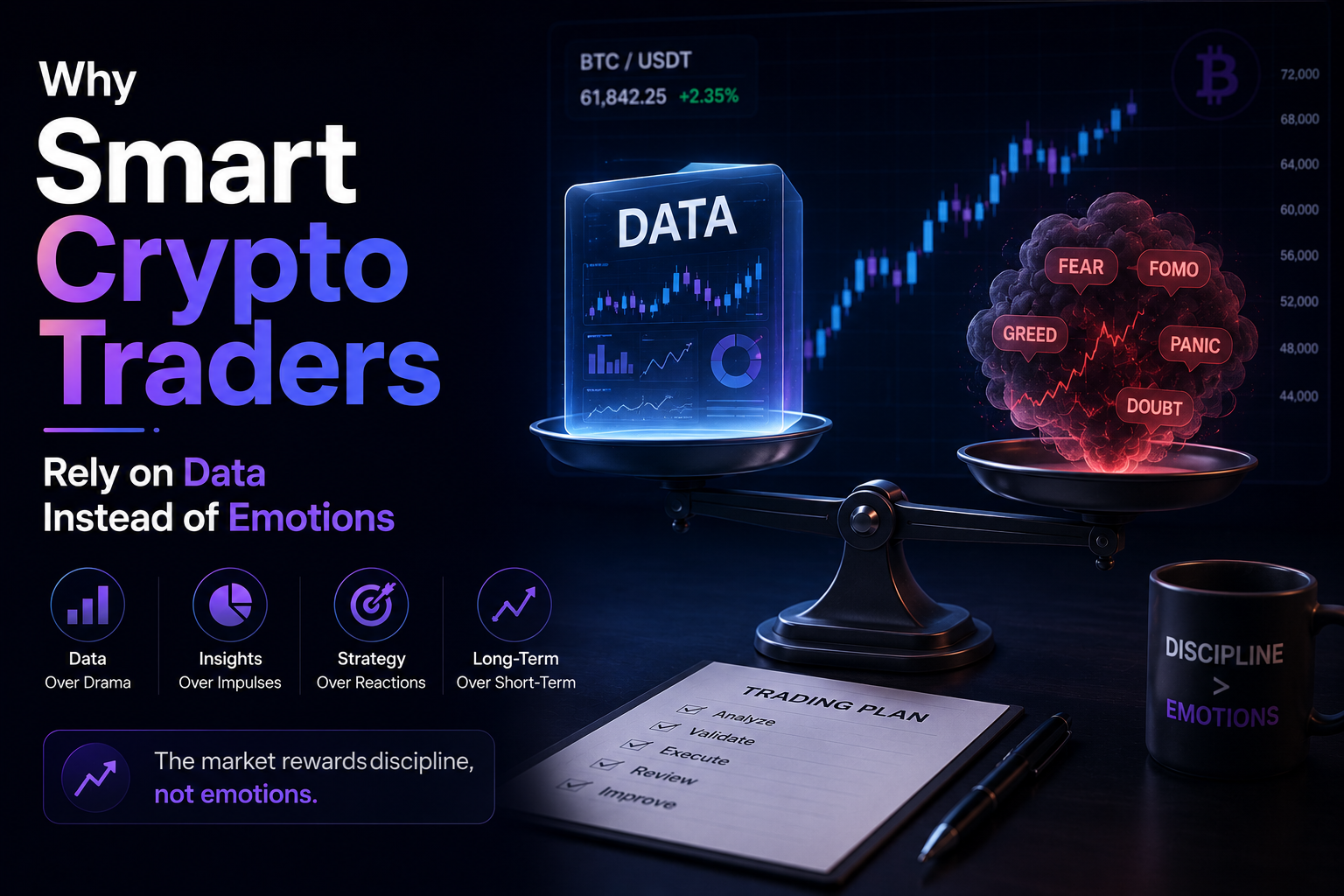
Yet emotions influence thousands of trading decisions every day.
Most traders have experienced it: buying after seeing a green candle race upward, refusing to close a losing trade because "it will recover," or selling in panic after a sudden market drop. These reactions feel natural, but they rarely produce consistent results.
The traders who survive multiple market cycles usually have one thing in common they build decisions around data instead of emotions.
Why Emotions Are So Powerful in Crypto
Crypto markets operate 24/7, move rapidly, and react instantly to news, liquidity shifts, and social sentiment. That environment creates emotional pressure unlike almost any other financial market.
Some of the most common emotional traps include:
Fear of Missing Out (FOMO)
A token gains 40% overnight.
Instead of asking why the move happened, traders rush to enter, often buying near local highs.
Panic Selling
A sharp correction creates fear.
Without understanding whether the move is temporary or supported by broader market conditions, positions are closed at the worst possible moment.
Confirmation Bias
Many traders search only for information that supports what they already believe.
Bullish? Every positive tweet becomes "proof."
Bearish? Every correction confirms a crash is coming.
The market rarely rewards these habits.
Data Creates Distance From Emotion
Data doesn't eliminate uncertainty.
It reduces unnecessary guesswork.
When decisions are based on measurable information rather than instinct, traders gain a clearer understanding of what's actually happening beneath the surface.
Instead of asking:
"Should I buy because everyone else is?"
A data-driven trader asks:
- Is capital flowing into the market?
- What does on-chain intelligence reveal?
- Are large holders accumulating or distributing?
- What are funding rates indicating?
- Is open interest rising with price?
- Does market sentiment support the trend?
These questions shift the focus from emotion to evidence.
What Kind of Data Matters Most?
Not every metric deserves equal attention.
Successful traders learn to prioritize information that provides meaningful context.
On-Chain Intelligence
Blockchain activity reveals how wallets behave before price movements become obvious.
Tracking large transfers, exchange inflows, and smart money accumulation can provide valuable clues about market positioning.
Market Sentiment
Community conversations often influence short-term momentum.
However, sentiment becomes useful only when combined with other forms of analysis instead of being viewed in isolation.
Derivatives Data
Metrics such as funding rates, open interest, and liquidation levels help explain how leveraged traders are positioned.
These indicators often reveal growing market pressure before significant volatility arrives.
Liquidity Analysis
Markets tend to move toward areas where liquidity exists.
Understanding liquidity distribution helps traders anticipate potential reactions instead of chasing sudden price movements.
A Practical Example
Imagine Bitcoin suddenly drops 6%.
An emotional trader immediately assumes the trend has reversed and exits every position.
A data-driven trader investigates first.
They review:
- Exchange inflows
- Whale wallet activity
- Funding rates
- Open interest
- Stablecoin inflows
- Market sentiment
- Liquidity zones
If most indicators remain healthy, the decline may simply represent a normal correction rather than the beginning of a larger downtrend.
The price movement hasn't changed.
Only the quality of the decision has.
Consistency Beats Excitement
Many people think successful trading is about finding the next 100x opportunity.
In reality, long-term profitability usually comes from making fewer emotional mistakes.
Consistent traders often:
- Follow predefined entry and exit criteria.
- Wait for confirmation instead of reacting instantly.
- Review multiple market indicators before acting.
- Accept losses as part of risk management.
- Avoid chasing every trending narrative.
Their advantage isn't predicting every move it's making disciplined decisions repeatedly.
Why Market Intelligence Is Becoming Essential
Crypto has evolved beyond simple chart analysis.
Today's markets generate enormous volumes of information across blockchains, exchanges, derivatives markets, news platforms, and social media.
No individual trader can manually process everything in real time.
This is why crypto market intelligence is becoming increasingly valuable.
Rather than overwhelming traders with endless alerts, modern intelligence platforms aim to organize real-time crypto insights, blockchain analytics, smart money tracking, crypto sentiment analysis, and market signal analysis into a more complete view of the market.
The objective isn't to replace human judgment but to improve it.
Building Better Trading Habits
Data alone won't guarantee profitable trades.
Discipline still matters.
A practical routine might include:
- Review broader market conditions before opening any position.
- Validate technical setups using on-chain intelligence and liquidity data.
- Check derivatives metrics for unusual leverage.
- Monitor sentiment without letting it dictate decisions.
- Document each trade and evaluate the outcome objectively.
Over time, this process builds confidence based on evidence rather than emotion.
The Future Belongs to Informed Traders
As crypto markets become more complex, the competitive advantage will come from interpreting information faster and more accurately not from reacting emotionally.
This is the direction newer trading intelligence platforms are exploring i5.xyz currently in its testnet phase, is being developed to help traders bring together multiple layers of market information including AI trading intelligence, crypto market analysis, real-time crypto insights, on-chain intelligence, liquidity data, derivatives metrics, and sentiment analysis into a unified decision-support experience. Instead of switching between multiple dashboards, traders can focus on understanding what truly matters before making their next move.
Final Thoughts
Emotions are part of every trader's journey, but they shouldn't be the foundation of every decision.
The most successful traders aren't emotionless they're prepared. They rely on evidence, validate assumptions with data, and understand that consistent decision-making often outperforms impulsive reactions.
In today's fast-moving crypto markets, the goal isn't to remove emotion entirely. It's to ensure that every trade is guided by reliable information, thoughtful analysis, and a clear understanding of market conditions.

 English
 Arabic
 French
 Spanish
 Deutsch
 Turkish
 Dutch
Dutch
 Italiano
 Russian
 Romaian
 Portuguese (Brazil)
 Greek
Greek