
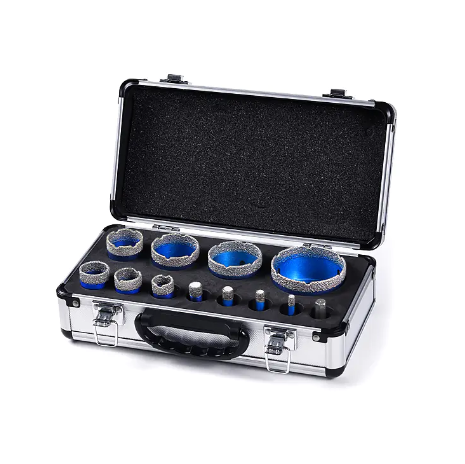
The Electroplated Diamond Hole Saw is widely used for precision drilling in brittle and hard materials such as glass, ceramic, porcelain, marble, slate, and fiberglass. Unlike conventional twist drills that rely on cutting edges, this tool works through abrasive grinding using industrial diamond particles bonded on the working edge. This structure allows stable hole formation with reduced cracking risk during operation.
The electroplating process creates a nickel-based layer that holds a single or multi-layer diamond coating on the steel body. This bond structure ensures that each diamond particle remains exposed for active cutting. Typical grit size used in production ranges from 50–60 mesh, which balances cutting speed and surface smoothness. The working depth of standard models is usually around 25–30 mm, while diameters can range from 3 mm to over 100 mm depending on application requirements.
One of the key advantages of an Electroplated Diamond Hole Saw is its ability to produce clean, chip-free edges. This is particularly important when drilling glass panels, ceramic tiles, or decorative stone surfaces where edge quality directly affects final installation appearance. The tool minimizes micro-cracks by reducing lateral stress during drilling.
Technical Characteristics
A typical configuration includes:
Steel body with nickel electroplated coating
Diamond grit: 50–60 mesh synthetic diamond
Shank diameter: 6–10 mm depending on size
Cutting depth: 25–30 mm standard
Compatible tools: hand drill, bench drill
Recommended speed: low RPM (800–3000 RPM depending on material)
Cooling method: continuous water lubrication
Cooling plays a critical role. Water reduces friction heat, removes abrasive debris, and prevents diamond layer overheating. Without coolant, the electroplated layer may degrade faster, reducing tool life.
Material Compatibility
This type of hole saw is designed for:
Glass (window glass, aquarium glass)
Ceramic and porcelain tiles
Marble and granite (light-duty drilling)
Slate and limestone
Fiberglass and composite panels
However, it is not suitable for metal, reinforced concrete, or tempered glass due to internal stress behavior and material hardness limitations.
Working Principle
The drilling process is based on controlled abrasion. Instead of cutting, the diamond particles grind the surface gradually. A circular groove forms first, followed by progressive penetration. Operators often start at a slight angle before stabilizing the drill vertically, improving hole accuracy and reducing tool wandering.
In industrial usage, the Electroplated Diamond Hole Saw is valued for its balance between cost efficiency and precision. While sintered diamond tools may offer longer lifespan in extreme environments, electroplated versions are widely used in fabrication shops, construction finishing, and DIY applications due to easier handling and lower initial cost.
Practical Usage Notes
Always apply water cooling during operation
Use low pressure to avoid material cracking
Start drilling at an angle before straight alignment
Remove debris periodically for stable cutting
Overall, this tool provides a controlled and efficient method for drilling fragile and abrasive materials where conventional cutting tools fail.

 English
 Arabic
 French
 Spanish
 Portuguese
 Deutsch
 Turkish
 Italiano
 Russian
 Romaian
 Portuguese (Brazil)
 Greek
Greek