
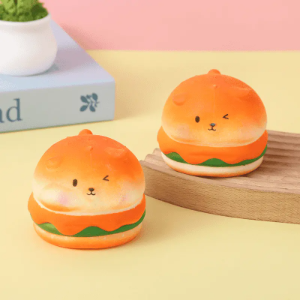
A Maltose Stress Ball is a sensory squeeze toy designed with a unique internal gel system that creates a distinct tactile response during hand compression. Unlike foam-based stress toys that rely on air pockets, this type of stress ball uses a maltose-based viscous filling that delivers a slower, denser rebound sensation.
The internal material is typically a refined maltose syrup blended with stabilizers and viscosity modifiers. Maltose itself is a disaccharide derived from starch hydrolysis, commonly used in food chemistry, but in stress ball applications it is processed into a non-edible gel state. This transformation changes its behavior from a simple sugar compound into a controlled mechanical damping medium.
Inside a standard Maltose Stress Ball, the gel density usually ranges between 1.1–1.3 g/cm³ depending on formulation. This higher density is responsible for the “heavy squeeze” sensation users often describe. The gel does not flow quickly; instead, it shifts slowly under pressure, creating a delayed deformation effect.
The outer shell is commonly made from thermoplastic polyurethane (TPU) or thermoplastic rubber (TPR), with thickness typically between 1.2 mm and 2.0 mm. This shell provides elasticity while maintaining structural integrity during repeated squeezing cycles. Some versions may also use silicone elastomers for improved softness and skin comfort.
One key mechanical feature is the internal pressure balance. The maltose gel is sealed in a semi-elastic chamber, which allows slight movement without full volume displacement. This prevents sudden shape collapse and ensures consistent rebound behavior.
confirms that maltose-filled stress balls rely on slow-flowing syrup systems designed specifically for tactile resistance rather than fluid motion. This distinguishes them from water-gel or foam-based alternatives.
Mechanical Behavior Under Compression
When a user squeezes a Maltose Stress Ball, three physical processes occur simultaneously:
Outer shell deformation under finger force
Internal gel displacement with high viscosity resistance
Gradual elastic recovery after pressure release
The response time can range from 0.8 seconds to several seconds depending on formulation thickness. This delay is what creates a calming sensory effect for repetitive use.
The gel also exhibits mild temperature sensitivity. At higher temperatures, viscosity decreases slightly, making the ball feel softer. At lower temperatures, internal resistance increases, producing a firmer squeeze feel.
Durability and Usage Cycle
Typical product testing includes 5,000–15,000 compression cycles. Failure usually occurs at seam junctions rather than in the gel itself. The internal maltose compound remains stable, but shell fatigue can lead to micro-leakage under extreme repeated stress.
The combination of material layers is what defines performance consistency:
Outer shell: TPU or TPR elastomer
Middle interface: bonding layer for sealing
Inner core: maltose viscous gel
Each layer contributes to controlled deformation and tactile feedback.
Functional Purpose
A Maltose Stress Ball is not only a novelty item but also a sensory regulation tool. The deep pressure input generated during squeezing activates proprioceptive feedback in the hands, which can support focus and relaxation routines. This is why it is often used in office environments, classrooms, and therapy-related contexts.
The combination of slow gel movement and elastic rebound creates a predictable sensory loop, which is the core design principle behind this type of stress toy.

 English
 Arabic
 French
 Spanish
 Portuguese
 Deutsch
 Turkish
 Dutch
Dutch
 Italiano
 Russian
 Portuguese (Brazil)
 Greek
Greek