
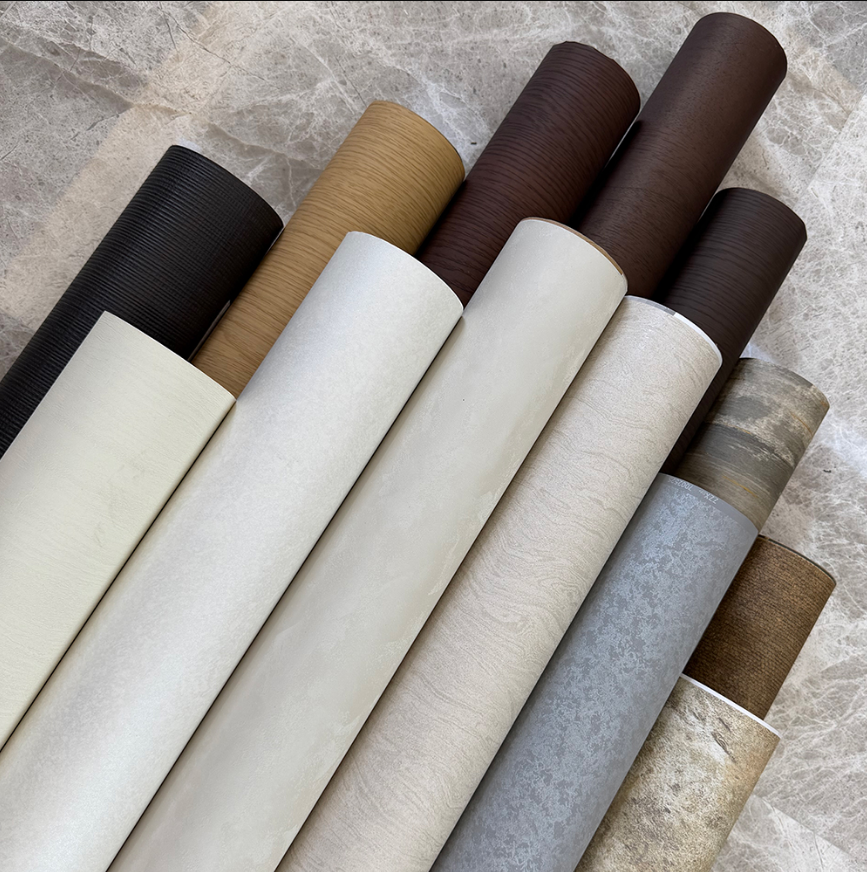
A door often becomes one of the visual focal points of a room, yet replacing old doors can require significant labor and material costs. Decorative film for doors provides an alternative surface solution that updates appearance while adding practical protection. Residential projects, commercial spaces, hotels, offices, and educational facilities increasingly use decorative films to create wood, stone, metallic, fabric, or solid-color finishes without changing the original door structure.
Modern decorative film technology combines printing, embossing, protective coatings, and adhesive systems into a multi-layer product designed for long service life. Typical constructions include a decorative printed layer, a wear-resistant top coating, a polymer base film, and an adhesive backing. PVC and PET materials are commonly used depending on the application requirements. Typical thickness ranges from 0.12 mm to 0.50 mm for door surface decoration, balancing flexibility with durability.
Surface Appearance and Material Choices
One reason decorative film for doors has become popular is the variety of finishes available. Manufacturers can create patterns that resemble:
Natural wood grain
Marble textures
Brushed metal
Leather effects
Fabric-inspired surfaces
Matte and glossy solid colors
Embossing technology adds depth to the printed design, creating a tactile feel that complements the visual appearance. Door manufacturers often select embossed textures to reduce visible fingerprints and minor scratches.
PVC decorative films generally offer good flexibility for profile wrapping and vacuum pressing, while PET decorative films provide enhanced surface hardness and dimensional stability for flat door panels.
Technical Features Worth Considering
A quality decorative film for doors should satisfy both decorative and functional requirements.
Common technical parameters include:
Film thickness:
0.12 mm to 0.50 mm.
Width:
1000 mm to 1420 mm for industrial processing.
Elongation:
Above 150% for three-dimensional forming applications.
Temperature resistance:
Many decorative films can tolerate temperatures approaching 80°C during normal indoor use.
Adhesion:
Strong bonding systems reduce edge lifting and delamination.
Surface protection:
Special coatings improve scratch resistance and stain resistance.
UV stabilization:
Helps reduce color fading under indoor sunlight exposure.
These characteristics contribute to stable appearance and easier maintenance throughout the product's service life.
Manufacturing Compatibility
Door manufacturers work with several production methods, and decorative films can support different processing routes.
Vacuum membrane pressing allows heated film to conform to routed MDF door panels.
Flat lamination works well for smooth composite boards.
Profile wrapping covers edges and complex shapes.
Hot pressing creates durable bonds between the decorative layer and substrate.
Compatible substrates include:
MDF
HDF
Plywood
WPC panels
PVC boards
Composite door skins
Production flexibility helps manufacturers offer multiple designs while reducing inventory complexity.
Maintenance Benefits
Decorative surfaces on doors experience daily contact from hands, bags, furniture movement, and cleaning operations. Protective coatings help maintain appearance under normal indoor conditions.
Routine maintenance is straightforward:
Clean with a soft cloth.
Use mild neutral cleaners.
Avoid strong solvents.
Remove stains promptly.
Prevent direct contact with sharp metal objects.
Unlike painted surfaces that may require repainting after damage, decorative films often maintain consistent color across the entire panel.
Design Flexibility for Modern Projects
Architects and interior designers frequently seek consistent finishes across multiple surfaces.
A decorative film for doors can coordinate with:
Wall panels
Cabinets
Wardrobes
Reception desks
Furniture
Elevator interiors
Wood grain collections remain popular because they provide a natural appearance while avoiding the variations associated with solid timber.
Matte finishes suit contemporary interiors, while textured patterns create visual depth under changing light conditions.
Environmental Considerations
Surface films can reduce the need for natural wood veneers in certain applications. Refurbishing existing doors rather than replacing them may also reduce material waste during renovation projects.
Modern production methods have introduced water-based inks, improved coating technologies, and controlled manufacturing processes that support stable product quality.
Long service life also contributes to reduced replacement frequency, particularly in commercial settings where maintenance schedules affect operating costs.
Future Trends
Decorative film for doors continues to evolve with new textures and protective coatings. Current developments focus on:
Anti-fingerprint surfaces.
Low-gloss finishes.
Improved scratch resistance.
Enhanced UV stability.
Digital printing customization.
Antimicrobial coatings for selected environments.
As interior design preferences shift, decorative films provide manufacturers and building owners with an adaptable surface solution that balances aesthetics and practical performance.
A carefully selected decorative film for doors offers more than a cosmetic upgrade. Material structure, coating technology, adhesion systems, and processing compatibility work together to create a finished surface suitable for residential and commercial interiors. Technical specifications, proper installation, and regular maintenance help maintain appearance and functionality across years of daily use.

 English
 Arabic
 French
 Spanish
 Portuguese
 Deutsch
 Dutch
Dutch
 Italiano
 Russian
 Romaian
 Portuguese (Brazil)
 Greek
Greek