
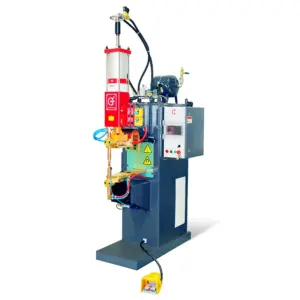
In modern manufacturing, precision, repeatability, and production efficiency define competitiveness. Among resistance welding technologies, the projection welder plays a critical role in joining components with pre-formed contact points. It is widely used in automotive, electrical, appliance, and heavy fabrication industries where consistent weld quality and high-volume output are required.
As a global industrial welding technology provider, Heron Welder delivers advanced projection welding systems designed for automated production lines, OEM integration, and high-strength metal joining applications.
What Is a Projection Welder?
A projection welder is a type of resistance welding machine that joins metal parts using localized heat and pressure at predetermined projection points on the workpiece.
Unlike traditional spot welding, where electrodes create the contact point, projection welding uses embossed or raised projections on one or both metal surfaces. These projections concentrate current flow and pressure, allowing multiple welds to be completed in a single operation.
This makes projection welding ideal for:
- Fasteners (nuts, bolts, studs)
- Sheet metal assemblies
- Electrical components
- Automotive brackets and mounts
Working Principle of Projection Welding
The projection welding process is based on the fundamentals of resistance heating:
1. Preparation of Workpieces
One or both metal components are stamped or machined with small projections (dimples, ridges, or embossed points). These act as controlled contact points.
2. Electrode Clamping
The workpieces are placed between flat or specially designed electrodes. The machine applies controlled force to hold the parts together.
3. Current Application
A high electrical current passes through the projections. Due to reduced contact area, electrical resistance is higher at these points, generating localized heat.
4. Fusion and Collapse
The projections heat rapidly, soften, and collapse under pressure. This forms a strong, uniform weld nugget at each projection point.
5. Cooling Phase
The current stops while pressure is maintained briefly to solidify the weld, ensuring structural integrity.
Key Advantages of Projection Welding
Projection welding is widely adopted in industrial manufacturing due to its efficiency and consistency.
1. Multiple Welds in One Cycle
Several projections can be welded simultaneously, significantly improving production speed.
2. Longer Electrode Life
Flat electrodes experience less wear compared to spot welding tips, reducing maintenance cost.
3. High Repeatability
The projection geometry ensures consistent heat concentration, resulting in uniform weld quality.
4. Ideal for Automation
Projection welding integrates easily into robotic and automated production lines.
5. Minimal Surface Damage
The process reduces indentation marks and surface distortion on visible parts.
Industrial Applications of Projection Welding
Projection welders are widely used across high-volume manufacturing sectors:
Automotive Industry
- Seat frames
- Door hinges
- Brackets and reinforcement plates
- Sensor mounts
Electrical Industry
- Busbars
- Terminal connections
- Switchgear components
- Conductive assemblies
Appliance Manufacturing
- Washing machine drums
- Refrigerator frames
- Microwave structural parts
Heavy Engineering
- Sheet metal fabrication
- Structural assemblies
- Industrial enclosures
The ability to weld multiple points simultaneously makes it especially valuable in mass production environments.
Projection Welding vs Spot Welding
Understanding the difference between projection welding and spot welding helps manufacturers choose the right process.
Heat Distribution
- Projection Welding: Heat is concentrated at predefined projections
- Spot Welding: Heat is generated at electrode contact points
Production Efficiency
- Projection welding allows multiple welds per cycle
- Spot welding typically produces one weld per cycle
Tool Wear
- Projection welding reduces electrode wear
- Spot welding requires frequent electrode dressing or replacement
Application Suitability
- Projection welding is ideal for fasteners and multi-point joints
- Spot welding is better for simple sheet-to-sheet joining
For high-volume production lines, projection welding is often the more efficient choice.
Types of Projection Welding Machines
Modern industrial systems come in several configurations:
1. Mechanical Projection Welders
Suitable for medium-duty applications with manual or semi-automatic operation.
2. Hydraulic Projection Welders
Provide higher force control, ideal for thick or complex assemblies.
3. MFDC Projection Welders
Medium Frequency Direct Current systems offer:
- Higher energy efficiency
- Precise current control
- Improved weld consistency
4. Automated Robotic Systems
Fully integrated welding cells used in automotive and OEM production lines.
Heron’s engineering approach focuses on integrating MFDC technology and automation-ready architectures for improved production efficiency and reduced operational cost.
Key Parameters Affecting Weld Quality
Several technical factors influence projection welding performance:
Welding Current
Higher current increases heat generation but must be carefully controlled to avoid spatter or burn-through.
Electrode Force
Proper force ensures uniform collapse of projections and prevents weak joints.
Projection Design
Shape, height, and number of projections determine heat concentration and weld strength.
Material Type
Steel, stainless steel, aluminum, and coated metals require adjusted welding parameters.
Welding Time
Optimized cycle time ensures full fusion without overheating surrounding material.
Best Practices for Projection Welding
To achieve consistent industrial-grade welds, manufacturers should follow these practices:
- Ensure precise projection stamping for uniform geometry
- Maintain clean surfaces free of oil, oxide, or coatings
- Use correctly aligned electrodes for balanced force distribution
- Optimize current and time settings for each material type
- Regularly inspect tooling and electrode surfaces
- Integrate quality monitoring systems in automated lines
These practices are essential for maintaining long-term production stability.
Integration with Automation Systems
Modern manufacturing increasingly relies on automation. Projection welders are commonly integrated into:
- Robotic arms for precision positioning
- Conveyor-based assembly lines
- CNC-controlled welding stations
- Smart production monitoring systems
Advanced systems enable real-time monitoring of current, force, and weld quality. This reduces defects, improves traceability, and enhances overall production efficiency.
Heron specializes in designing welding systems compatible with Industry 4.0 environments, allowing seamless integration into smart factories.
Maintenance and Operational Efficiency
To ensure long service life and stable output:
- Perform regular electrode inspection and cleaning
- Monitor cooling systems to prevent overheating
- Calibrate force and current settings periodically
- Replace worn components proactively
- Maintain proper electrical grounding and insulation
Proper maintenance not only improves weld quality but also reduces downtime in production environments.
FAQs About Projection Welding
1. What materials are suitable for projection welding?
Projection welding works well with carbon steel, stainless steel, coated metals, and certain aluminum applications depending on machine capability.
2. Why is projection welding more efficient than spot welding?
Because multiple weld points can be completed in a single cycle, increasing throughput significantly.
3. Can projection welding be automated?
Yes, it is widely used in automated and robotic production systems across automotive and appliance industries.
4. What industries use projection welders the most?
Automotive, electrical manufacturing, appliance production, and heavy fabrication industries.
5. How do projections affect weld quality?
They control heat concentration and ensure consistent, repeatable weld formation at predefined points.
Conclusion
Projection welding is a highly efficient resistance welding method designed for precision, repeatability, and mass production environments. Its ability to produce multiple strong welds in a single cycle makes it a preferred solution for OEMs and industrial manufacturers seeking productivity and consistency.
With advanced engineering capabilities and automation-ready systems, Heron Welder delivers reliable projection welding solutions tailored to modern manufacturing demands.
Request a Customized Welding Solution
If your production line requires high-efficiency projection welding systems, automated integration, or application-specific welding design, Heron can support your requirements with engineered solutions built for industrial performance.
Contact Heron Welder to request a quotation or consultation for customized projection welding equipment and complete automation solutions.

 English
 Arabic
 French
 Portuguese
 Deutsch
 Turkish
 Dutch
Dutch
 Italiano
 Russian
 Romaian
 Portuguese (Brazil)
 Greek
Greek