
Introduction
Telehealth has moved from a convenience to a core care delivery model. In 2026, virtual visits account for nearly 30% of all patient encounters, making telehealth a major revenue stream for healthcare providers.
But with growth comes complexity. Billing for virtual care is not the same as in-person services—it involves evolving payer rules, telehealth-specific codes, and strict documentation requirements. This is why many practices are turning to telehealth billing companies to protect revenue and maintain compliance.
Telehealth Billing Challenges
Telehealth billing introduces unique operational and financial challenges that directly impact reimbursement:
1. Constantly changing payer rules
Telehealth reimbursement policies change frequently across Medicare, Medicaid, and private insurers. Practices struggle to keep up, increasing the risk of claim errors.
2. Complex coding and modifiers
Billing requires precise use of CPT codes, place-of-service (POS) codes, and modifiers like 95 or GT. Even minor mistakes lead to denials.
3. High denial rates
Some specialties report denial rates as high as 25% due to coding errors, credentialing gaps, and documentation issues.
4. Credentialing gaps
Providers may be credentialed for in-person care but not telehealth services, resulting in automatic claim rejections.
5. Documentation and compliance risks
Incomplete documentation—such as missing patient location or service type—can trigger audits and denied claims.
6. Technology and workflow gaps
Telehealth requires integrated systems for scheduling, documentation, and billing. Disconnected workflows increase errors and delays.
These challenges explain why telehealth billing companies are becoming essential for modern practices.
How to Choose the Right Telehealth Billing Partner
Not all billing providers are equal. When evaluating telehealth billing companies, focus on:
- Telehealth expertise – Experience with virtual care coding, modifiers, and payer-specific rules
- Denial rate benchmarks – Look for companies with low denial rates and high clean claim rates
- Credentialing support – Ability to manage telehealth enrollment and payer credentialing
- Technology integration – Compatibility with EHR, telehealth platforms, and clearinghouses
- Compliance knowledge – Strong understanding of HIPAA and payer regulations
- Transparent reporting – Real-time dashboards for claims, AR, and revenue tracking
- Scalability – Capability to handle increasing telehealth volumes
Choosing the right partner ensures smoother operations and predictable cash flow.
How Telehealth Billing Companies Reduce Denials
Reducing claim denials is the biggest value telehealth billing companies bring. Here’s how:
- Pre-claim verification
Insurance eligibility, coverage, and authorization are verified before submission to avoid preventable denials. - Accurate coding and modifiers
Expert coders ensure correct CPT, HCPCS, and telehealth modifiers are applied consistently. - Real-time claim scrubbing
Automated tools detect errors before claims are submitted, improving first-pass acceptance rates. - Credentialing management
Ensuring providers are properly enrolled for telehealth services across all payers. - Denial tracking and analytics
Identifying patterns (e.g., payer-specific issues) and fixing root causes. - Timely follow-ups and appeals
Faster resubmissions and structured appeals recover lost revenue. - Continuous staff training
Keeping billing teams updated with evolving telehealth policies and coding changes.
These strategies significantly reduce revenue leakage and improve reimbursement timelines.
HIPAA Compliance and Technology in Telehealth Billing
Telehealth billing is tightly connected to data security and compliance.
- HIPAA-compliant platforms ensure patient data is encrypted and securely transmitted
- Integrated billing systems reduce manual errors and improve workflow efficiency
- Audit-ready documentation protects practices from penalties and payer audits
- Automation tools streamline coding, claim submission, and reporting
With data breaches in healthcare rising, secure billing infrastructure is no longer optional—it’s critical.
How 247 Medical Billing Services Helps
247 Medical Billing Services is designed to address the exact challenges practices face with telehealth billing.
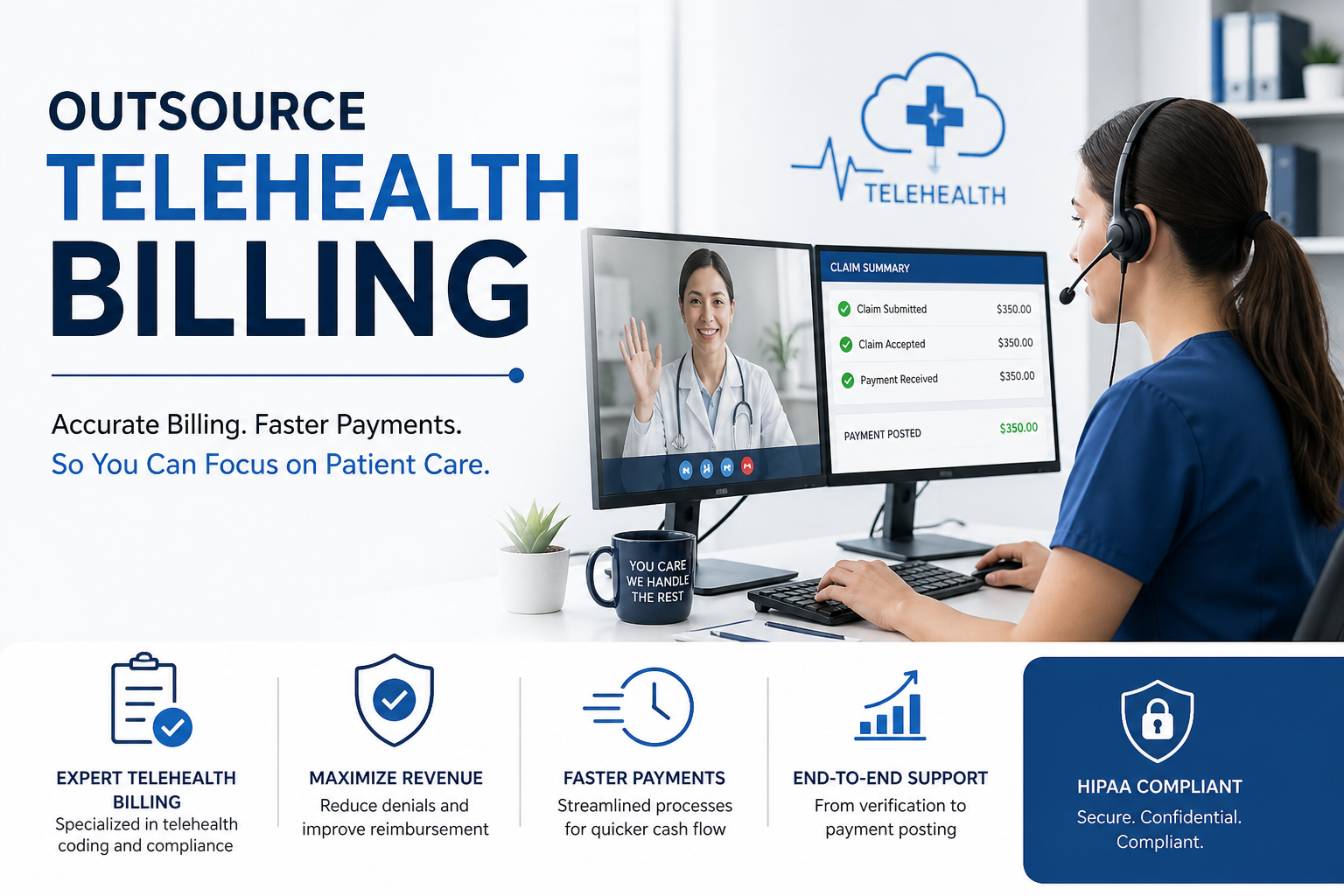
Specialized telehealth expertise
The team understands payer-specific rules, telehealth modifiers, and documentation requirements—reducing errors at the source.
End-to-end revenue cycle management
From patient eligibility checks to final payment posting, 247 Medical Billing Services manages the entire billing lifecycle.
Denial reduction strategies
By combining claim scrubbing, coding accuracy, and analytics, 247 Medical Billing Services helps minimize denials and improve clean claim rates.
Credentialing and compliance support
Ensures providers are properly enrolled for telehealth services and remain compliant with evolving regulations.
Technology-driven approach
Advanced billing tools and reporting systems provide transparency into performance metrics like AR days and reimbursement rates.
With a structured, data-driven approach, 247 Medical Billing Services helps practices turn telehealth into a reliable revenue stream.
Call to Action
Telehealth is here to stay—but billing complexity can quickly erode your profits if not managed correctly. Partnering with experienced telehealth billing companies ensures accurate claims, faster reimbursements, and fewer denials.
If your practice is struggling with telehealth billing, now is the time to optimize your revenue cycle. Connect with 247 Medical Billing Services to streamline your billing process, reduce denials, and maximize your telehealth revenue.

 English
 French
 Spanish
 Portuguese
 Deutsch
 Turkish
 Dutch
Dutch
 Italiano
 Russian
 Romaian
 Portuguese (Brazil)
 Greek
Greek