
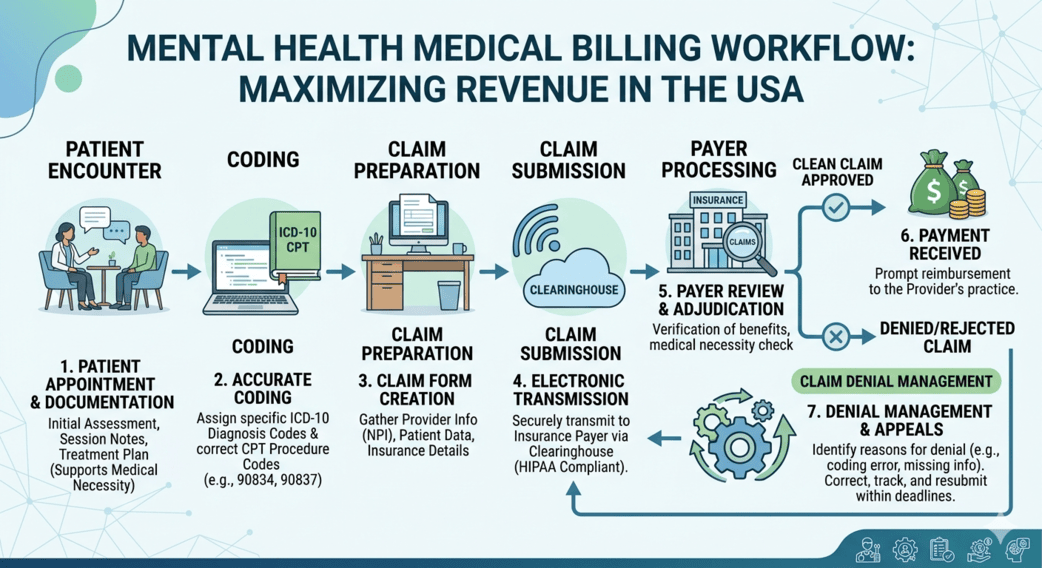
Mental health care is finally getting the attention it deserves across the United States. With increased awareness, expanded coverage, and growing patient demand, providers are seeing more opportunities—but also more complexity. One of the biggest challenges behind the scenes is mental health insurance billing.
Unlike other specialties, mental health billing involves nuanced coding, strict documentation, and payer-specific rules that can easily lead to delays or denials. Whether you’re a solo therapist or part of a multi-provider practice, understanding how to manage billing efficiently is critical for financial stability and patient care continuity.
This guide breaks down everything you need to know—from common billing challenges to the advantages of working with a mental health billing specialist.
Understanding Mental Health Insurance Billing
At its core, mental health insurance billing is the process of submitting claims to insurance companies for services like therapy sessions, psychiatric evaluations, and medication management.
However, it’s not as straightforward as it sounds.
Mental health services often require:
- Accurate use of CPT and ICD-10 codes
- Time-based billing precision
- Authorization and eligibility verification
- Detailed session documentation
Even a small error can result in claim rejection or delayed reimbursement.
Why Mental Health Billing is More Complex Than Other Specialties
Mental health providers face unique hurdles that general practitioners may not encounter:
1. Time-Based CPT Codes
Billing often depends on session duration (e.g., 30, 45, or 60 minutes). Incorrect time documentation can lead to underpayment or audits.
2. Frequent Policy Changes
Insurance policies for behavioral health services frequently change, making it difficult to stay updated.
3. Pre-Authorization Requirements
Many insurance plans require prior authorization for therapy sessions, especially for long-term treatment.
4. Stigma and Documentation Sensitivity
Mental health records must balance clinical accuracy with patient privacy, adding another layer of complexity.
The Role of a Mental Health Billing Specialist
A mental health billing specialist is trained to navigate the intricacies of behavioral health claims. They ensure that every claim is coded correctly, submitted on time, and followed up properly.
Key responsibilities include:
- Verifying patient eligibility and benefits
- Handling claim submissions and rejections
- Managing insurance follow-ups
- Ensuring compliance with payer guidelines
For many providers, working with a specialist significantly reduces administrative burden.
Benefits of Outsourced Mental Health Billing Services
Many practices are now choosing to outsource mental health billing services instead of managing everything in-house.
Here’s why:
✔ Reduced Administrative Stress
Outsourcing frees up time so providers can focus on patient care instead of paperwork.
✔ Improved Accuracy
Experienced teams minimize coding errors and ensure compliance with payer rules.
✔ Faster Reimbursements
Clean claims lead to quicker processing and fewer denials.
✔ Cost Efficiency
Hiring and training in-house staff can be more expensive than outsourcing.
What to Look for in the Best Mental Health Billing Agency
Not all billing partners are created equal. Choosing the best mental health billing agency can directly impact your revenue.
Here are key factors to consider:
Experience in Behavioral Health
A general billing company may not understand the nuances of mental health billing.
Transparent Reporting
Look for detailed reports on claims, denials, and revenue trends.
Compliance Expertise
HIPAA compliance and payer regulation knowledge are non-negotiable.
Scalable Services
Your billing needs will grow as your practice expands.
Key Services Offered by Mental Health Billing Companies
A reliable mental health billing services agency typically provides end-to-end solutions:
1. Insurance Verification
Ensures patients are eligible before services are provided.
2. Claims Submission
Accurate and timely claim filing reduces delays.
3. Denial Management
Identifying and correcting issues quickly improves cash flow.
4. Payment Posting
Tracking payments ensures financial transparency.
5. Reporting & Analytics
Helps practices understand performance and improve revenue.
Mental Health Medical Billing Services: A Closer Look
Professional mental health medical billing services go beyond just submitting claims. They integrate multiple processes into a streamlined workflow.
These services often include:
- Medical billing services to manage the entire claim lifecycle
- Medical coding services for accurate diagnosis and procedure coding
- Medical billing and coding services combined for efficiency
- Revenue cycle management services to optimize financial performance
- Credentialing services to ensure providers are enrolled with insurance networks
When these elements work together, practices experience fewer disruptions and stronger revenue growth.
Real-World Example: Small Practice Transformation
Consider a small therapy clinic struggling with delayed payments and frequent claim denials.
After switching to an outsourced mental health billing provider:
- Claim acceptance rate improved by 35%
- Payment turnaround time reduced from 45 days to 20 days
- Administrative workload dropped significantly
This allowed therapists to focus more on patient care rather than chasing payments.
Common Mistakes in Mental Health Insurance Billing
Avoiding these pitfalls can save time and money:
- Incorrect CPT code selection
- Missing or incomplete documentation
- Failure to verify insurance eligibility
- Ignoring denied claims instead of resubmitting
- Not staying updated with payer rules
Even experienced providers can make these mistakes without proper systems in place.
Why Many Providers Choose a Mental Health Billing Consultant
A mental health billing consultant provides strategic guidance rather than just operational support.
They help practices:
- Identify revenue leaks
- Improve billing workflows
- Train in-house staff
- Optimize reimbursement strategies
For growing practices, this can be a game-changer.
Choosing the Right Mental Health Billing Provider
When selecting a mental health billing provider, consider:
- Industry reputation
- Client testimonials
- Technology integration
- Data security measures
- Customization options
The right partner acts as an extension of your practice—not just a service provider.
The Rise of Outsourced Mental Health Billing in the USA
With increasing administrative complexity, mental health medical billing services outsourcing is becoming the norm rather than the exception.
Practices across the USA are turning to the top outsource mental health billing company options to:
- Reduce operational costs
- Improve efficiency
- Scale without hiring additional staff
This trend is expected to grow as mental health services continue to expand nationwide.
How Revenue Cycle Management Impacts Mental Health Practices
Strong revenue cycle management services are essential for financial health.
They cover:
- Patient registration
- Insurance verification
- Coding and billing
- Payment collection
- Reporting
When optimized, RCM ensures consistent cash flow and fewer disruptions.
Integrating Credentialing into Your Billing Strategy
Many providers overlook the importance of credentialing services.
Without proper credentialing:
- Claims may be denied
- Payments can be delayed
- Providers may not be recognized by insurers
Integrating credentialing with billing ensures smoother operations and faster reimbursements.
Before You Decide: In-House vs Outsourced Billing
In-House Billing
- More control
- Higher operational costs
- Requires continuous training
Outsourced Billing
- Lower overhead
- Access to experts
- Scalable and efficient
For most practices, outsourcing offers a better return on investment.
Conclusion
Mental health care is evolving rapidly, and so are the systems that support it. Efficient mental health insurance billing is no longer optional—it’s essential for sustaining and growing a practice.
From reducing denials to improving cash flow, the right billing strategy can transform operations. Many providers are now relying on integrated solutions that include medical billing services, medical coding services, medical billing and coding services, revenue cycle management services, and credentialing services to stay competitive.
Organizations like 247 medical billing services are helping practices navigate this complexity with tailored solutions that align with modern healthcare demands—without adding unnecessary pressure on providers.
FAQs
1. What is mental health insurance billing?
Mental health insurance billing is the process of submitting and managing claims for behavioral health services to insurance companies for reimbursement.
2. Why is mental health billing so complex?
It involves time-based codes, strict documentation requirements, and constantly changing insurance policies, making it more detailed than many other specialties.
3. Should I outsource mental health billing services?
Outsourcing can reduce administrative burden, improve accuracy, and speed up reimbursements, especially for growing practices.
4. What does a mental health billing specialist do?
They handle coding, claim submission, denial management, and ensure compliance with insurance guidelines.
5. How can I reduce claim denials in mental health billing?
Focus on accurate coding, proper documentation, insurance verification, and timely follow-ups on denied claims.
6. What services are included in mental health medical billing solutions?
They typically include billing, coding, revenue cycle management, reporting, and credentialing support.

 English
 Arabic
 French
 Spanish
 Portuguese
 Deutsch
 Turkish
 Dutch
Dutch
 Italiano
 Russian
 Romaian
 Greek
Greek