
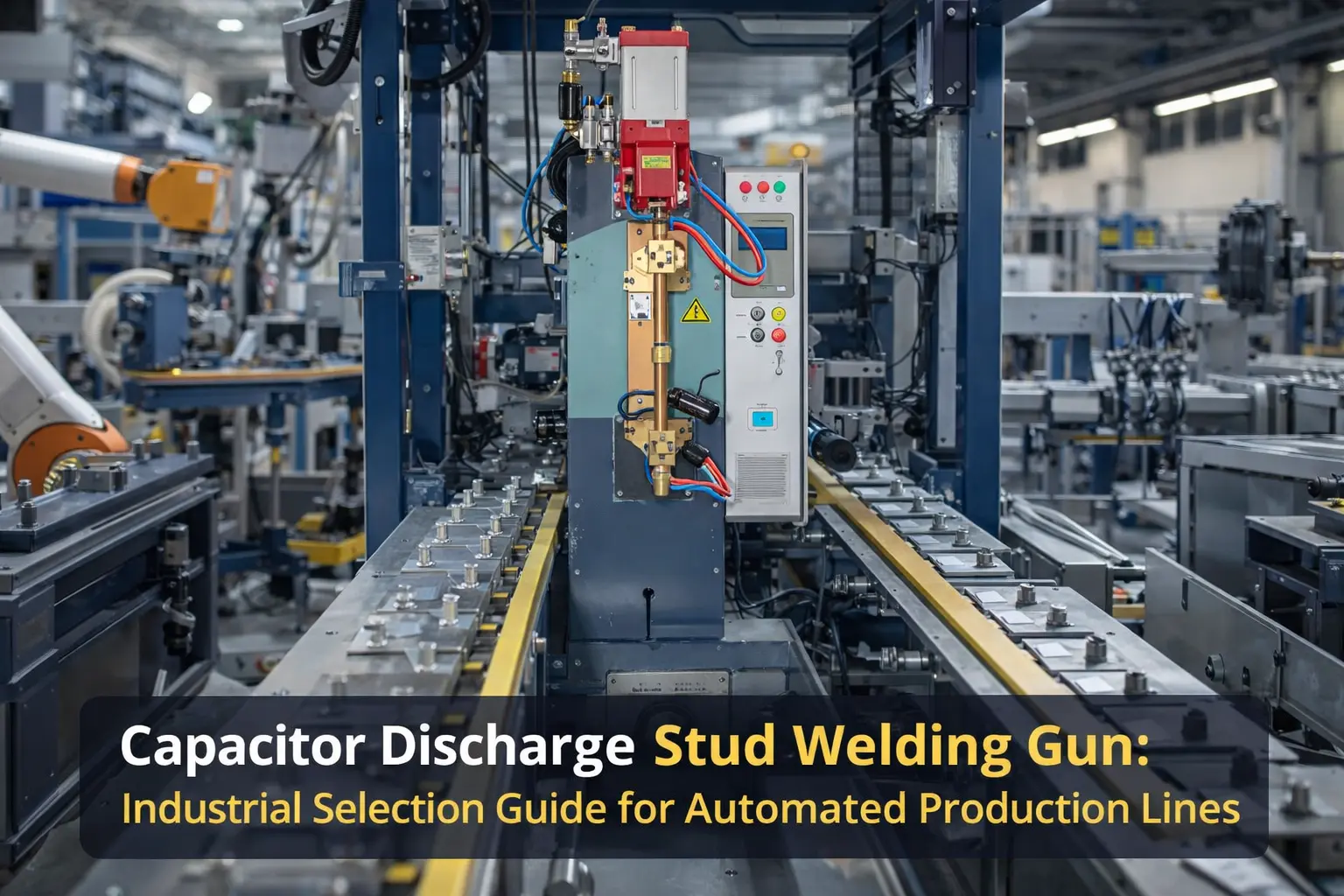
Capacitor Discharge (CD) welding is a highly efficient, precision-driven resistance welding process designed for joining small to medium conductive components with exceptional speed and minimal thermal impact. In today’s competitive manufacturing environment where OEMs, automation integrators, and production engineers demand consistency, speed, and material integrity CD welding has become a preferred solution for thin-sheet applications, fasteners, and precision assemblies.
As a global manufacturer of advanced welding technologies, Heron Welder provides capacitor discharge welding systems engineered for repeatability, energy efficiency, and industrial-scale production environments.
What is Capacitor Discharge Welding?
Capacitor discharge welding is a resistance-based process that uses stored electrical energy in capacitors, which is released in an extremely short pulse to create a weld. Instead of drawing continuous power from the grid, energy is first stored and then discharged in milliseconds.
This rapid energy release generates a controlled arc or projection weld that melts the contact surfaces and forms a metallurgical bond upon cooling.
The entire weld cycle is typically completed in just a few milliseconds, making it one of the fastest industrial welding methods available.
How Capacitor Discharge Welding Works
The CD welding process is built on three key stages:
1. Energy Storage
Capacitors are charged to a specific voltage based on material type, thickness, and required weld strength.
2. Instant Energy Release
Once triggered, the stored energy is discharged through the welding electrode or stud tip, producing a high-intensity current pulse.
3. Fusion and Solidification
The heat generated melts a localized zone of both materials. Pressure from the welding gun ensures intimate contact, and the molten metal solidifies into a strong joint.
Because the energy is released so quickly, surrounding material remains largely unaffected, minimizing distortion and heat damage.
Key Advantages of Capacitor Discharge Welding
For manufacturing engineers and production planners, CD welding offers several performance benefits that directly impact cost and quality.
Ultra-Fast Welding Cycles
Weld times measured in milliseconds significantly increase production throughput, making CD welding ideal for automation and mass production lines.
Minimal Heat-Affected Zone (HAZ)
The extremely short energy pulse reduces thermal spread, protecting sensitive components and maintaining material properties.
High Precision and Repeatability
Each weld is controlled through stored energy levels, ensuring consistent quality across large production batches.
No Burn Marks or Surface Damage
The process minimizes discoloration and warping—critical for visible or aesthetic components.
Efficient for Thin Materials
CD welding is particularly effective for thin sheet metals and delicate assemblies where traditional welding would cause burn-through or deformation.
Capacitor Discharge Welding vs Traditional Welding
Compared to conventional resistance or arc welding, CD welding offers distinct industrial advantages:
- Speed: CD welding is significantly faster, completing welds in milliseconds rather than seconds.
- Thermal Control: Lower heat input reduces deformation and post-processing requirements.
- Energy Efficiency: Energy is only used during discharge, reducing overall consumption.
- Automation Compatibility: Easily integrated into robotic and automated production systems.
This makes CD welding especially suitable for high-volume manufacturing environments where consistency and cycle time are critical.
Industrial Applications of CD Welding
Capacitor discharge welding is widely used across industries that require precision fastening and lightweight assembly.
Automotive Manufacturing
Used for sensors, brackets, fasteners, and lightweight structural components.
Electronics and Electrical Panels
Ideal for grounding studs, terminals, and thin conductive enclosures.
Aerospace Components
Supports lightweight materials and precision assemblies where heat distortion must be minimized.
Appliance Manufacturing
Used in household appliances requiring clean, hidden welds without surface damage.
Sheet Metal Fabrication
Perfect for thin-gauge stainless steel, aluminum, brass, and coated metals.
Why Engineers Prefer Capacitor Discharge Welding
For OEMs and production engineers, CD welding offers a balance of speed, control, and material integrity that is difficult to achieve with traditional welding systems.
Key engineering benefits include:
- Reduced rework due to consistent weld quality
- Improved cycle time efficiency in automated lines
- Lower thermal stress on components
- Compatibility with multi-material assemblies
These advantages make it a strategic choice for modern smart factories and Industry 4.0 environments.
Heron Welder: Advanced CD Welding Solutions
At Heron Welder, capacitor discharge welding systems are designed for industrial reliability and production-scale performance. Our solutions focus on:
- High-precision energy control systems
- Integration with automated welding lines
- Durable industrial-grade welding heads and controllers
- Custom engineering for OEM production requirements
Whether you are upgrading an existing production line or developing a fully automated welding system, Heron provides tailored solutions to optimize efficiency and weld quality.
FAQs About Capacitor Discharge Welding
1. What materials can be welded using capacitor discharge welding?
CD welding is suitable for conductive metals such as steel, stainless steel, aluminum, copper, brass, and nickel alloys.
2. Is capacitor discharge welding suitable for automation?
Yes, CD welding is highly compatible with robotic systems and automated production lines due to its fast cycle time and repeatability.
3. What thickness of material can be welded?
It is ideal for thin sheets and precision components, typically where minimal heat input is required to avoid distortion.
4. How is CD welding different from traditional resistance welding?
CD welding uses stored capacitor energy released in a short pulse, while traditional resistance welding uses continuous electrical current.
5. Does CD welding require filler materials?
No, the process relies purely on electrical energy and pressure, eliminating the need for filler metals or shielding gases.
Final Thoughts
Capacitor discharge welding represents a major advancement in precision metal joining technology. With its ultra-fast cycle times, minimal thermal impact, and excellent repeatability, it is a preferred choice for modern manufacturing industries focused on automation and efficiency.
From automotive production lines to electronics and aerospace assemblies, CD welding delivers consistent, high-quality results where traditional welding methods fall short.
Partner with Heron for Advanced Welding Solutions
If you are looking to improve production efficiency, reduce weld distortion, or integrate high-speed welding into your automated manufacturing system, Heron Welder can help.
Contact Heron today to request a quote or consultation for customized capacitor discharge welding and automation solutions tailored to your production needs.

 Arabic
 French
 Spanish
 Portuguese
 Deutsch
 Turkish
 Dutch
Dutch
 Italiano
 Russian
 Romaian
 Portuguese (Brazil)
 Greek
Greek