
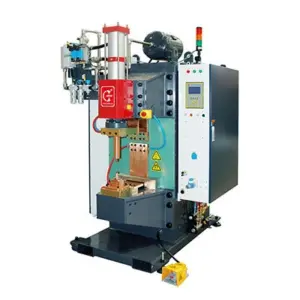
In modern manufacturing, precision, efficiency, and repeatability are non-negotiable. That’s where a resistance welder comes into play. From automotive assembly to appliance fabrication, these machines have become essential for manufacturers aiming to produce high-quality metal joints at scale. For engineers, OEMs, and factory decision-makers, understanding the principles, types, and applications of resistance welding can help optimize production while reducing operational costs.
Heron Welder, a global leader in industrial welding and metal-joining solutions, offers a comprehensive range of resistance welding machines, automated production lines, and customized automation systems to meet diverse industrial requirements.
What is a Resistance Welder?
A resistance welder is a machine that joins metal components by applying heat generated from electrical resistance at the contact points of the workpieces. Unlike traditional welding, which uses a flame or arc, resistance welding relies on the electrical current passing through the metal to generate localized heat, creating a strong metallurgical bond.
The process requires three main elements:
-
Electrodes – conduct electricity and apply pressure to the workpieces.
-
Current – high amperage electrical flow generates heat at the metal interface.
-
Pressure – mechanical force ensures proper fusion of the metals.
This method is highly efficient, repeatable, and suitable for automated manufacturing environments, making it a go-to solution for high-volume production lines.
Types of Resistance Welding Machines
Heron Welder offers a wide array of resistance welding technologies tailored to specific industrial needs:
1. Spot Welding Machines
Ideal for sheet metal fabrication, spot welders create localized welds at specific points. Commonly used in automotive and appliance manufacturing, spot welding ensures consistent quality with minimal material distortion.
2. Projection Welding Machines
Projection welding uses embossed or raised areas on metal surfaces to focus heat and pressure. This technique is perfect for components with complex geometries, such as fasteners or brackets.
3. Seam Welding Machines
Seam welding provides continuous welds along joints, often used for tanks, containers, or metal drums. It ensures airtight and leak-proof bonds, critical in industries like beverage packaging and fuel storage.
4. MFDC & Capacitor Discharge Welders
Modern applications demand precise control. MFDC (Medium Frequency Direct Current) resistance welders and capacitor discharge systems offer superior control over weld time, energy, and force, making them ideal for sensitive materials and lightweight alloys.
Applications of Resistance Welding
Resistance welders are versatile, supporting a variety of industries:
-
Automotive Manufacturing: Spot and projection welding for car body assemblies, battery packs, and lightweight chassis components.
-
Electrical Appliances: Seam welding for heating elements, enclosures, and connectors.
-
Metal Furniture & Fabrication: Precision spot and seam welding for durable frames and panels.
-
Aerospace & Transportation: High-strength, lightweight metal joining using MFDC or capacitor discharge systems.
-
Automation Lines: Integrating resistance welders into robotic systems for faster, repeatable production.
Heron’s expertise ensures each system is optimized for throughput, quality, and energy efficiency, whether for standalone machines or fully automated production lines.
Resistance Welding vs. Other Welding Methods
It’s important to understand how resistance welding compares to other methods:
| Welding Type | Heat Source | Material Suitability | Speed/Automation | Distortion Risk |
|---|---|---|---|---|
| Resistance Welding | Electrical current | Sheet metals, alloys | High, easy to automate | Low |
| MIG Welding | Arc with filler | Various metals | Medium | Medium |
| TIG Welding | Arc without filler | Stainless, aluminum | Low | Low |
| Laser Welding | Laser beam | Thin metals, precise | Medium-High | Very Low |
Resistance welding excels in high-volume, repeatable applications with minimal heat-affected zones, making it more efficient and cost-effective for many industrial processes.
Best Practices for Resistance Welding
To maximize the efficiency and longevity of a resistance welder, manufacturers should follow these guidelines:
-
Proper Electrode Maintenance – Regularly inspect and dress electrodes to prevent inconsistent weld quality.
-
Material Compatibility – Ensure metals are clean, properly aligned, and suitable for resistance welding.
-
Optimized Parameters – Calibrate current, pressure, and weld time according to material thickness and type.
-
Automation Integration – Pair machines with robotic arms or conveyor systems to improve throughput and reduce human error.
-
Quality Monitoring – Implement real-time sensors or data logging to monitor weld quality and reduce scrap.
Heron Welder provides not just machines but also guidance and system integration expertise to ensure manufacturers achieve optimal results every time.
Why Choose Heron Welder for Resistance Welding Solutions?
Heron Welder stands out as a trusted partner for industrial manufacturers worldwide:
-
Comprehensive Product Range – Spot, projection, seam, MFDC, and capacitor discharge welders for diverse applications.
-
Automation Expertise – Customizable production lines and robotic integration for high-volume manufacturing.
-
Global Support & Service – Expert technical support, training, and maintenance solutions.
-
Innovation & Reliability – High-performance machines engineered for precision, durability, and efficiency.
By choosing Heron, manufacturers gain not only high-quality equipment but also a strategic partner committed to optimizing metal-joining processes.
FAQs About Resistance Welders
Q1: Can resistance welding be used on aluminum and stainless steel?
Yes. With proper MFDC or capacitor discharge systems, resistance welding can handle a range of materials including aluminum, stainless steel, and coated metals.
Q2: How do I select the right resistance welder for my production line?
Consider material type, thickness, production volume, automation needs, and joint design. Heron offers consultation to identify the ideal system.
Q3: What maintenance is required for resistance welders?
Electrode dressing, system calibration, and periodic inspection of electrical and hydraulic components are essential to maintain consistent weld quality.
Q4: Are resistance welders suitable for automated production lines?
Absolutely. These machines are designed for robotic and conveyor integration, ensuring precise, repeatable welds at high speeds.
Q5: How does Heron ensure weld quality?
Through advanced control systems, real-time monitoring, and optional data logging for traceability and process optimization.
Conclusion
A resistance welder is more than just a machine it’s a strategic tool for manufacturers seeking precision, speed, and reliability. Heron Welder combines advanced technology, automation expertise, and global support to deliver solutions that improve efficiency and product quality.
For customized welding solutions, automation integration, or expert consultation, contact Heron Welder today to request a quote and elevate your manufacturing operations.

 English
 French
 Spanish
 Portuguese
 Deutsch
 Turkish
 Dutch
Dutch
 Italiano
 Russian
 Romaian
 Portuguese (Brazil)
 Greek
Greek